

What is the Power of a Power Rule?
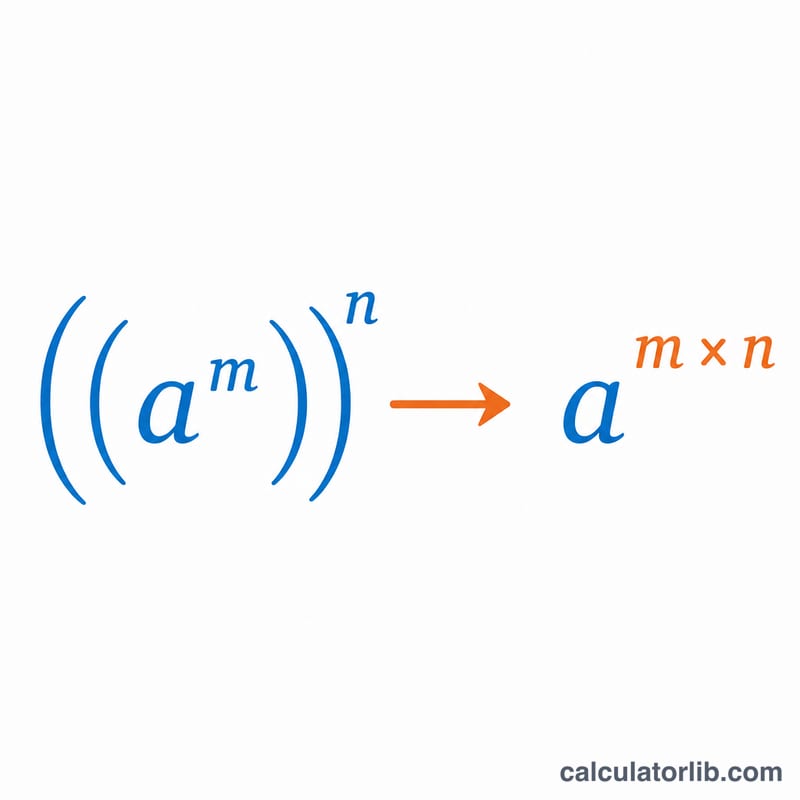
The power of a power rule is one of the fundamental laws of exponents. It states that when an expression raised to a power is itself raised to another power, you simply multiply the two exponents together: \((a^m)^n = a^{m\times n}\). This calculator applies the rule for any base and any pair of exponents, including decimals and negatives.
How to Use This Calculator
Enter the base (a), the inner exponent (m), and the outer exponent (n). The tool multiplies m and n to find the combined exponent, then raises the base to that combined exponent to produce the final value. It also shows the combined exponent so you can follow the math.
The Formula Explained
Because exponentiation repeats multiplication, raising am to the n-th power means writing am down n times and multiplying. That stacks m copies of the base n times, for a total of m×n copies. Hence $$(a^m)^n = a^{m\cdot n}.$$ The order of m and n does not matter since multiplication is commutative.
Worked Example
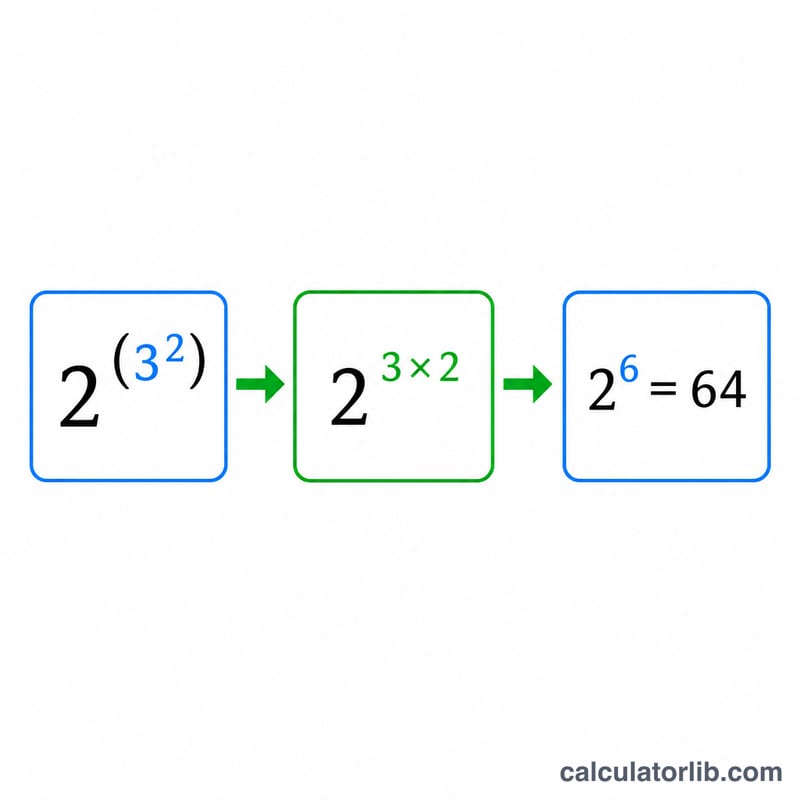
Take \((2^3)^2\). First multiply the exponents: \(3 \times 2 = 6\). Then compute $$2^6 = 64.$$ You can verify it directly: \(2^3 = 8\), and \(8^2 = 64\). Both routes agree.
FAQ
Does this work with negative exponents? Yes. For example \((5^2)^{-1} = 5^{-2} = 0.04\).
What about fractional exponents? Fractional exponents represent roots, so \((a^m)^n\) still equals \(a^{m\cdot n}\) — for instance \((4^2)^{0.5} = 4^1 = 4\).
Is \((a^m)^n\) the same as \(a^m \cdot a^n\)? No. The product rule \(a^m \cdot a^n = a^{m+n}\) adds exponents, while the power of a power rule multiplies them.