
What is the Power of 10 Calculator?
The Power of 10 Calculator computes the value of 10 raised to an exponent n, written as \(10^{n}\). Powers of ten are the backbone of the decimal system, scientific notation, orders of magnitude, and metric prefixes (kilo, mega, milli, etc.). This tool handles positive, negative, and even decimal exponents.
How to Use It
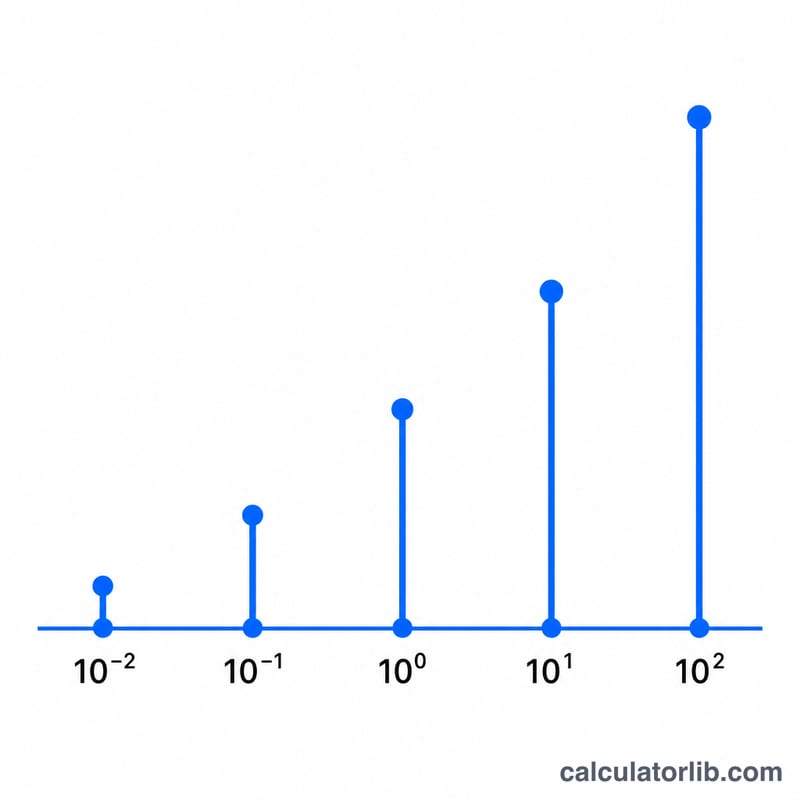
Enter the exponent n in the input box and the calculator returns \(10^{n}\). A positive exponent moves the decimal point to the right (a large number), while a negative exponent moves it to the left (a small fraction). A decimal exponent gives a non-round result, since 10 raised to a fractional power is a root.
The Formula Explained
The formula is simply:
$$\text{result} = 10^{n}$$
For whole-number exponents, \(10^{n}\) equals a 1 followed by n zeros. For example, \(10^{4} = 10{,}000\). Negative exponents are reciprocals: \(10^{-2} = 1 / 10^{2} = 0.01\). Fractional exponents represent roots: \(10^{0.5} = \sqrt{10} \approx 3.162\).

Worked Example
Suppose n = 6. Then \(10^{6} = 1{,}000{,}000\) (one million). If n = -3, then \(10^{-3} = 0.001\) (one thousandth). And if n = 2.5, then $$10^{2.5} = 10^{2} \times 10^{0.5} = 100 \times 3.16228 \approx 316.228.$$
FAQ
What is 10 to the power of 0? Any nonzero number raised to the power 0 equals 1, so \(10^{0} = 1\).
Can the exponent be negative? Yes. A negative exponent produces a fraction between 0 and 1, equal to the reciprocal of the positive power.
Why use powers of 10? They underpin scientific notation, making it easy to write very large or very small numbers compactly, and they define metric prefixes used in science and engineering.