
What Is the Math Power Calculator?
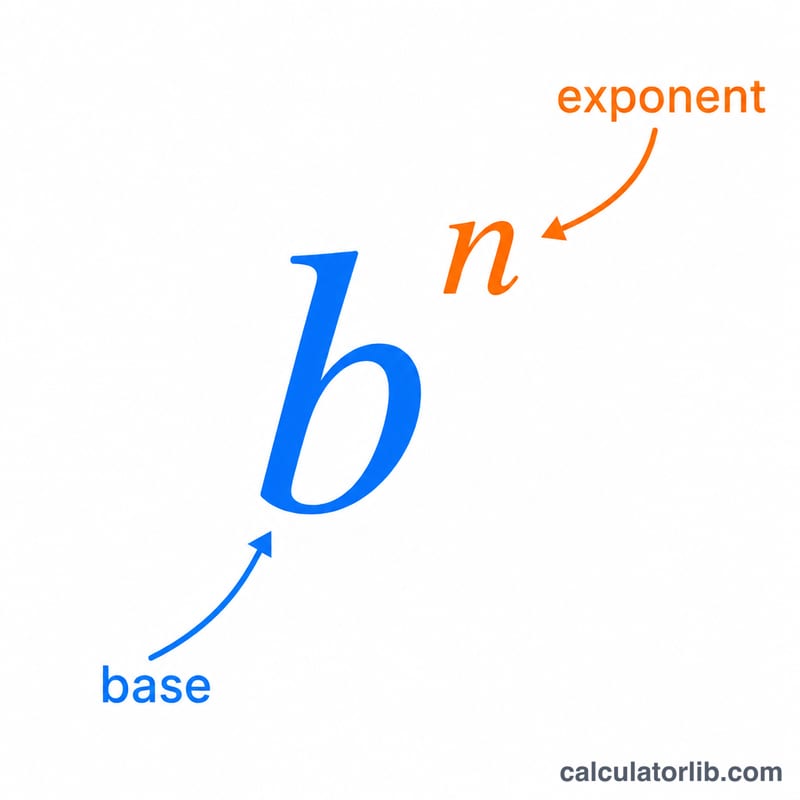
The Math Power Calculator computes exponentiation — raising a base number to an exponent (also called the power or index). It evaluates the expression \(\text{base}^{\text{exponent}}\), supporting whole numbers, decimals, negative bases, and even fractional exponents (which produce roots).
How to Use It
Enter the base value and the exponent value, then read the result instantly. For example, a base of 2 with an exponent of 10 gives 1,024. A fractional exponent like 0.5 produces a square root, and a negative exponent gives the reciprocal of the positive power.
The Formula Explained
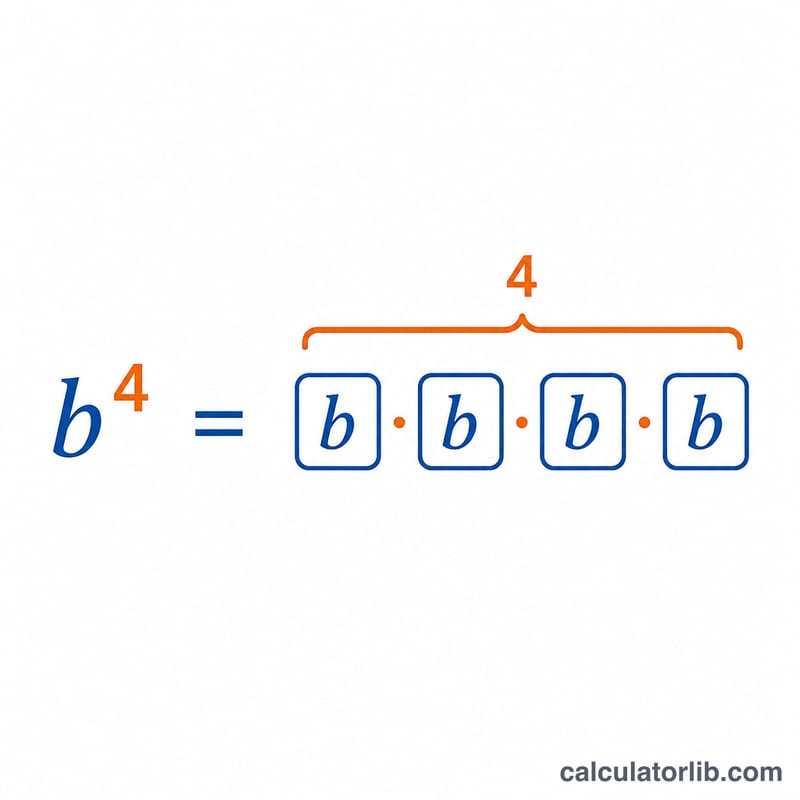
Exponentiation is defined as $$\text{result} = \text{base}^{\text{exponent}}$$ For a positive whole-number exponent \(n\), this means multiplying the base by itself \(n\) times: \(b^3 = b \times b \times b\). A negative exponent inverts the result: \(b^{-n} = 1 / b^n\). A fractional exponent is a root: \(b^{1/2} = \sqrt{b}\). Any non-zero number raised to the power 0 equals 1.
Worked Example
Suppose base = 3 and exponent = 4. Then $$\text{result} = 3^4 = 3 \times 3 \times 3 \times 3 = 81.$$ If instead exponent = -2, \(\text{result} = 3^{-2} = 1 / 9 \approx 0.111111\).
FAQ
What does an exponent of 0 give? Any non-zero base raised to 0 equals 1.
Can I use a negative exponent? Yes — it returns the reciprocal of the base raised to the positive exponent.
Can the exponent be a decimal? Yes. Fractional exponents return roots; for example base 8 with exponent 1/3 gives 2, the cube root of 8.