What Is the Midsegment of a Trapezoid?
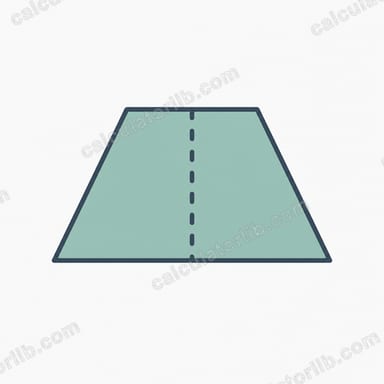
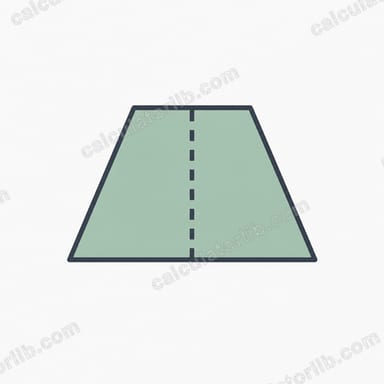
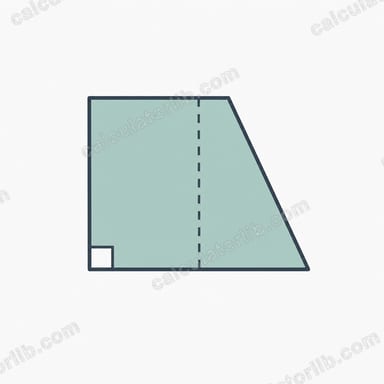
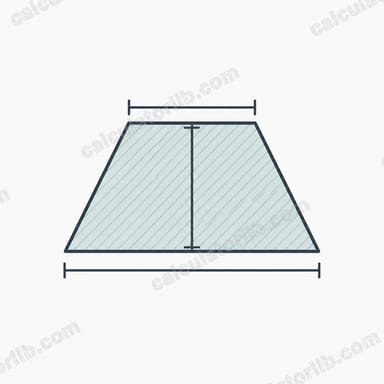
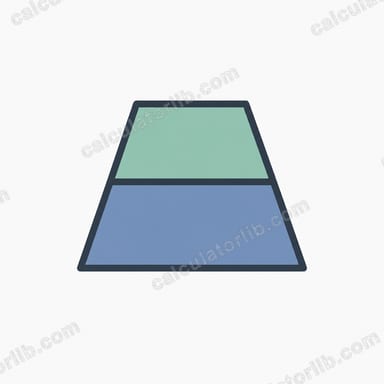
The midsegment of a trapezoid — also called the median or midline — is the line segment that connects the midpoints of the two non-parallel sides (the legs). A key property of this segment is that it runs parallel to the two bases and its length is exactly the average of those two bases. This calculator computes that length for you in one step.

How to Use This Calculator
Enter the length of the first parallel side (base a) and the length of the second parallel side (base b) in the same units. Click calculate and the tool returns the midsegment length m. The result table also echoes your inputs so you can verify them at a glance.
The Formula Explained
The governing equation is $$m = \frac{\text{Base }a + \text{Base }b}{2}$$ Because the midsegment sits exactly halfway between the two parallel bases, its length is the arithmetic mean of those bases. The formula is independent of the trapezoid's height or the lengths of its slanted legs — only the two parallel sides matter.
Worked Example
Suppose a trapezoid has a longer base of 10 cm and a shorter base of 6 cm. The midsegment is $$m = \frac{10 + 6}{2} = \frac{16}{2} = 8\text{ cm}$$ So a line drawn across the midpoints of the legs would be 8 cm long.

Midsegment for Different Base Combinations
The midsegment (median) of a trapezoid is the average of its two parallel bases: \(m = \frac{a + b}{2}\). The table shows several base combinations. Lengths can be in any unit, as long as both bases use the same one.
| Base a | Base b | Midsegment m | Note |
|---|---|---|---|
| 10 | 6 | 8 | \(\frac{10 + 6}{2} = 8\), a typical trapezoid |
| 12 | 4 | 8 | \(\frac{12 + 4}{2} = 8\); different bases can give the same midsegment |
| 5 | 5 | 5 | \(\frac{5 + 5}{2} = 5\); equal bases form a parallelogram or rectangle |
| 9 | 0 | 4.5 | \(\frac{9 + 0}{2} = 4.5\); degenerate triangle, where the midsegment is half the base |
| 7.5 | 2.5 | 5 | \(\frac{7.5 + 2.5}{2} = 5\), decimals work the same way |
In every row, m lies between the two bases, and exactly halfway between them: \(\min(a, b) \le m \le \max(a, b)\). For example, 6 < 8 < 10 in the first row. When a = b, the midsegment equals both bases. A true trapezoid has both bases greater than 0, so the 9 and 0 row is only a limiting case.
How to Find the Midsegment by Hand
- Identify the two parallel sides. These are the bases a and b. The slanted legs are not used.
- Check that the units match. Convert first if one base is in cm and the other in m.
- Add the bases. For a = 10 and b = 6: \(10 + 6 = 16\).
- Divide by 2. \(m = \frac{16}{2} = 8\).
- State the units. If the bases were in centimeters, m = 8 cm.
Reverse step: finding a missing base
If you know the midsegment and one base, rearrange the formula: \(b = 2m - a\). For example, with m = 8 and a = 6: \(b = 2 \times 8 - 6 = 16 - 6 = 10\).
Useful facts
- The midsegment is parallel to both bases.
- It joins the midpoints of the two legs.
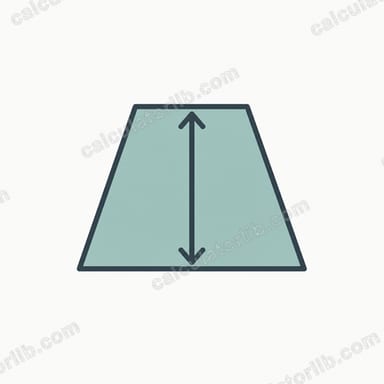
- The area of the trapezoid is \(A = m \times h\), where h is the perpendicular height between the bases. For bases 10 and 6 with h = 5: \(A = 8 \times 5 = 40\) square units.
FAQ
Does the height affect the midsegment? No. The midsegment length depends only on the two parallel bases, not the height or leg lengths.
Can I use this for a parallelogram? Yes. In a parallelogram both bases are equal, so the midsegment equals either base.
What units does it return? The midsegment is returned in the same units you enter the bases in — keep both inputs consistent.