
What This Calculator Does
The Square Feet of a Triangle Calculator finds the area of any triangle when you know its base and perpendicular height, both measured in feet. The result is returned in square feet (ft²) and automatically converted to square yards and square meters. It is ideal for estimating flooring, sod, paint, tile, or material for triangular sections of a room, yard, roof, or lot.
How to Use It
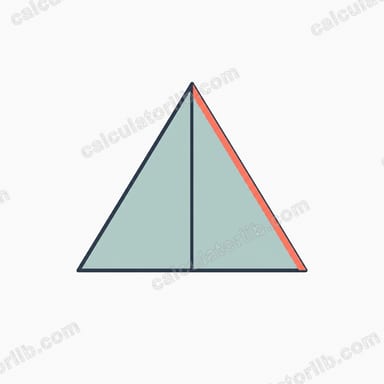
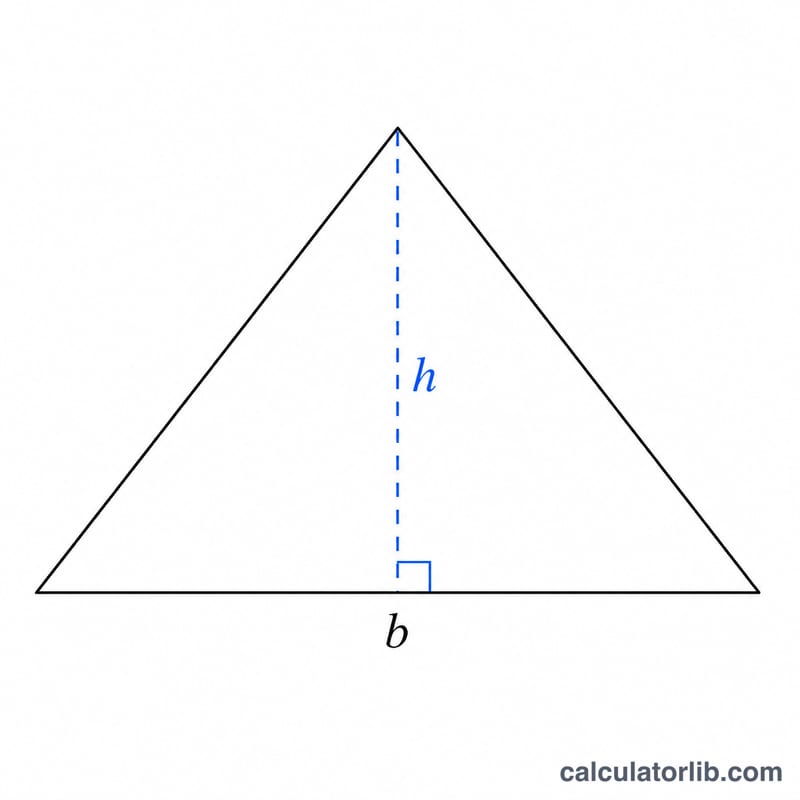
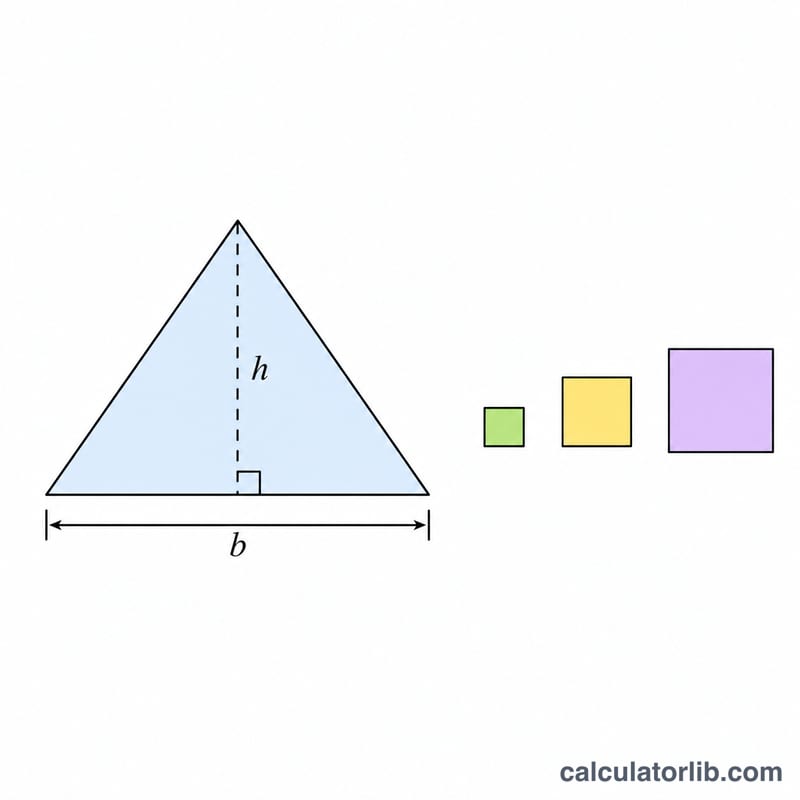
Enter the base length of the triangle in feet and its height in feet. The height must be measured straight from the base to the opposite vertex (a right-angle distance), not along a slanted side. Click calculate and the tool returns the area instantly.
The Formula Explained
A triangle's area is exactly half that of a rectangle with the same base and height, which is why the formula is $$A = \frac{\text{base} \times \text{height}}{2}$$ Because both measurements are in feet, multiplying them gives square feet, and halving accounts for the triangular shape.
Worked Example
Suppose a triangular garden bed has a base of 12 feet and a height of 8 feet. The area is $$(12 \times 8) \div 2 = 96 \div 2 = \textbf{48 square feet}.$$ That equals about 5.33 square yards or roughly 4.46 square meters.
FAQ
What if I only know the three side lengths? This calculator uses base and height. For three sides you would need Heron's formula instead.
Can I enter measurements in inches? Convert inches to feet first by dividing by 12, then enter the decimal foot values.
Does the height have to be the slanted side? No. Height is the perpendicular (straight-down) distance from the base to the top vertex, not the length of a sloped edge.