
What this calculator does
Jurisdiction note: the era presets are Japan-specific. The dropdown lists Japanese historical periods (Jomon, Yayoi, Edo, Meiji, and so on) and auto-fills their conventional start and end years. The underlying math, however, is universal: it simply divides the number of years that have passed by an assumed number of years per generation. If you are studying a non-Japanese era, ignore the presets and type any start and end year directly.
How to use it
Pick an era to auto-fill the start and end calendar years, or enter them yourself. Express BCE years as negatives (300 BCE = -300). Set the years per generation (30 by default) and the current year (today by default). The result shows about how many generations ago the era's start and end were, displayed as a range.
The formula explained
For a calendar year y and current year Y, the years elapsed are \(Y - y\), and generations ago equals \((Y - y) / g\), where \(g\) is years per generation. Because an era's start is older than its end, the start always yields a larger number, so the range reads from the bigger value down to the smaller. The tool uses straight subtraction and does not correct for the missing year 0 between 1 BCE and 1 CE - a negligible discrepancy next to the uncertainty in generation length.
$$G = \frac{\text{Current Year} - Y}{\text{Years/Generation}}$$where
$$\left\{ \begin{aligned} G_{\text{start}} &= \frac{\text{Current Year} - \text{Start Year}}{\text{Years/Generation}} \\[0.6em] G_{\text{end}} &= \frac{\text{Current Year} - \text{End Year}}{\text{Years/Generation}} \end{aligned} \right.$$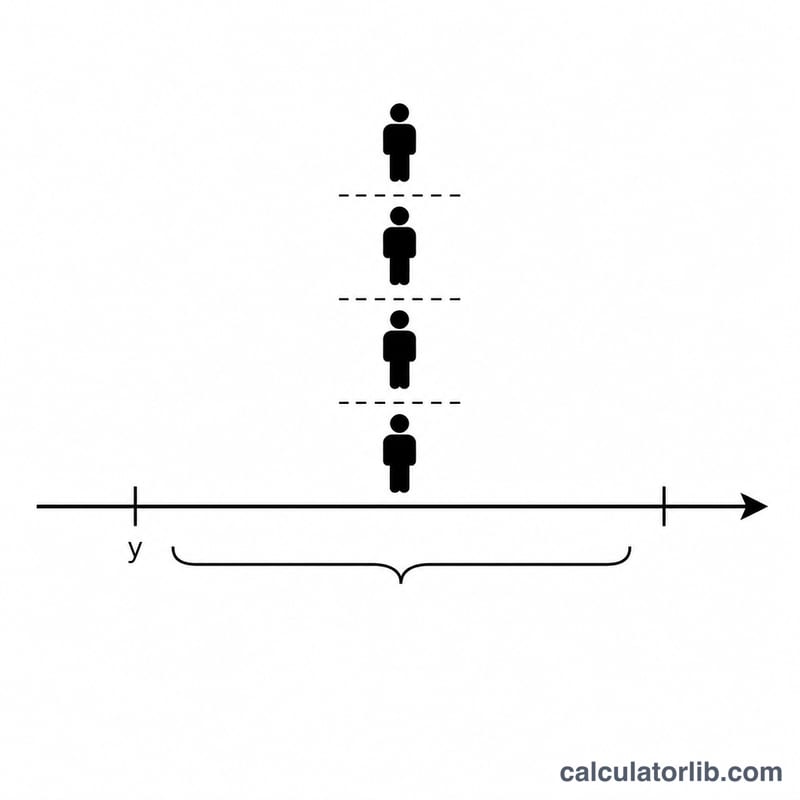
Worked example
For the Edo period (1603-1868) with 30 years per generation and a current year of 2025: start = (2025 - 1603) / 30 = 422 / 30 = 14.07 (about 14 generations ago); end = (2025 - 1868) / 30 = 157 / 30 = 5.23 (about 5 generations ago). So Edo was roughly "14 ~ 5 generations ago."
$$G_{\text{start}} = \frac{2025 - 1603}{30} = \frac{422}{30} = 14.07$$$$G_{\text{end}} = \frac{2025 - 1868}{30} = \frac{157}{30} = 5.23$$FAQ
Why 30 years per generation? It is a common heuristic. Real generation length varies; people often use 25-33 years. Since it strongly affects the result, the field is editable.
Are the era years exact? No - period boundaries are conventional approximations that differ between historians. Treat the presets as editable defaults.
Can the result be negative? Yes, if a year is in the future relative to the current year, meaning "generations from now" rather than ago.