
What this calculator does
This tool settles a common shopping dilemma: is it better to earn loyalty reward points on a purchase, or to take an immediate cash (percentage) discount? It models two equally priced purchases and compares the total amount you spend under each plan. The lower total is the better deal. The underlying math is universal arithmetic, so it applies to any currency or store.
The scenario modeled
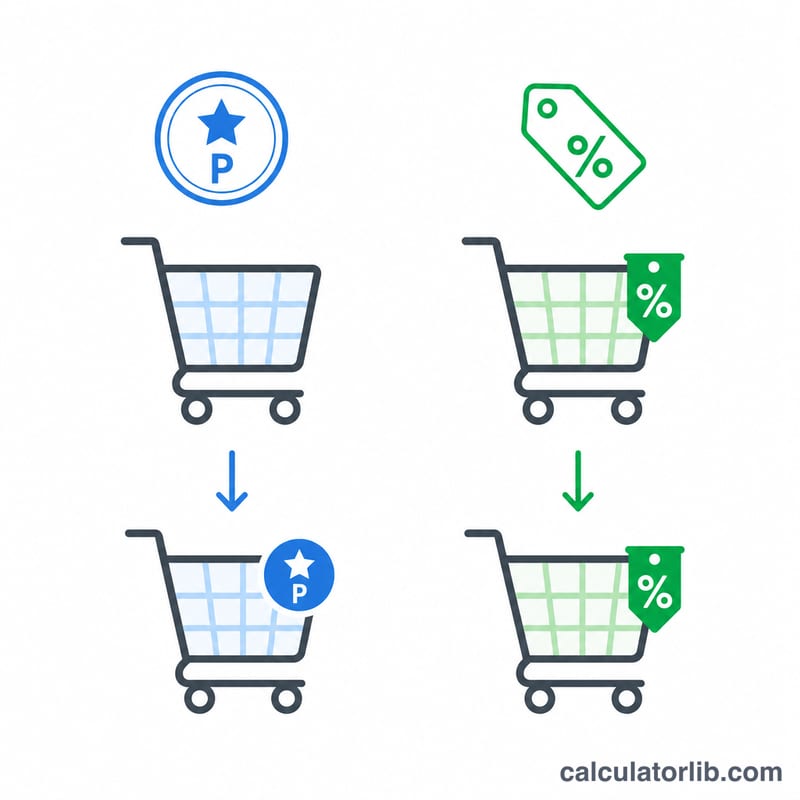
You buy the same item twice. Under the Points plan, your first purchase is paid in full and earns points at the reward rate; on the second purchase you redeem all those points (1 point = 1 currency unit) to lower the price. Under the Cash discount plan, both purchases get an instant percentage discount. The calculator adds up each plan's two payments and shows the difference.
How to use it
Enter the item price per purchase, the point reward rate (%), and the cash discount rate (%). The result shows the total spent under each plan, the difference, the effective discount rate of each, and a clear verdict on which is cheaper plus how much you save.
The formula explained
Let P be the price, pr the point rate as a fraction, and cr the cash rate as a fraction. Points total \(= P(2 - p_r)\); cash total \(= 2P(1 - c_r)\). A handy rule of thumb: earning \(p_r\%\) in points and spending them on a second equal purchase is worth only about half as much per purchase, so a cash discount beats points whenever \(c_r\% > p_r\%/2\).
$$\Delta = \text{Total}_{\text{points}} - \text{Total}_{\text{cash}}$$$$\text{where}\quad \left\{ \begin{aligned} \text{Total}_{\text{points}} &= \text{Price} + \max\!\left(0,\; \text{Price}\left(1 - \tfrac{\text{Point Rate}}{100}\right)\right) \\ \text{Total}_{\text{cash}} &= 2 \cdot \text{Price}\left(1 - \tfrac{\text{Cash Discount Rate}}{100}\right) \end{aligned} \right.$$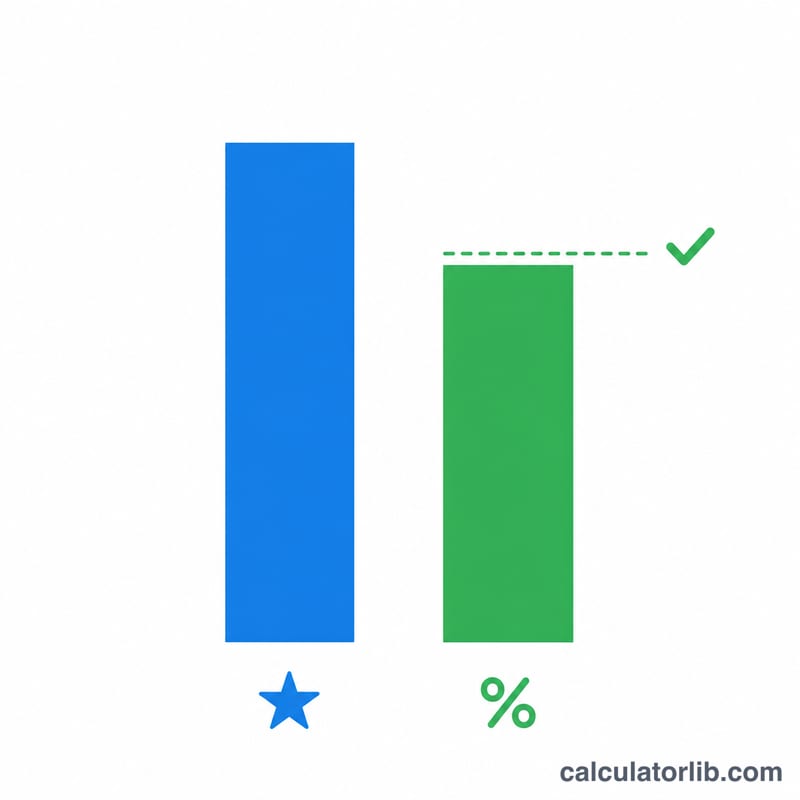
Worked example
Price 10000, point rate 1%, cash discount 5%. Points plan:
$$10000 + (10000 - 100) = 19900$$Cash plan:
$$2 \times 10000 \times 0.95 = 19000$$Difference \(= 900\), so the cash discount is better and you save 900. The rule of thumb agrees: \(5\% > 0.5\%\).
FAQ
Why is a 1% point reward weaker than it looks? Because you only get value when you spend the points on a future purchase, the effective discount across two buys is roughly half the headline rate.
What if I buy more than twice? The two-purchase model is the standard comparison; for many repeat purchases the effective points rate approaches the headline rate. Use it as a baseline guide.
Does it count leftover points? No. To match the simple "use all the points" assumption, residual points earned on the second purchase are ignored.