
What Is a Double Discount?
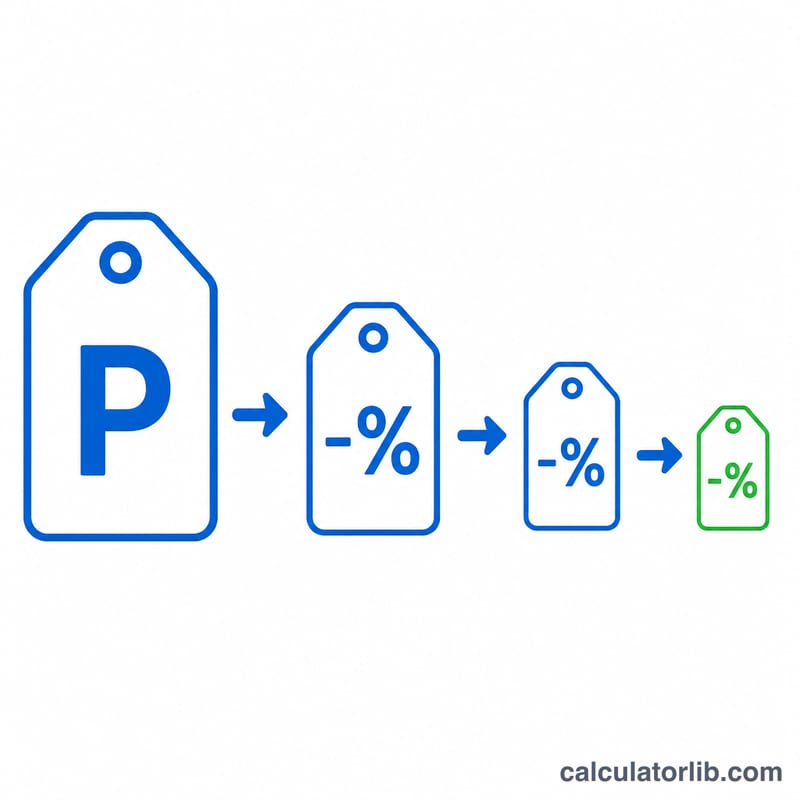
A double discount happens when two percentage discounts are applied one after another to the same item — for example, "20% off, then an extra 10% off at checkout." A common misconception is that 20% + 10% equals 30% off. It does not. The second discount is applied to the already-reduced price, so the combined effect is always slightly less than the simple sum. This calculator does the math for you and reveals the true effective discount.
How to Use It
Enter the original price, then enter your first discount percentage and your second discount percentage. The calculator instantly shows the final price you'll pay, the total amount saved, and the single equivalent ("effective") discount rate so you can compare deals fairly.
The Formula Explained
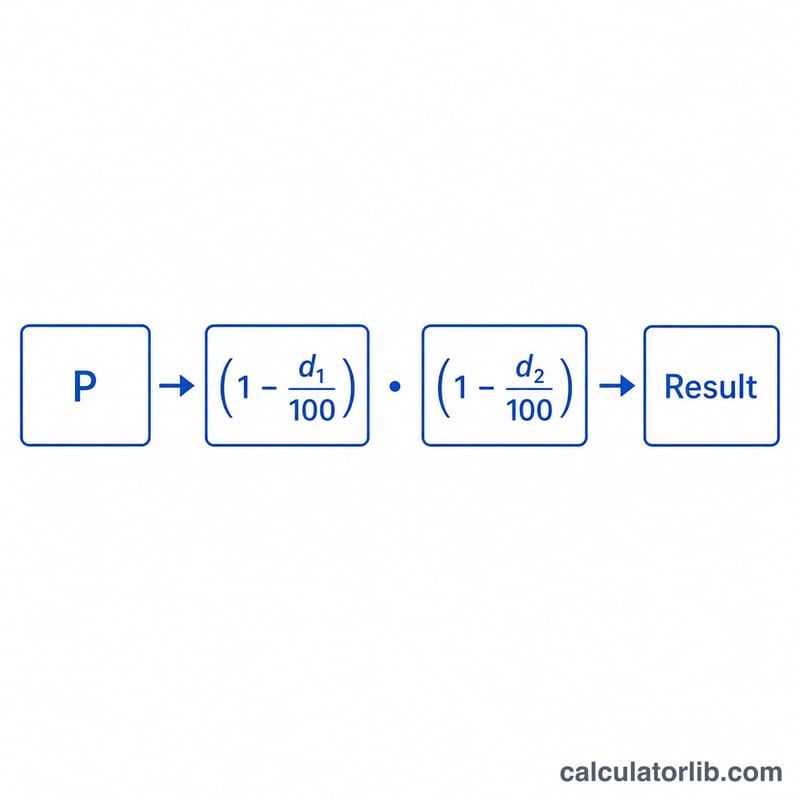
The final price is calculated as:
$$\text{Final} = \text{Price} \times \left(1 - \frac{d_1}{100}\right) \times \left(1 - \frac{d_2}{100}\right)$$Each factor in parentheses is the fraction of the price that remains after a discount. Multiplying them together applies both discounts in sequence. Note that the order of the two discounts does not change the final price — multiplication is commutative.
Worked Example
Suppose an item costs $100 with a 20% discount followed by a 10% discount. First, \(\$100 \times (1 - 0.20) = \$80\). Then \(\$80 \times (1 - 0.10) = \$72\). The final price is $72, you save $28, and the effective discount is 28% — not 30%.
FAQ
Is 20% then 10% the same as 30% off? No. Stacked discounts give 28% off in this case, because the second discount applies to the reduced price.
Does the order of discounts matter? No. Applying 10% then 20% gives the same final price as 20% then 10%.
Can I use this for three discounts? This tool handles two. For three, run it once and use the result as the new starting price.