
What Is Margin and Markup?
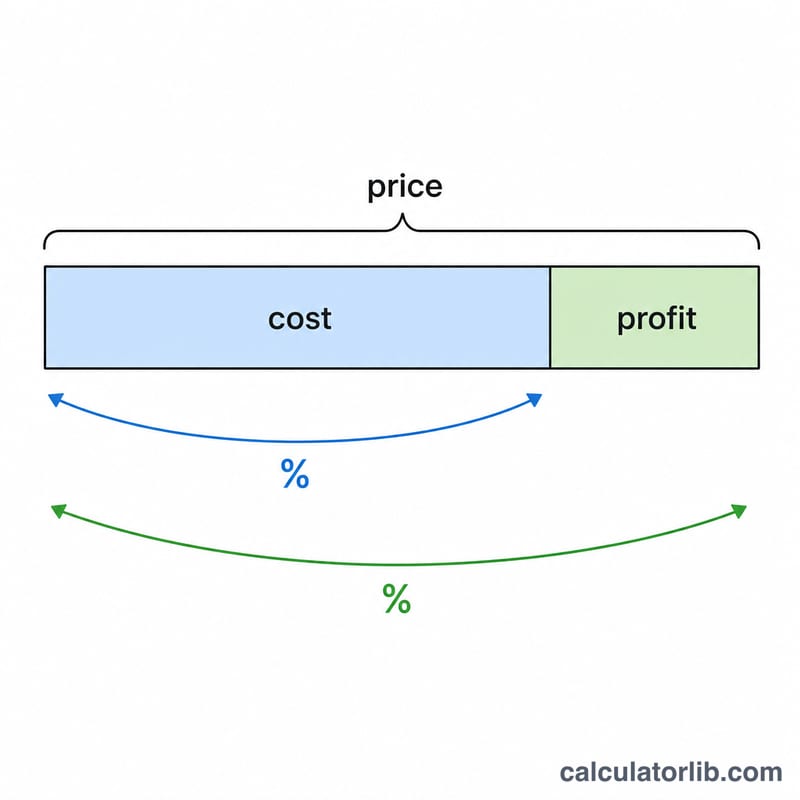
Margin and markup both describe profit, but they measure it against different bases. Markup is the profit divided by the cost of a product, while gross margin is the profit divided by the selling price. Confusing the two is one of the most common pricing mistakes in retail and business, because a given markup always produces a smaller margin percentage. This calculator computes both at once from a cost and a price you enter.
How to Use It
Enter the unit cost (what you pay) and the selling price (what the customer pays). The calculator returns the markup percentage, the gross margin percentage, and the gross profit in dollars. Use markup when you set prices by adding a percentage to cost; use margin when you analyze profitability against revenue.
The Formula Explained
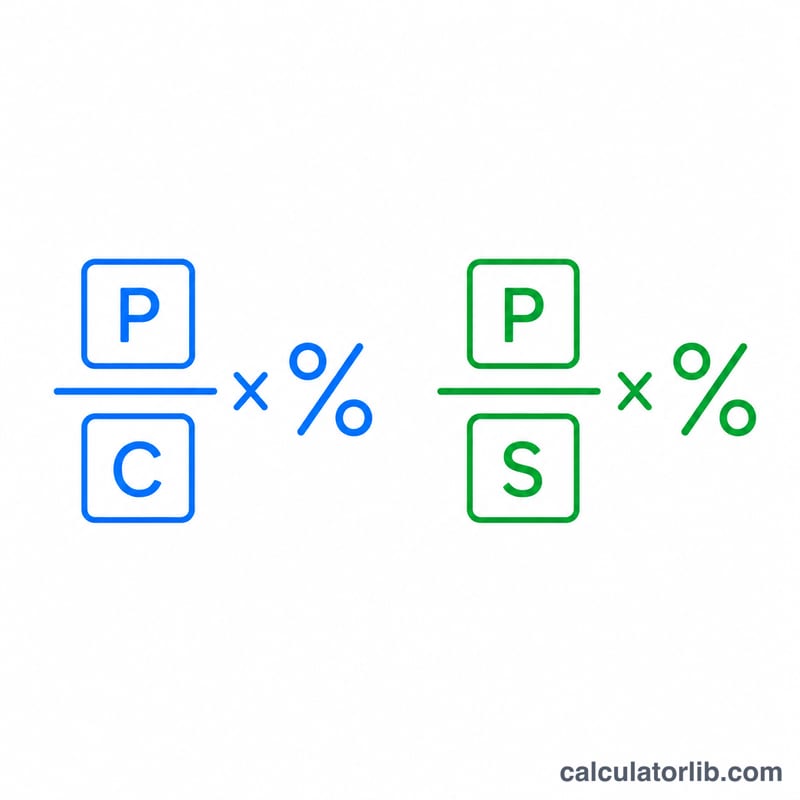
Gross profit is simply Price − Cost. From there:
The denominator is the only difference — cost for markup, price for margin.
Worked Example
Suppose an item costs $80 and sells for $100. Gross profit is \(\$100 - \$80 = \$20\). Markup = $$\frac{20}{80} \times 100 = \mathbf{25\%}.$$ Margin = $$\frac{20}{100} \times 100 = \mathbf{20\%}.$$ So a 25% markup yields a 20% margin.
FAQ
Is margin ever higher than markup? No. For the same cost and price, markup is always greater than or equal to margin.
Can margin exceed 100%? No — margin is capped at 100% because profit can never exceed the selling price. Markup, however, has no upper limit.
How do I convert markup to margin? Margin = \(\frac{\text{Markup}}{1 + \text{Markup}}\), with both expressed as decimals.