

What Is the Accrual Ratio?
The accrual ratio measures the portion of a company's earnings that comes from accounting accruals rather than actual cash. It is a widely used indicator of earnings quality. A high accrual ratio means reported net income is supported by relatively little cash flow, which can be a warning sign of aggressive accounting or future earnings reversals. A low or negative ratio generally signals higher-quality, cash-backed earnings.
How to Use This Calculator
Enter four figures from the financial statements: net income (income statement), cash flow from operations (cash flow statement), and total assets at the beginning and end of the period (balance sheet). The calculator computes total accruals, the average total assets, and the resulting accrual ratio as both a decimal and a percentage.
The Formula Explained
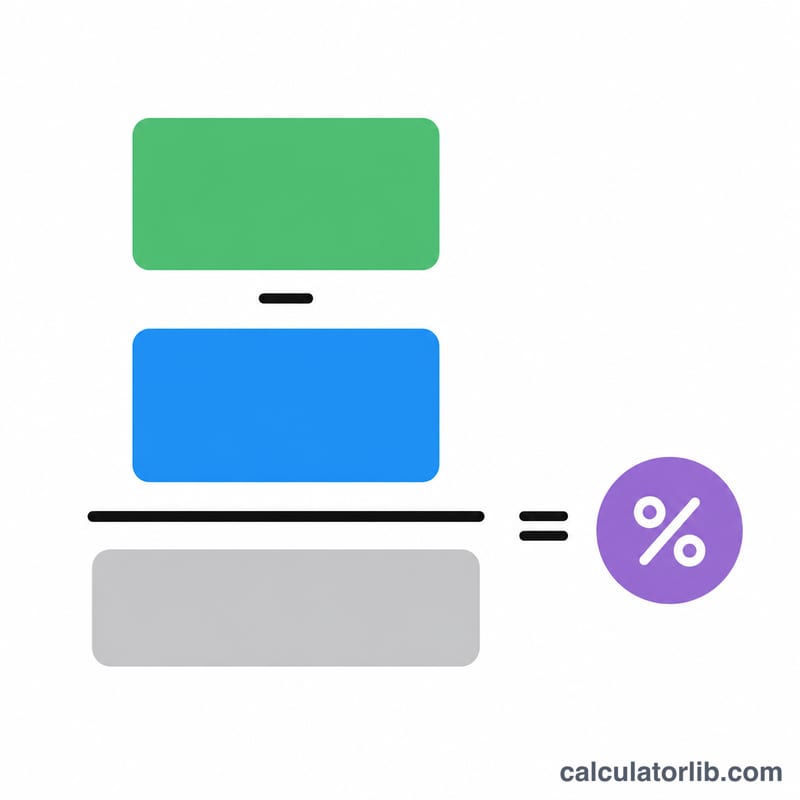
The balance-sheet accrual ratio is: (Net Income − Cash Flow from Operations) ÷ Average Total Assets. The numerator isolates accruals — the non-cash component of earnings. Dividing by average total assets scales accruals to company size so you can compare firms of different sizes or track one firm over time.
$$\text{Accrual Ratio} = \dfrac{\text{Net Income} - \text{Cash Flow}}{\text{Average Total Assets}}$$
Worked Example
Suppose net income is $500,000, operating cash flow is $400,000, beginning assets are $2,000,000 and ending assets are $2,200,000. Average total assets:
$$\overline{A} = \dfrac{2{,}000{,}000 + 2{,}200{,}000}{2} = \$2{,}100{,}000$$
Total accruals:
$$500{,}000 - 400{,}000 = \$100{,}000$$
Accrual ratio:
$$\text{AR} = \dfrac{100{,}000}{2{,}100{,}000} \approx 0.0476 \text{, or about } 4.76\%$$
Key Terms & Definitions
- Net Income
- The company's bottom-line accounting profit after all expenses, interest, and taxes, as reported on the income statement. It includes both cash and non-cash (accrual) items.
- Cash Flow from Operations (CFO)
- The cash actually generated by the company's core business operations during the period, reported on the cash flow statement. Unlike net income, it strips out non-cash accounting entries.
- Total Accruals
- The non-cash portion of earnings, calculated as net income minus operating cash flow. Positive accruals mean reported earnings exceed cash generated; negative accruals mean cash exceeds reported earnings.
- Average Total Assets
- The mean of beginning-of-period and end-of-period total assets, \((\text{Begin Assets} + \text{End Assets})/2\). Using the average scales accruals against the asset base the firm operated with over the whole period.
- Earnings Quality
- The degree to which reported earnings reflect genuine, sustainable, cash-backed economic performance rather than aggressive accounting estimates or one-off items. Higher quality earnings are more persistent and predictive of future results.
- Cash-Flow-Statement Accrual Ratio
- The variant used by this calculator: \((\text{Net Income} - \text{CFO}) / \text{Average Total Assets}\). It draws accruals directly from the cash flow statement and is generally considered the more reliable measure.
- Balance-Sheet Accrual Ratio
- An alternative that estimates accruals from period-over-period changes in non-cash working capital and other balance-sheet items, divided by average total assets. It can capture items the cash flow statement omits but is more susceptible to distortions from acquisitions and non-operating changes.
FAQ
What is a good accrual ratio? Lower is generally better. Negative or near-zero ratios indicate earnings are well supported by cash. Persistently high positive ratios warrant scrutiny.
Why use average assets instead of ending assets? Averaging beginning and ending balances better matches the income earned over the period to the asset base that generated it.
Can the ratio be negative? Yes. If cash flow exceeds net income, accruals are negative, giving a negative ratio — often viewed as a sign of conservative, high-quality earnings.