
What Is the Cash Ratio?
The cash ratio is the most conservative of the liquidity ratios. It measures a company's ability to pay off its current (short-term) liabilities using only its most liquid assets — cash and cash equivalents. Unlike the current ratio or quick ratio, it excludes receivables and inventory, so it shows how well a business could cover its obligations if it had to do so immediately, without relying on collecting payments or selling stock.
How to Use This Calculator
Enter three figures from the balance sheet: Cash (currency and bank deposits), Cash Equivalents (highly liquid short-term investments such as Treasury bills and money market funds maturing within 90 days), and Current Liabilities (debts due within one year). The calculator returns the cash ratio as a decimal multiple and as a percentage.
The Formula Explained
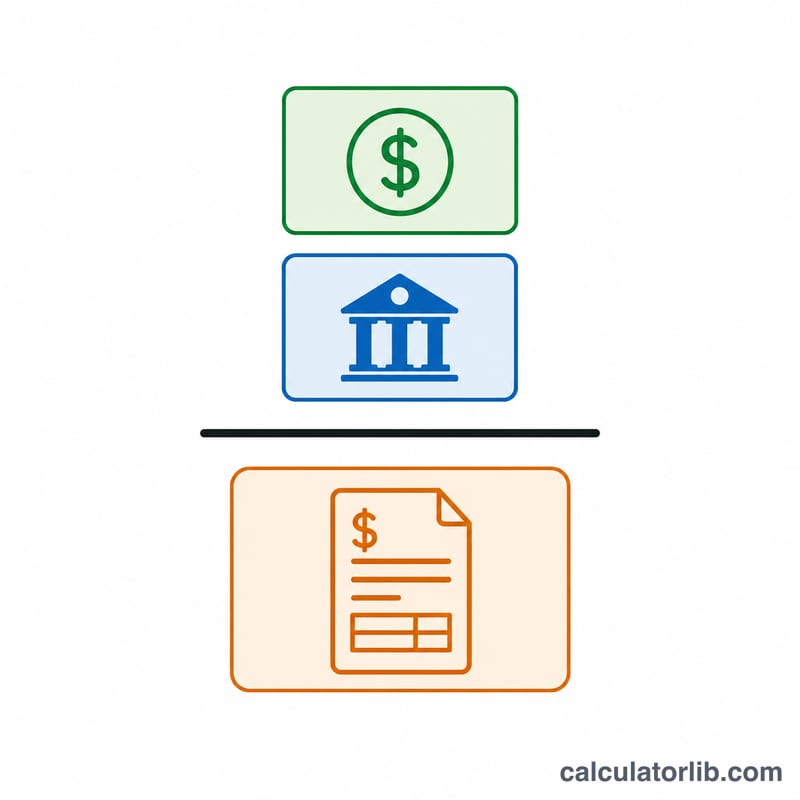
$$\text{Cash Ratio} = \frac{\text{Cash} + \text{Cash Equivalents}}{\text{Current Liabilities}}$$ A result of 1.0 means a company holds exactly enough liquid cash to cover every dollar of short-term debt. A ratio below 1.0 means it could not cover all current liabilities with cash alone, while a ratio well above 1.0 may signal under-utilised idle cash.
Worked Example
Suppose a company has $50,000 in cash, $30,000 in cash equivalents, and $100,000 in current liabilities. Total liquid cash is $80,000. $$\text{Cash Ratio} = \frac{80{,}000}{100{,}000} = 0.8 = 80\%$$ The firm can cover 80% of its short-term obligations from cash on hand.
FAQ
What is a good cash ratio? There is no universal target, but a ratio between 0.5 and 1.0 is often considered healthy. Too low suggests liquidity risk; too high may mean cash is sitting idle.
How is it different from the quick ratio? The quick ratio also includes accounts receivable and marketable securities, making it less strict. The cash ratio uses only cash and cash equivalents.
Can the cash ratio be greater than 1? Yes. A ratio above 1 means a company holds more cash than its total current liabilities.