
What Is Days Inventory Outstanding (DIO)?
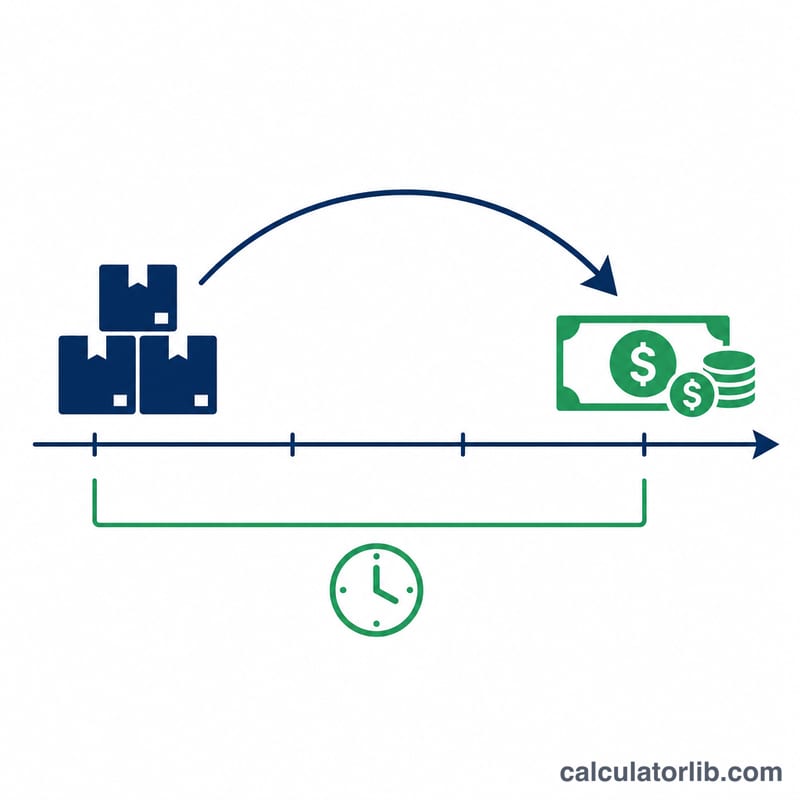
Days Inventory Outstanding (DIO), also called Days Sales of Inventory (DSI), measures the average number of days a company takes to convert its inventory into sales. A lower DIO generally signals efficient inventory management and strong demand, while a higher DIO may indicate overstocking or slow-moving goods. DIO is a key component of the Cash Conversion Cycle alongside Days Sales Outstanding and Days Payable Outstanding.
How to Use This Calculator
Enter your average inventory (typically the average of beginning and ending inventory for the period), your cost of goods sold (COGS) for the same period, and the number of days in the period (365 for a year, 90 for a quarter). The calculator returns your DIO in days plus the corresponding inventory turnover ratio.
The Formula Explained
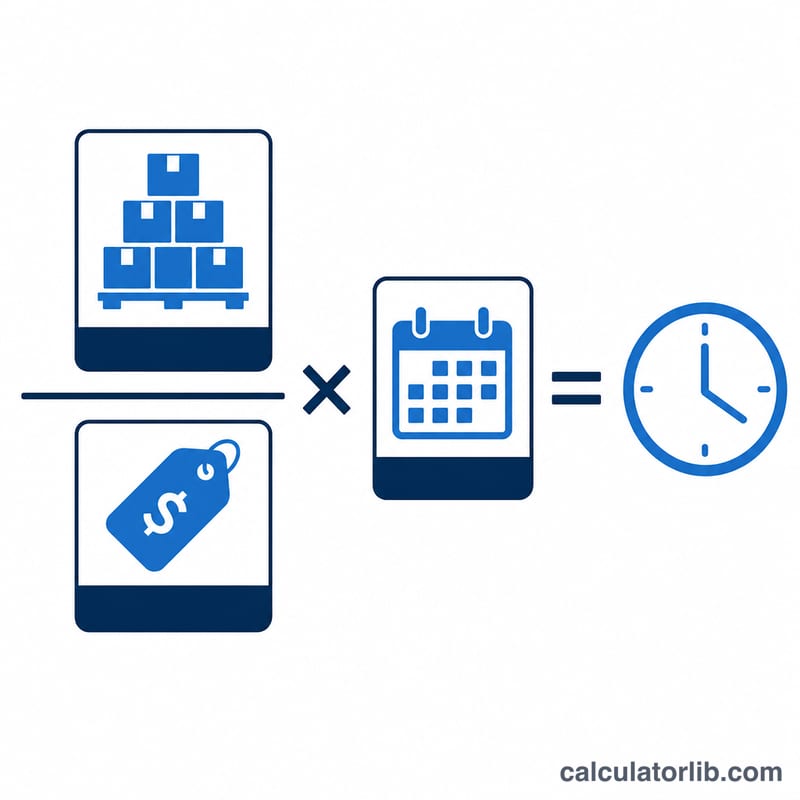
$$\text{DIO} = \frac{\text{Average Inventory}}{\text{COGS}} \times \text{Days}$$ The ratio of inventory to COGS shows what fraction of a period's cost is tied up in stock; multiplying by the number of days converts that fraction into a day count. Inventory turnover is the inverse relationship: \(\text{COGS} \div \text{Average Inventory}\), telling you how many times stock cycles through.
Worked Example
Suppose a retailer has average inventory of $50,000 and COGS of $365,000 over a 365-day year. $$\text{DIO} = \left(\frac{50{,}000}{365{,}000}\right) \times 365 = 50 \text{ days}$$ The inventory turnover = \(365{,}000 \div 50{,}000 = 7.3\) times per year. So inventory sits on shelves for about 50 days and turns over roughly 7.3 times annually.
FAQ
What is a good DIO? It varies widely by industry — grocery stores have very low DIO, while machinery or jewelry have high DIO. Compare against industry peers rather than a fixed benchmark.
Should I use average or ending inventory? Average inventory smooths out seasonal swings and is generally preferred, but ending inventory is acceptable for quick estimates.
How does DIO relate to turnover? They are inverses: \(\text{DIO} = \text{Days} \div \text{Turnover}\). A higher turnover means a lower DIO and faster-moving inventory.