
What Is Days Payable Outstanding (DPO)?
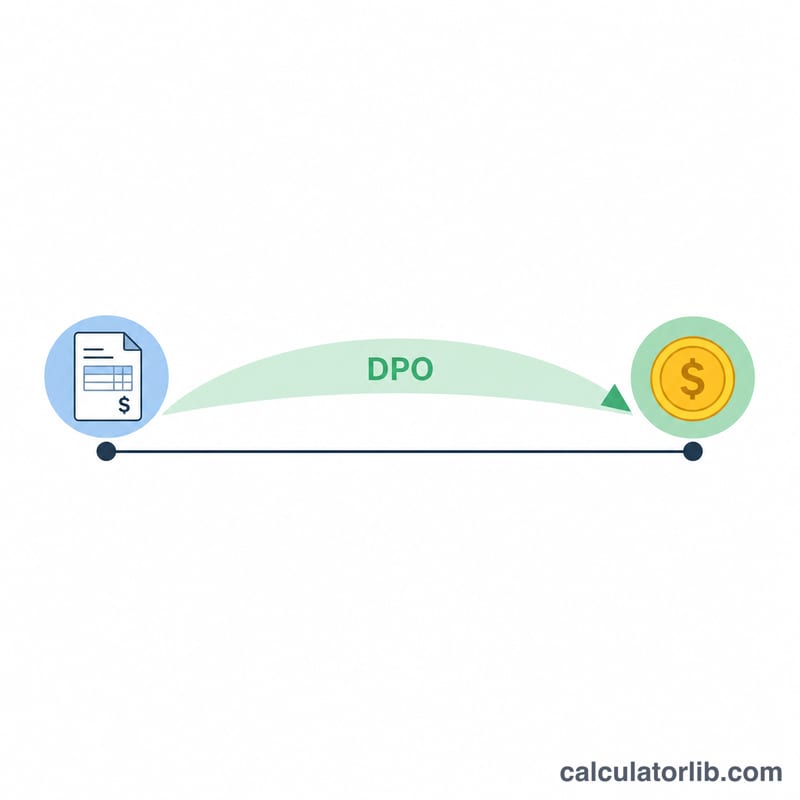
Days Payable Outstanding (DPO) is a working-capital metric that measures the average number of days a company takes to pay its suppliers and trade creditors. A higher DPO means the business holds onto its cash longer before paying bills, which can improve liquidity — but stretching it too far can strain supplier relationships. DPO is one of the three components of the cash conversion cycle, alongside Days Sales Outstanding (DSO) and Days Inventory Outstanding (DIO).
How to Use This Calculator
Enter your accounts payable (the balance owed to suppliers, typically from the balance sheet), your cost of goods sold (COGS) for the period (from the income statement), and the number of days in that period — 365 for a full year, 90 for a quarter, or 30 for a month. The calculator instantly returns your DPO and the related payables turnover ratio.
The Formula Explained
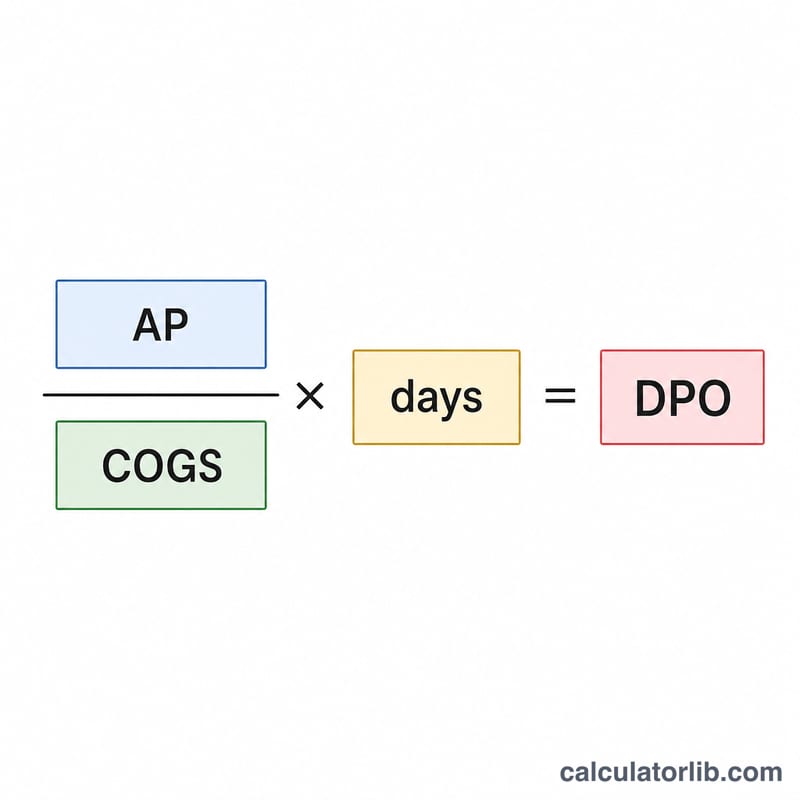
The standard formula is:
$$\text{DPO} = \frac{\text{Accounts Payable}}{\text{COGS}} \times \text{Number of Days}$$
Accounts payable divided by COGS gives the fraction of a period's purchases still unpaid; multiplying by the days in the period converts that fraction into a number of days. Some analysts use average accounts payable (opening + closing ÷ 2) instead of a single balance for greater accuracy.
Worked Example
Suppose a company has $50,000 in accounts payable and $365,000 in COGS over a 365-day year. $$\text{DPO} = \left(\frac{50{,}000}{365{,}000}\right) \times 365 = 0.13699 \times 365 = \textbf{50 days}$$ On average, the company pays its suppliers 50 days after receiving goods, and its payables turnover is \(365{,}000 \div 50{,}000 = 7.3\) times per year.
FAQ
Is a high or low DPO better? A higher DPO frees up cash, but it should stay within supplier payment terms to avoid late fees or damaged relationships. Compare against industry peers.
Should I use COGS or total purchases? COGS is the most common denominator and works well for most businesses; companies with large inventory swings sometimes use net credit purchases instead.
What is a good DPO range? It varies widely by industry — many companies fall between 30 and 90 days. The key is to benchmark against competitors and your own historical trend.