
What Is the EBITDA Margin?
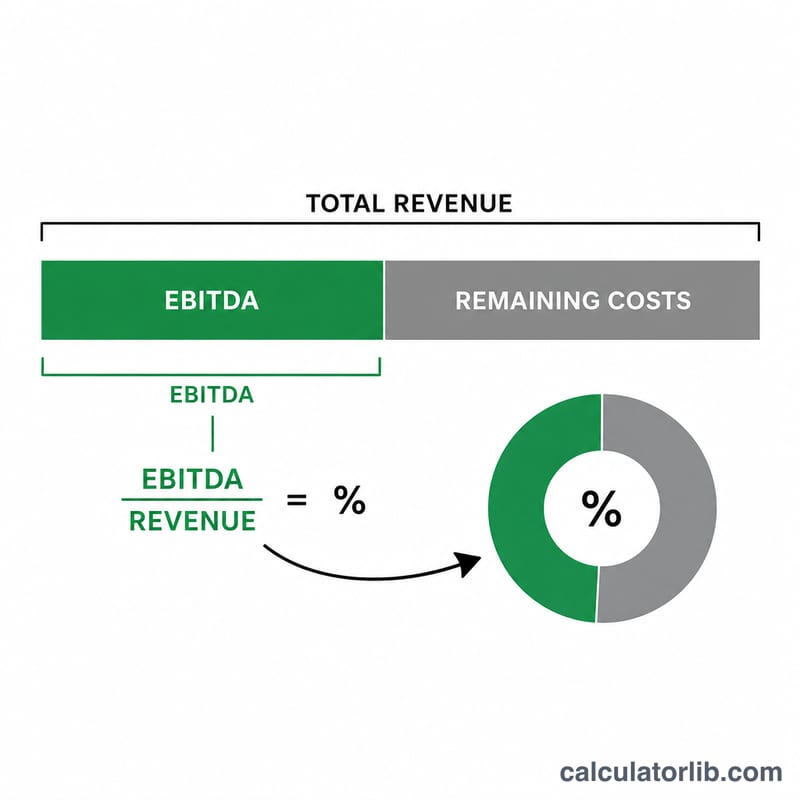
The EBITDA margin measures a company's operating profitability as a percentage of its total revenue. EBITDA stands for Earnings Before Interest, Taxes, Depreciation, and Amortization. By stripping out financing decisions, tax environments, and non-cash accounting charges, the EBITDA margin offers a clean view of how efficiently a business converts revenue into core operating profit. It is widely used by analysts and investors to compare companies of different sizes and capital structures.
How to Use This Calculator
Enter your company's EBITDA and its total revenue for the same period (typically a fiscal quarter or year). Click calculate, and the tool returns the EBITDA margin as a percentage. A higher margin indicates stronger operating efficiency relative to sales.
The Formula Explained
The calculation is straightforward: $$\text{EBITDA Margin} = \frac{\text{EBITDA}}{\text{Revenue}} \times 100\%$$ Both figures must cover the same accounting period and use the same currency. The result tells you how many cents of operating profit the business generates per dollar of revenue, before interest, taxes, depreciation, and amortization.
Worked Example
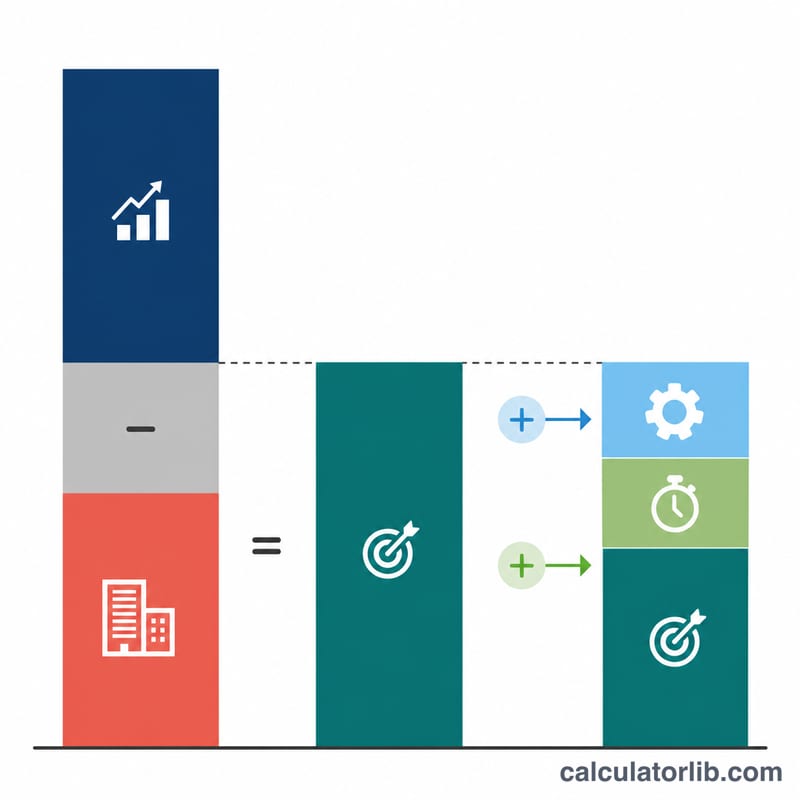
Suppose a company reports EBITDA of $250,000 on revenue of $1,000,000. The EBITDA margin is $$\left(\frac{250{,}000}{1{,}000{,}000}\right) \times 100 = 25\%$$ This means the firm keeps 25 cents of operating earnings for every dollar of revenue, a healthy result for many industries.
FAQ
What is a good EBITDA margin? It varies by industry. Software companies may exceed 30–40%, while grocery retailers often sit in single digits. Always compare against industry peers.
Is EBITDA margin the same as net profit margin? No. Net profit margin includes interest, taxes, and non-cash charges, so it is usually lower than the EBITDA margin.
Can EBITDA margin be negative? Yes. If a company's EBITDA is negative (operating losses), the margin will be negative, signaling that core operations are not yet profitable.