
What Is Markup vs. Margin?
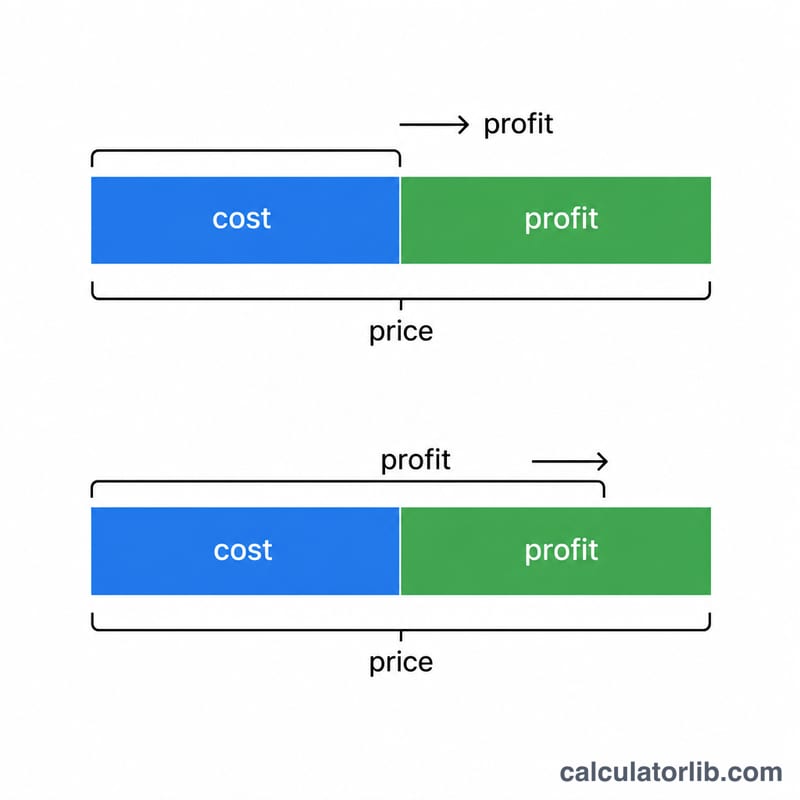
Markup and margin are two ways of describing the same profit, but measured against different bases. Markup is the profit expressed as a percentage of the cost, while margin (gross profit margin) is the same profit expressed as a percentage of the selling price. Because the denominators differ, a 50% markup is not a 50% margin — confusing the two is one of the most common pricing mistakes in retail and wholesale.
How to Use This Calculator
Enter your markup percentage (for example, 50 if you mark goods up by 50% over cost) and the calculator returns the equivalent profit margin percentage. This helps you compare suppliers, set consistent pricing rules, and avoid under-pricing your products.
The Formula Explained
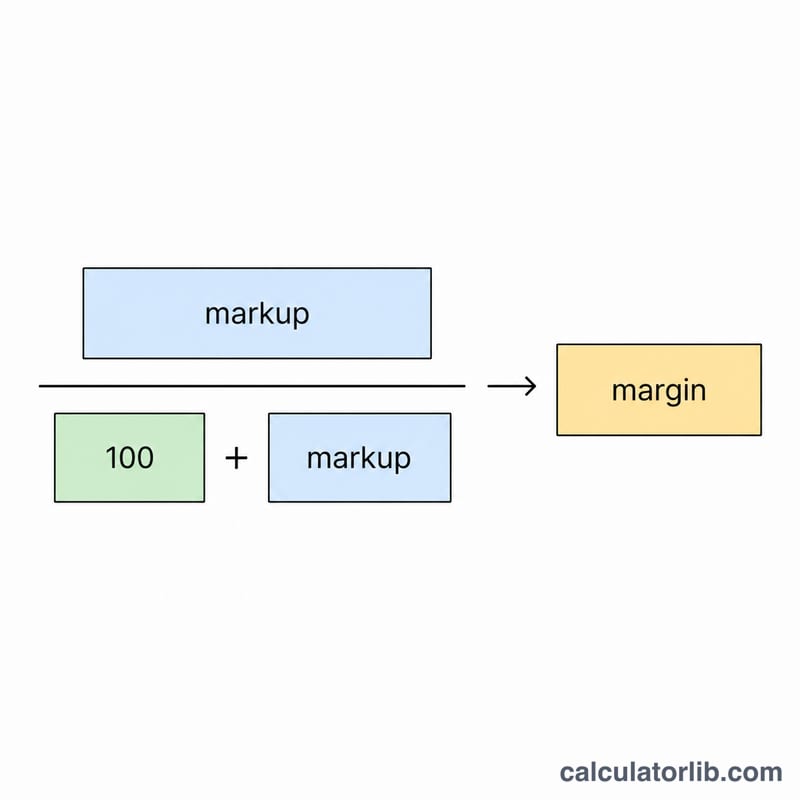
The conversion is: $$\text{Margin\%} = \frac{\text{Markup\%}}{100 + \text{Markup\%}} \times 100$$ The denominator \((100 + \text{Markup\%})\) represents the selling price as a percentage of cost. Dividing the markup by that figure rebases the profit onto the selling price, giving the margin.
Worked Example
Suppose an item costs $100 and you apply a 50% markup, selling it for $150. The profit is $50. As a margin, that $50 profit divided by the $150 selling price equals 33.33%. Using the formula: $$\frac{50}{100 + 50} \times 100 = \frac{50}{150} \times 100 = 33.33\%$$ So a 50% markup equals a 33.33% margin.
FAQ
Is markup always bigger than margin? Yes. Because cost is always less than selling price, the markup percentage is always greater than or equal to the margin percentage.
What markup gives a 50% margin? A 100% markup yields a 50% margin (\(100 / 200 \times 100 = 50\%\)).
Can margin exceed 100%? No. Margin approaches but never reaches 100% as markup grows, since profit can never exceed the full selling price.