
What is the Colebrook-White Friction Factor?
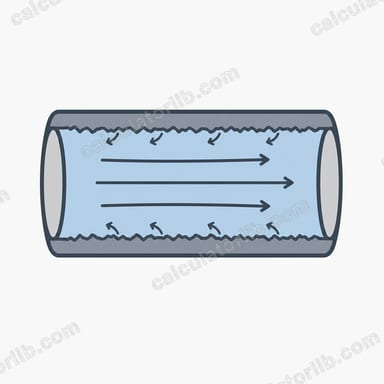
The Colebrook-White equation is the standard implicit relation used to determine the Darcy-Weisbach friction factor f for turbulent flow in rough or smooth pipes. The friction factor is the dimensionless number that links pressure loss to flow velocity, pipe length and diameter through the Darcy-Weisbach head-loss equation. Because f appears on both sides of the equation, it cannot be solved algebraically and must be found by iteration.
How to Use This Calculator
Enter the Reynolds number (Re) for your flow, the absolute pipe roughness (ε) and the internal pipe diameter (D). Roughness and diameter should be entered in the same unit (millimetres here) so that the relative roughness \(\varepsilon/D\) is correct. The calculator then iterates the Colebrook-White equation to convergence and reports the friction factor along with the relative roughness.
The Formula Explained
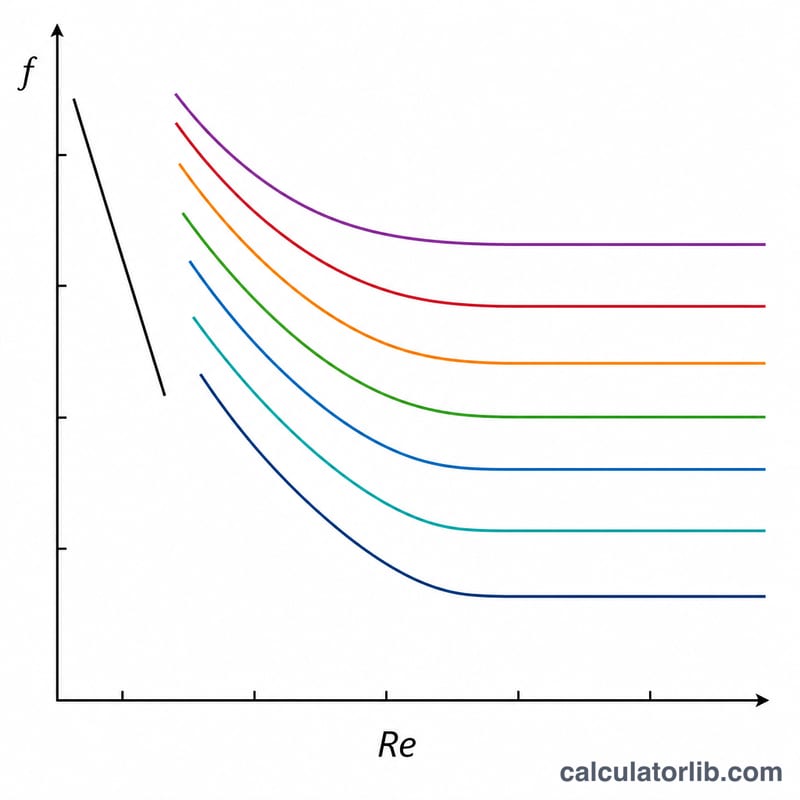
The equation is $$\frac{1}{\sqrt{f}} = -2 \log_{10}\!\left( \frac{\varepsilon/D}{3.7} + \frac{2.51}{\text{Re}\,\sqrt{f}} \right) \qquad \frac{\varepsilon}{D} = \frac{\text{Roughness }\varepsilon}{\text{Diameter }D}$$ The first term inside the logarithm captures wall roughness effects (dominant at high Reynolds numbers), while the second term captures viscous effects (dominant at lower Reynolds numbers). For perfectly smooth pipes (\(\varepsilon = 0\)) it reduces to the Prandtl smooth-pipe law. The solver seeds the iteration with the explicit Swamee-Jain approximation, then refines it via fixed-point iteration until \(f\) stops changing.

Worked Example
For \(\text{Re} = 100{,}000\), \(\varepsilon = 0.045\ \text{mm}\) and \(D = 100\ \text{mm}\), the relative roughness is \(0.00045\). Iterating the Colebrook-White equation converges to a Darcy friction factor of approximately \(f \approx 0.0205\), a typical value for commercial steel pipe in turbulent flow.
FAQ
Is this the Darcy or Fanning friction factor? It returns the Darcy (Moody) friction factor. The Fanning factor is one quarter of this value.
When is Colebrook-White valid? It applies to turbulent flow, roughly \(\text{Re} > 4000\). For laminar flow (\(\text{Re} < 2300\)) use \(f = 64/\text{Re}\) instead.
Do roughness and diameter units matter? Only their ratio matters, so enter both in the same unit — the result is identical whether you use mm, m or inches.