
What is a Rational Equation?
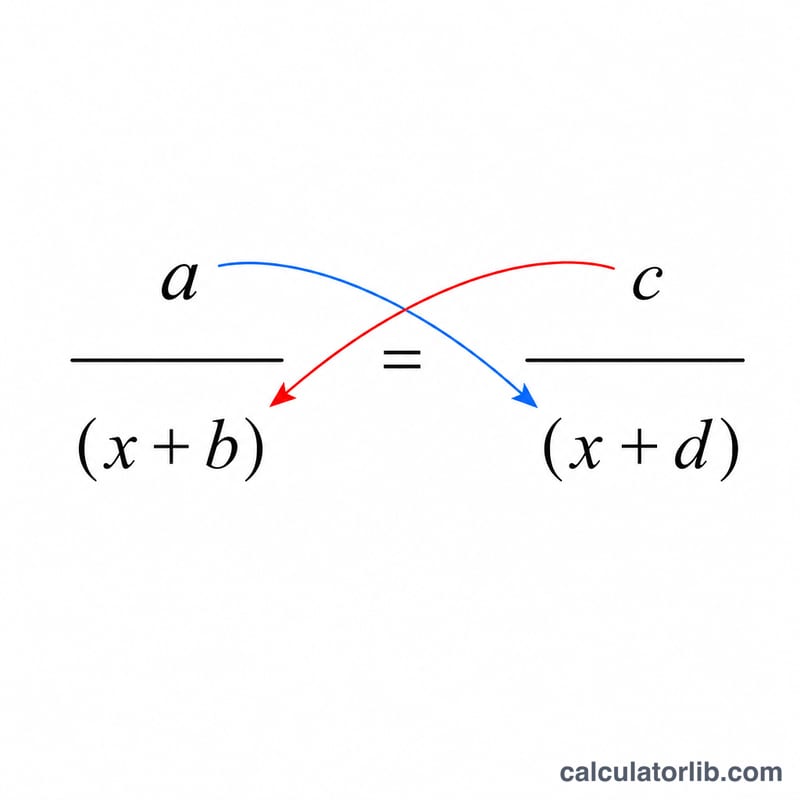
A rational equation is an equation that contains one or more fractions with a variable in the denominator. This calculator handles the common two-fraction form \(\frac{a}{x + b} = \frac{c}{x + d}\), where a, b, c and d are numbers you supply and x is the unknown. These equations show up in algebra, rates, mixtures, and proportion problems.
How to Use This Calculator
Enter the four constants: a and b describe the left fraction \(\frac{a}{x + b}\), while c and d describe the right fraction \(\frac{c}{x + d}\). Press calculate and the tool clears the fractions, solves for x, and warns you if the answer is an excluded value (one that would make a denominator zero).
The Formula Explained
Start by cross-multiplying: \(a(x + d) = c(x + b)\). Expanding gives \(ax + ad = cx + cb\). Move the x terms to one side: \((a - c)x = cb - ad\). As long as a is not equal to c, divide to get $$x = \frac{cb - ad}{a - c}.$$ If a equals c, there is either no solution or infinitely many, depending on whether \(cb - ad\) is nonzero.
Worked Example
Solve \(\frac{2}{x + 1} = \frac{3}{x + 4}\). Here \(a = 2\), \(b = 1\), \(c = 3\), \(d = 4\). Then $$x = \frac{cb - ad}{a - c} = \frac{3\cdot 1 - 2\cdot 4}{2 - 3} = \frac{3 - 8}{-1} = \frac{-5}{-1} = 5.$$ Check: \(\frac{2}{5 + 1} = \frac{2}{6} = \frac{1}{3}\) and \(\frac{3}{5 + 4} = \frac{3}{9} = \frac{1}{3}\). Both sides match, so \(x = 5\).
FAQ
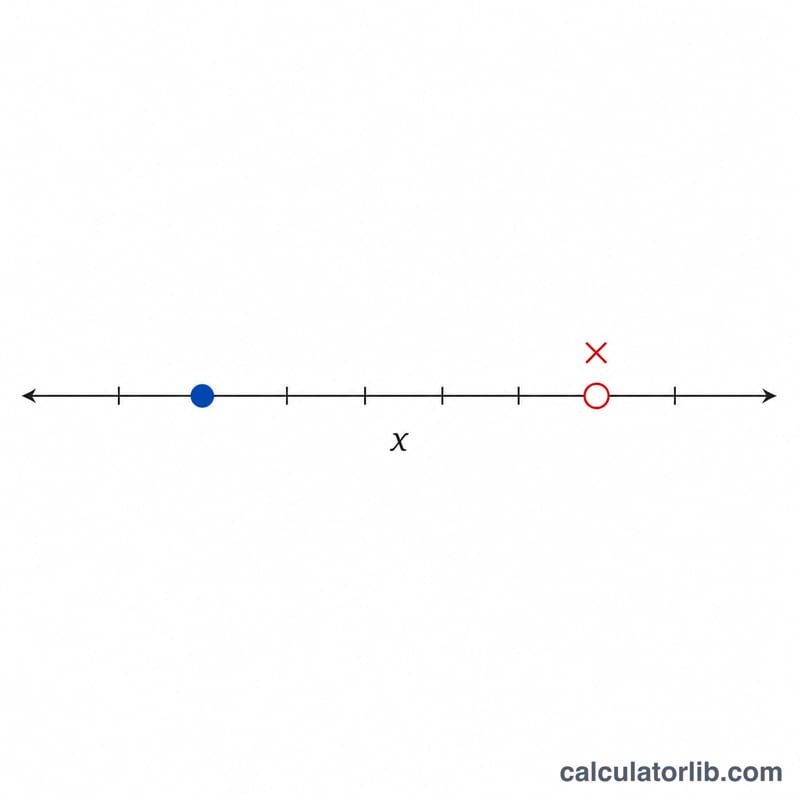
What is an extraneous solution? A value of x that solves the cleared equation but makes an original denominator zero. It must be rejected. The calculator flags these automatically.
What if a equals c? The x terms cancel. If cb equals ad the equation is an identity (all real x); otherwise there is no solution.
Can it solve quadratics? For this two-fraction form the equation is linear in x after clearing denominators, so there is at most one solution.