
What It Does
The Percent Off Between Two Prices Calculator tells you exactly how big a discount is when you know both the original price and the discounted (sale) price. Instead of guessing whether a markdown is a good deal, this tool converts the price gap into a clear percentage and shows you the dollar amount you save.
How To Use It
Enter the original price (the regular, pre-discount price) and the sale price (what you actually pay). The calculator instantly returns the percent off, the original and sale prices for reference, and the amount saved. The same method works for any currency since percentages are unit-free.
The Formula Explained
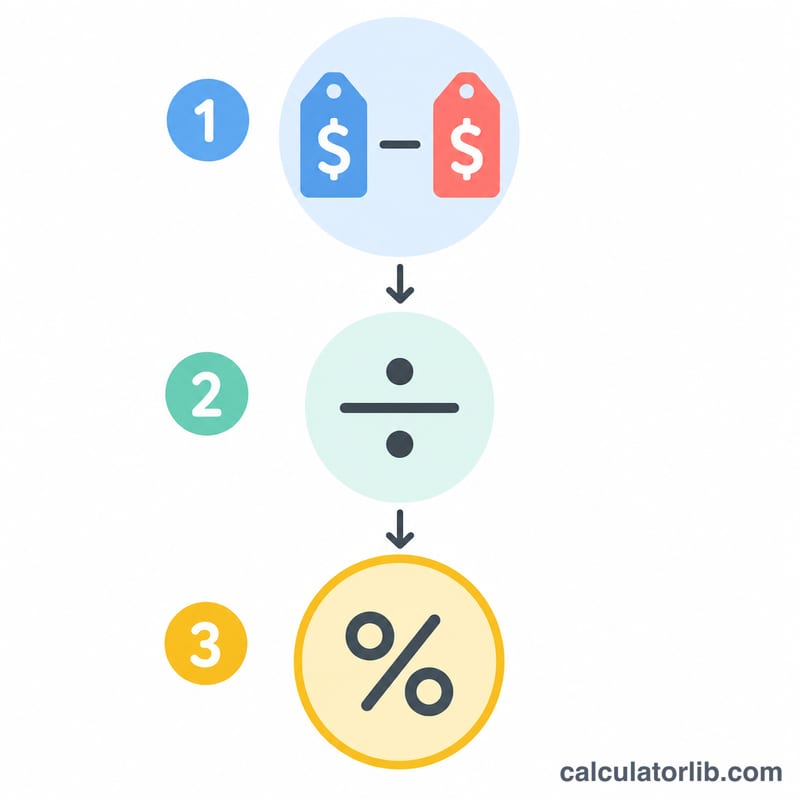
The calculation is simple: subtract the sale price from the original price to find how much was knocked off, divide that by the original price, then multiply by 100 to turn the ratio into a percentage.
$$\text{Percent Off} = \frac{\text{Original Price} - \text{Sale Price}}{\text{Original Price}} \times 100$$
Dividing by the original price (not the sale price) is what makes the result a true "percent off." Always anchor the percentage to the starting price.
Worked Example
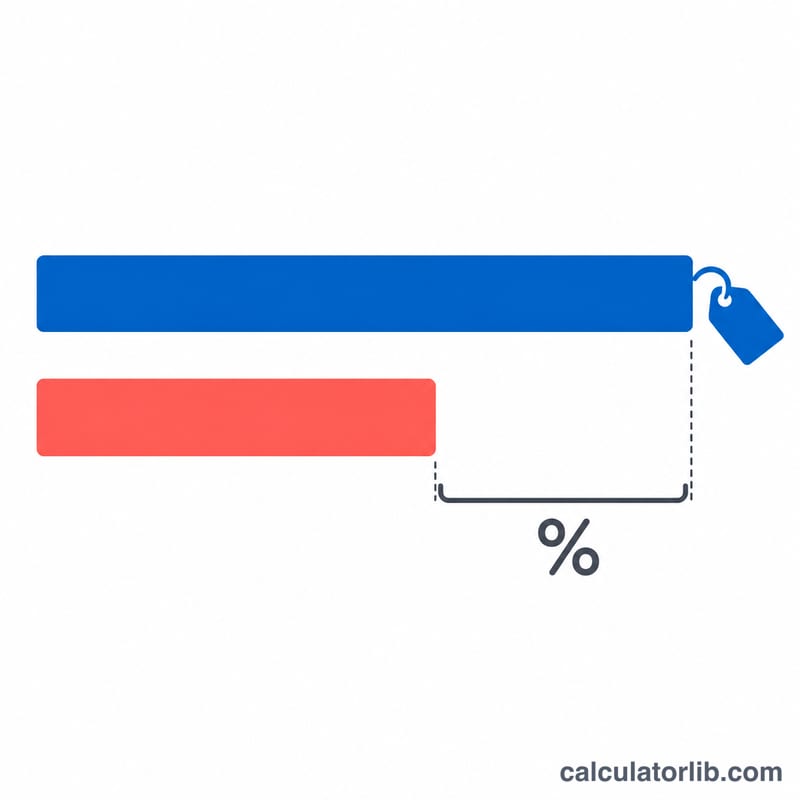
Suppose a jacket normally costs $120 and is on sale for $90. The amount saved is \(120 - 90 = \$30\). The percent off is $$\frac{30}{120} \times 100 = 25\%$$ So the jacket is 25% off, and you save $30.
FAQ
Why divide by the original price and not the sale price? Percent off measures the reduction relative to where the price started, so the original price is the correct denominator. Dividing by the sale price would give the markup, a different number.
What if the sale price is higher than the original? The result will be negative, indicating a price increase rather than a discount.
Can I use this for any currency? Yes. The percentage is the same regardless of currency, and the amount saved is reported in whatever units you enter.