
What Is the Compressibility Factor?
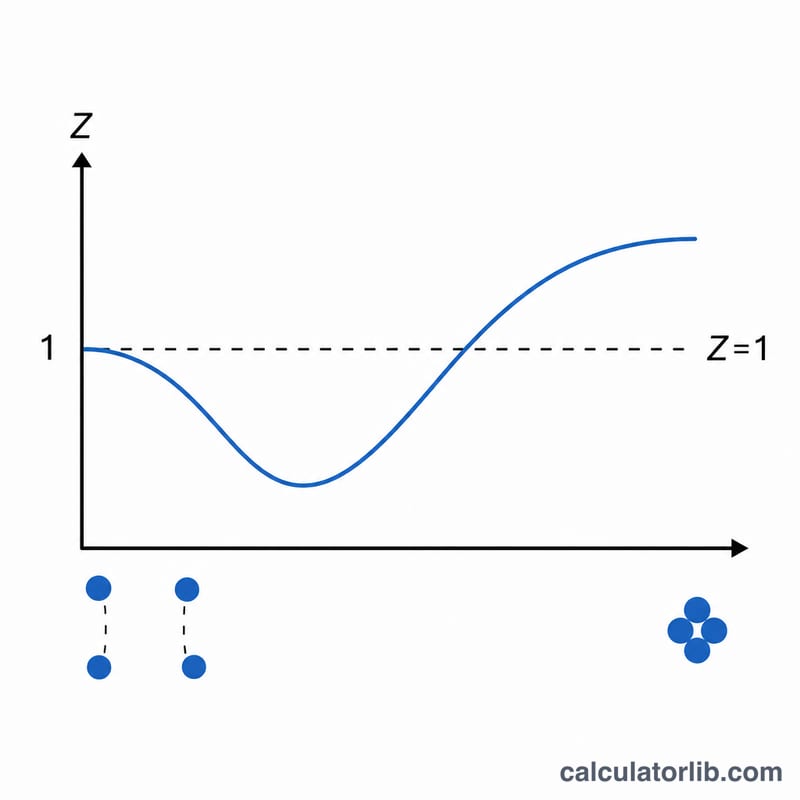
The compressibility factor, denoted Z, measures how much a real gas deviates from ideal-gas behavior. For an ideal gas \(Z = 1\) exactly. When \(Z < 1\) the gas is more compressible than ideal (attractive forces dominate); when \(Z > 1\) it is less compressible than ideal (repulsive/finite-volume effects dominate). Z is dimensionless and is central to chemical and petroleum engineering, where accurate gas density and volume predictions matter.
The Formula
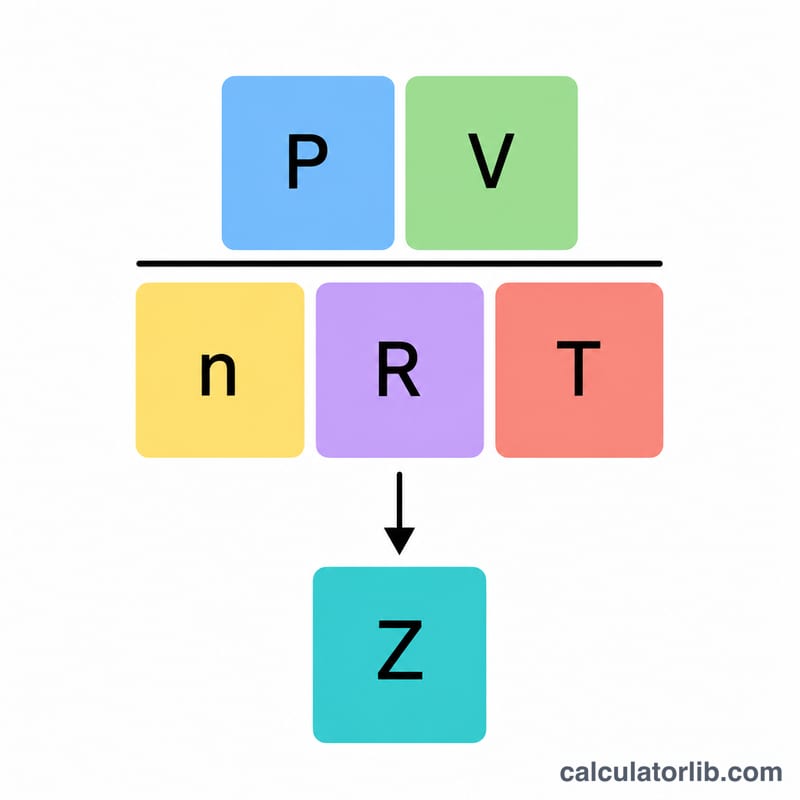
Z is defined by rearranging the real-gas equation of state \(PV = ZnRT\):
$$Z = \frac{\text{P} \cdot \text{V}}{\text{n} \cdot R \cdot \text{T}}$$
where P is absolute pressure (Pa), V is volume (m³), n is amount of substance (mol), T is absolute temperature (K), and \(R = 8.314462618\ \text{J/(mol}\cdot\text{K)}\) is the universal gas constant. Be sure to use SI units and absolute (Kelvin) temperature.
How to Use This Calculator
Enter the measured pressure, volume, number of moles, and temperature of your gas sample. The calculator returns Z along with the actual PV product and the ideal nRT product so you can see exactly how the two compare.
Worked Example
Suppose 1 mol of gas occupies 0.0224 m³ at 101325 Pa and 273.15 K. Then $$nRT = 1 \times 8.314462618 \times 273.15 \approx 2271.10\ \text{J}$$ and $$PV = 101325 \times 0.0224 \approx 2269.68\ \text{J}.$$ So $$Z = \frac{2269.68}{2271.10} \approx 0.9994$$ — very close to ideal, as expected for a gas near standard conditions.
FAQ
What does \(Z = 1\) mean? The gas behaves ideally at those conditions.
Why must temperature be in Kelvin? The gas law requires absolute temperature; using Celsius or Fahrenheit gives wrong results.
Can Z be greater than 1? Yes — at high pressures repulsive forces and finite molecular volume make many gases less compressible than the ideal model predicts.