
What is the Coefficient of Performance?
The coefficient of performance (COP) measures how efficiently a heat pump, refrigerator, or air conditioner moves thermal energy. It is the ratio of useful heat transferred to the work (electrical or mechanical energy) required to move it. Because heat pumps move energy rather than create it, COP values are typically greater than 1 — a COP of 3 means three units of heat are delivered for every unit of electricity consumed.
How to use this calculator
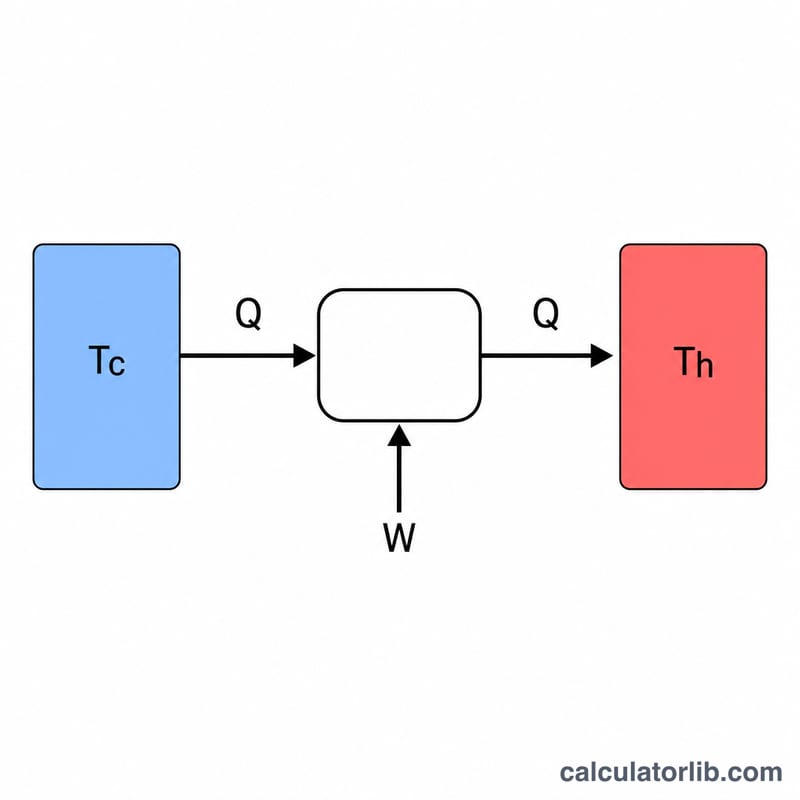
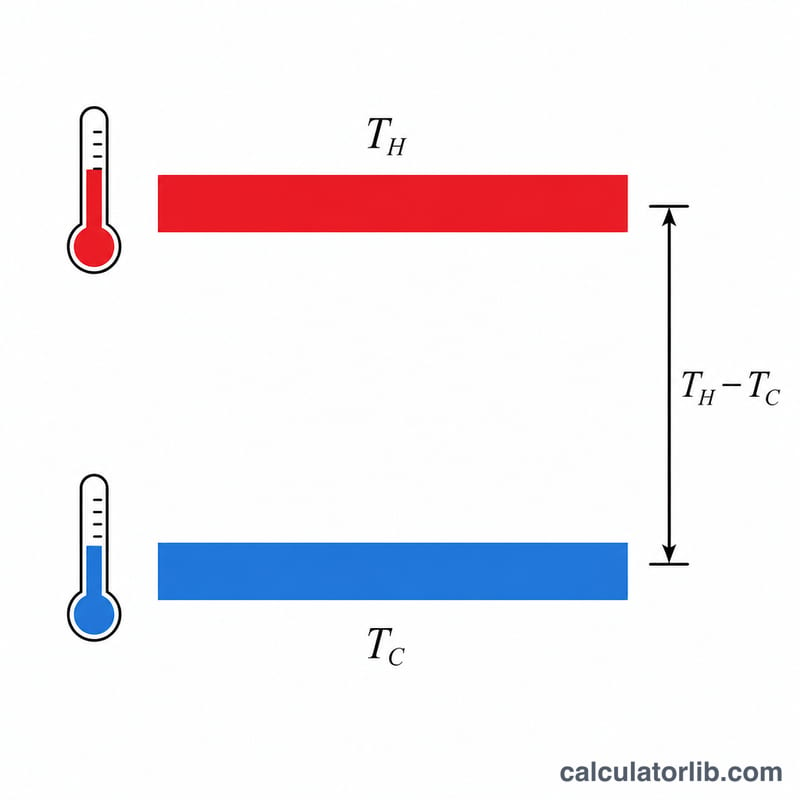
Choose a calculation method. With the Energy method, enter the heat moved \(Q\) and the work input \(W\) (in the same units, watts or joules) to get the real-world \(\text{COP} = Q/W\). With the Carnot method, enter the cold and hot reservoir temperatures in Kelvin to find the maximum theoretical COP for that temperature span. Select Cooling or Heating to choose the appropriate Carnot formula.
The formula explained
For real systems, $$\text{COP} = \frac{\text{Heat } Q}{\text{Work } W}$$ For the ideal Carnot limit, cooling COP equals $$\text{COP}_{\text{cool}} = \frac{\text{Cold } T_c}{\text{Hot } T_h - \text{Cold } T_c}$$ and heating COP equals $$\text{COP}_{\text{heat}} = \frac{\text{Hot } T_h}{\text{Hot } T_h - \text{Cold } T_c}$$ Note that the heating COP always equals the cooling COP plus 1, since the heat rejected to the hot side includes the work input.
Worked example
A heat pump moves 3000 W of heat using 1000 W of electrical power. $$\text{COP} = \frac{3000}{1000} = 3.0$$ For the Carnot limit with \(T_c = 275\ \text{K}\) and \(T_h = 300\ \text{K}\) in cooling mode: $$\text{COP} = \frac{275}{300 - 275} = \frac{275}{25} = 11.0$$
FAQ
Is a higher COP better? Yes — a higher COP means more heat moved per unit of energy consumed, so lower running costs.
Why use Kelvin for the Carnot formula? The Carnot relation requires absolute temperature; Celsius would give incorrect ratios. Add 273.15 to convert °C to K.
How does COP relate to EER and SEER? EER and SEER are similar efficiency ratings; \(\text{EER} \approx \text{COP} \times 3.412\) when using BTU/h per watt.