
What Is the Lift Coefficient?
The lift coefficient (CL) is a dimensionless number that captures how effectively a wing, airfoil, or lifting body generates lift in a given flow. It bundles the complex effects of shape, angle of attack, and flow conditions into a single value, letting engineers compare designs independent of size and speed. This calculator is universal — it uses SI units and applies to any aircraft, drone, or hydrofoil.
The Formula Explained
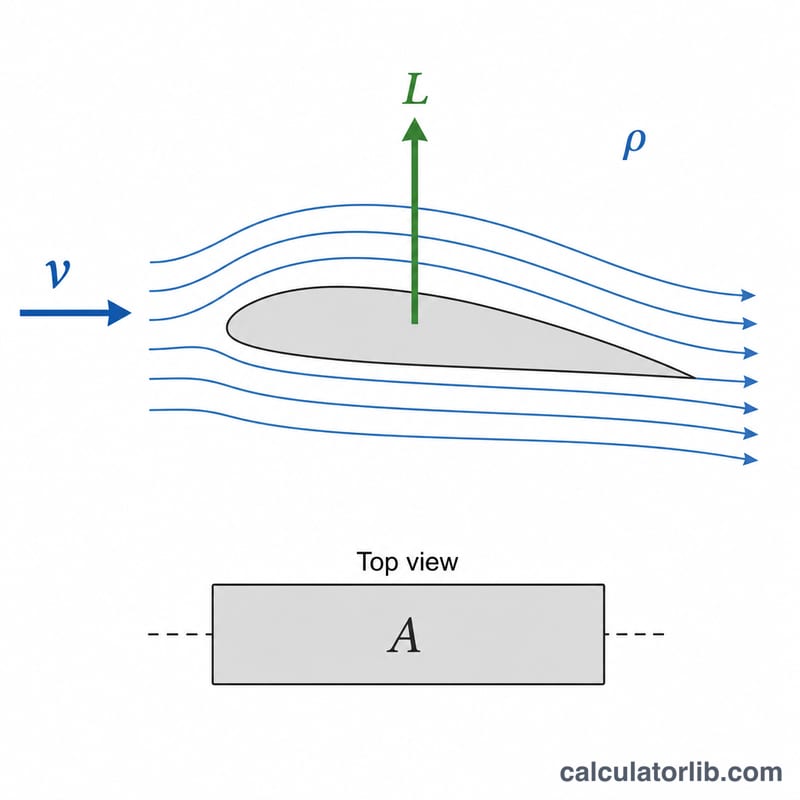
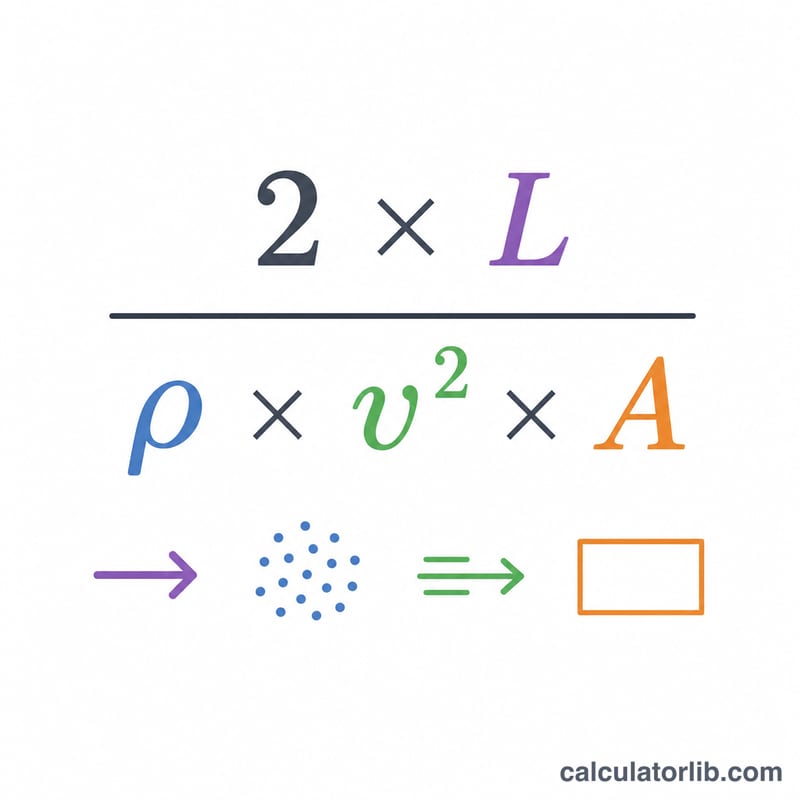
Lift coefficient is defined as:
$$C_L = \frac{2L}{\rho \cdot v^2 \cdot A}$$
where L is the lift force in newtons, ρ (rho) is the fluid density in kg/m³ (sea-level air ≈ 1.225), v is the freestream velocity in m/s, and A is the reference (wing planform) area in m². The denominator \(\rho \cdot v^2 \cdot A\) is twice the dynamic pressure (\(q = \tfrac{1}{2}\rho v^2\)) multiplied by area, so \(C_L = \frac{L}{q \cdot A}\).
How to Use the Calculator
Enter the lift force your wing must produce (often equal to weight in level flight), the air density at your altitude, the airspeed, and the wing area. The tool returns the lift coefficient and the dynamic pressure of the flow.
Worked Example
For L = 5000 N, ρ = 1.225 kg/m³, v = 50 m/s, A = 16 m²: dynamic pressure $$q = 0.5 \times 1.225 \times 50^2 = 1531.25 \text{ Pa}.$$ Denominator $$1.225 \times 2500 \times 16 = 49000.$$ $$C_L = \frac{2 \times 5000}{49000} \approx 0.2041.$$
FAQ
What is a typical lift coefficient? Most aircraft cruise at CL around 0.2–0.5, while values near maximum (just before stall) often reach 1.2–1.6 for plain wings and higher with flaps.
Can CL exceed 1? Yes. High-lift devices and high angles of attack can push CL above 2 before the wing stalls.
What area should I use? Use the same reference area consistently — typically the wing planform area for aircraft.