
What Is the Cv Flow Coefficient?
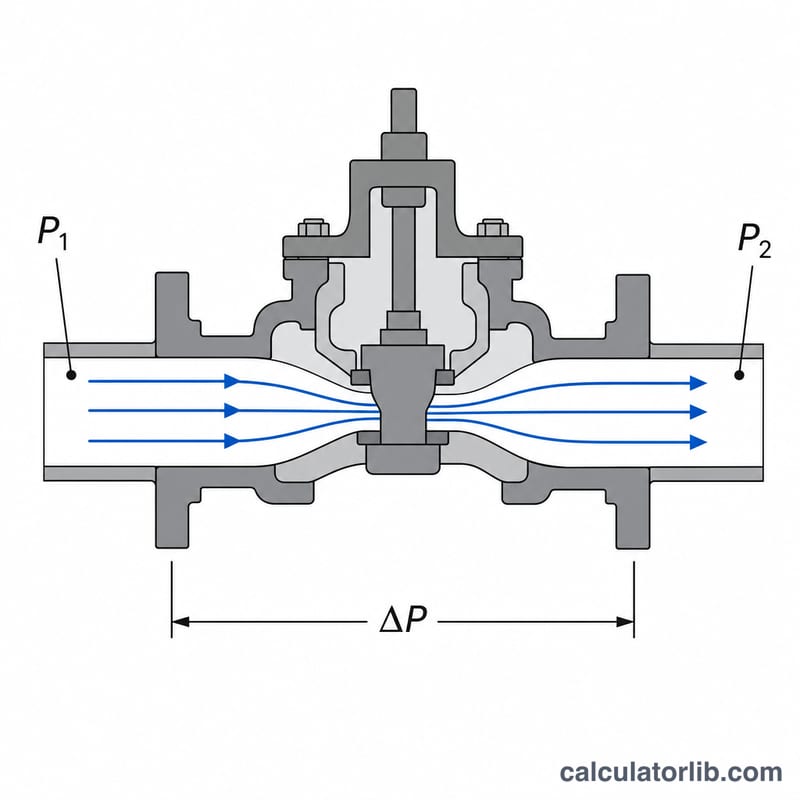
The flow coefficient (Cv) is a standard measure of a valve's capacity to pass liquid. By definition, a Cv of 1 allows 1 US gallon per minute (GPM) of water (specific gravity = 1) to flow with a 1 psi pressure drop across the valve. Engineers use Cv to size and compare control valves, ball valves, and other flow components.
How to Use This Calculator
Enter three values: the valve's flow coefficient (Cv) from its datasheet, the pressure drop (ΔP) across the valve in psi, and the specific gravity (SG) of the liquid (water = 1.0). The calculator returns the resulting volumetric flow rate in US gallons per minute.
The Formula Explained
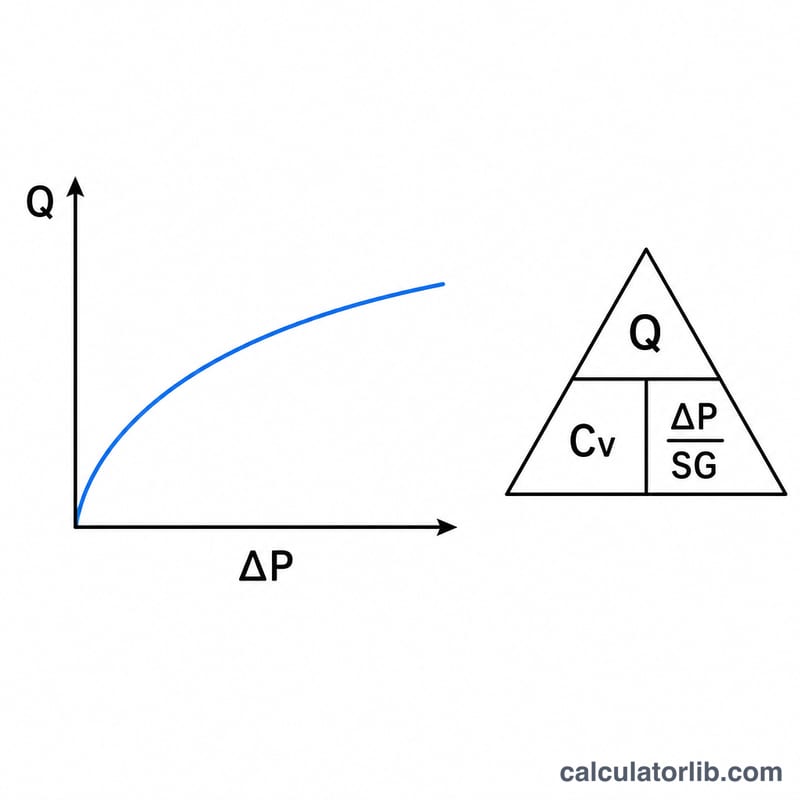
For liquid (turbulent, non-choked) flow the relationship is:
$$Q = \text{Cv} \times \sqrt{\dfrac{\text{ΔP (psi)}}{\text{SG}}}$$
where Q is flow in GPM, ΔP is pressure drop in psi, and SG is specific gravity relative to water. Higher pressure drop or a lower-density fluid increases flow; you can also rearrange the equation to solve for required Cv: \(\text{Cv} = Q / \sqrt{\text{ΔP} / \text{SG}}\).
Worked Example
A valve has Cv = 10, a pressure drop of 25 psi, and water (SG = 1.0). Then $$Q = 10 \times \sqrt{\dfrac{25}{1}} = 10 \times 5 = 50 \text{ GPM}.$$ If the same valve carried a fluid with SG = 0.8, flow would rise to $$10 \times \sqrt{\dfrac{25}{0.8}} = 10 \times 5.59 = 55.9 \text{ GPM}.$$
FAQ
Does this work for gases? No — gases require a compressible-flow Cv equation that accounts for pressure ratio and temperature. This formula is for liquids.
What units does it use? Imperial: Cv per US GPM, ΔP in psi. The metric equivalent is Kv (m³/h, bar); \(\text{Cv} \approx 1.156 \times \text{Kv}\).
What is specific gravity? It is the fluid's density relative to water at the same temperature. Water = 1.0, lighter fluids are below 1, heavier fluids above 1.