
What Is Ballistic Coefficient?
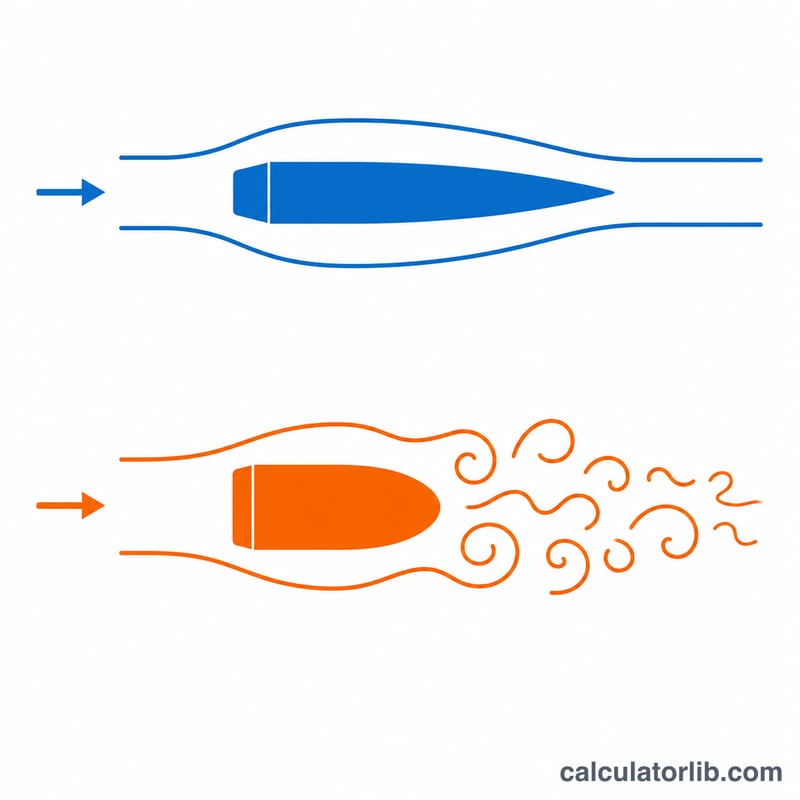
The ballistic coefficient (BC) measures how well a projectile overcomes air resistance in flight. A higher BC means the bullet retains velocity better, drops less, and is less affected by wind. BC is central to long-range shooting, hunting, and ballistics modeling. This calculator uses the classic relationship between sectional density and a reference drag profile via the form factor.
How to Use This Calculator
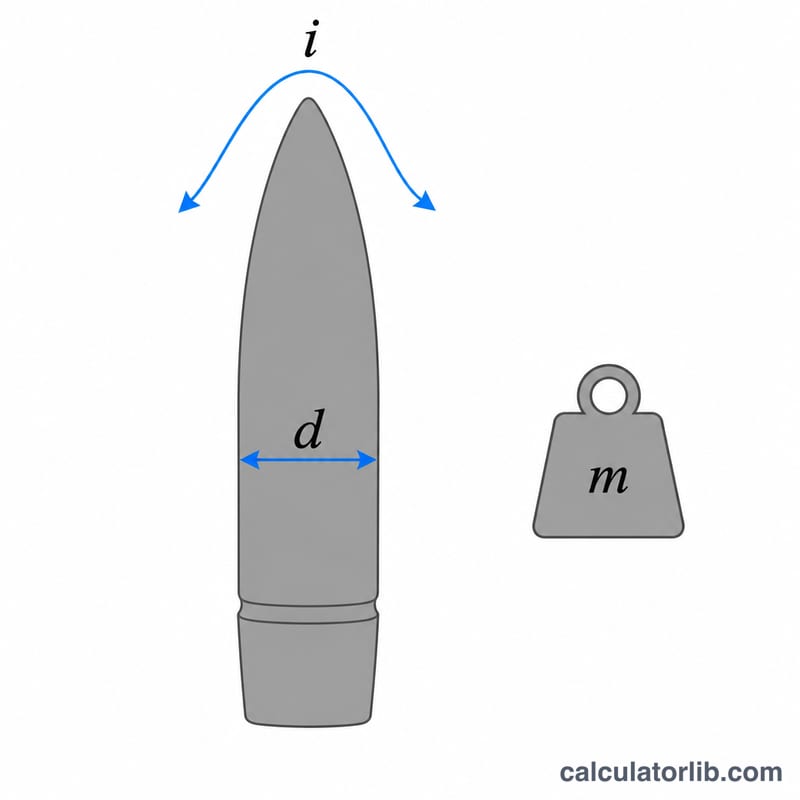
Enter the bullet mass in grains (the standard unit on ammunition boxes), the bullet diameter in inches (e.g. 0.308 for a .308/7.62mm), and the form factor (i). The form factor compares your bullet's drag to a standard reference projectile — a sleek, aerodynamic bullet has a form factor below 1.0, while a blunt bullet exceeds 1.0. The tool converts grains to pounds (7000 grains = 1 lb) and returns the BC plus the sectional density.
The Formula Explained
The formula is $$\text{BC} = \frac{m}{d^{2} \cdot i}$$ where m is mass in pounds, d is diameter in inches, and i is the dimensionless form factor. Because sectional density is \(\text{SD} = m / d^{2}\), the BC is simply SD divided by the form factor. When \(i = 1.0\), the BC equals the sectional density.
Worked Example
A 168-grain .308 bullet with a form factor of 0.5: mass in pounds = \(168 / 7000 = 0.024\) lb. \(d^{2} = 0.308^{2} = 0.094864\). Sectional density = \(0.024 / 0.094864 \approx 0.253\). $$\text{BC} = \frac{0.253}{0.5} \approx 0.506$$ This matches typical published BCs for a match-grade .308 projectile.
Typical Ballistic Coefficients by Bullet Type
Ballistic coefficient (BC) describes how well a bullet overcomes air resistance in flight: the higher the value, the less the bullet slows down and the flatter it shoots. Published BC values are always tied to a drag model — most commonly the G1 model (a flat-base reference projectile) or the G7 model (a long boat-tail reference projectile that better matches modern long-range bullets). G7 values run lower numerically than G1 for the same bullet and are generally more consistent across velocity. The table below lists representative published values; always check the specific manufacturer's data for a given load.
| Bullet / Caliber | Weight (gr) | Type | G1 BC (approx.) | G7 BC (approx.) |
|---|---|---|---|---|
| .223 / 5.56mm | 55 | FMJ boat-tail | ~0.243 | ~0.122 |
| .223 / 5.56mm | 77 | Match HPBT | ~0.372 | ~0.188 |
| 6.5mm | 140 | Match boat-tail | ~0.600 | ~0.305 |
| .270 | 130 | Spitzer boat-tail | ~0.450 | ~0.230 |
| 7mm | 162 | Match HPBT | ~0.625 | ~0.315 |
| .308 / 7.62mm | 168 | Match HPBT (e.g. SMK) | ~0.450 | ~0.224 |
| .308 / 7.62mm | 175 | Match HPBT | ~0.505 | ~0.243 |
| .338 | 300 | Match HPBT | ~0.768 | ~0.384 |
| .50 BMG | 750 | Match (A-MAX class) | ~1.050 | ~0.525 |
Note: G7 figures shown are typical industry values and roughly half the G1 figure for these long, boat-tail designs; the exact ratio depends on bullet shape, so use published per-bullet data when precision matters.
Key Terms Explained
- Ballistic coefficient (BC)
- A measure of a bullet's ability to resist air drag relative to a standard reference projectile. Numerically it is the sectional density divided by the form factor. A higher BC means the bullet retains velocity and resists wind better over distance.
- Sectional density (SD)
- The ratio of a bullet's mass to the square of its diameter, \(\text{SD}=\dfrac{\text{mass (lb)}}{\text{diameter (in)}^{2}}\), with mass in pounds (grains ÷ 7000). It captures how "heavy for its width" a bullet is, independent of nose shape.
- Form factor (i)
- A dimensionless number comparing the bullet's actual drag profile to the reference projectile of the chosen drag model. A form factor of 1.0 matches the reference exactly; values below 1.0 indicate a more streamlined (lower-drag) shape. BC = SD / i.
- Grain (gr)
- The traditional unit of bullet and powder mass in the imperial system. There are exactly 7000 grains in one pound, which is why BC formulas divide grains by 7000 to obtain pounds.
- G1 vs G7 drag models
- Standard reference projectiles used to compute BC. The G1 model is based on a flat-based, blunt projectile and is the most commonly published; its BC varies with velocity. The G7 model uses a long, boat-tailed reference shape that closely matches modern long-range match bullets, giving a more stable BC across the trajectory. A G1 and G7 BC for the same bullet are not interchangeable.
- Boat-tail
- A bullet base that tapers inward like the stern of a boat, reducing base drag and turbulence. Boat-tail designs typically have higher BCs than flat-base bullets of the same weight and caliber.
- Spitzer
- A bullet with a sharply pointed, elongated nose (from the German Spitze, "point"). The streamlined profile lowers the form factor and raises the BC compared with round-nose bullets.
FAQ
Why convert grains to pounds? The standard BC formula uses pounds for mass and inches for diameter, which yields the familiar dimensionless-style BC values around 0.2–0.7.
What is a good form factor? Modern boat-tail spitzer bullets often have form factors near 0.5 (G1) or close to 1.0 (G7), depending on the drag model used.
Is BC constant? In practice BC varies slightly with velocity. Published BCs are averages over a velocity range, so treat this result as a reference value.