
What is the conservation of momentum?
The law of conservation of momentum states that in a closed, isolated system the total momentum stays constant. Momentum is mass times velocity, so for two interacting objects the total momentum before a collision equals the total momentum after it. This is one of the most powerful principles in classical mechanics and applies to collisions, explosions, and recoil.
How to use this calculator
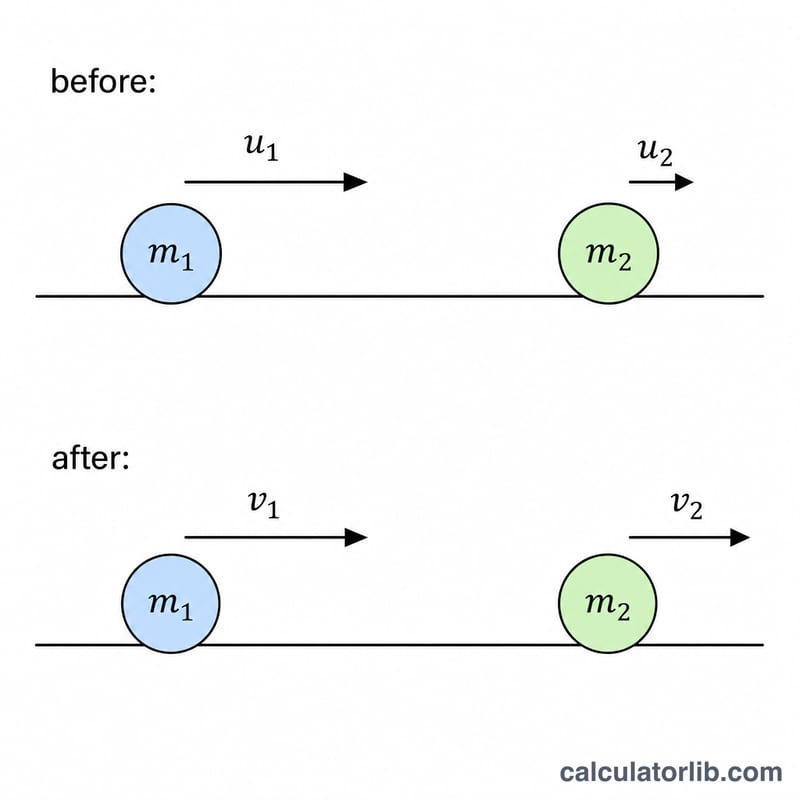
Enter the two masses (\(m_1\) and \(m_2\)), their initial velocities (\(u_1\) and \(u_2\)), and the known final velocity of object 1 (\(v_1\)). The calculator solves for the unknown final velocity of object 2 (\(v_2\)) and confirms that total momentum is conserved. Use a negative sign for velocities directed opposite to your chosen positive direction.
The formula explained
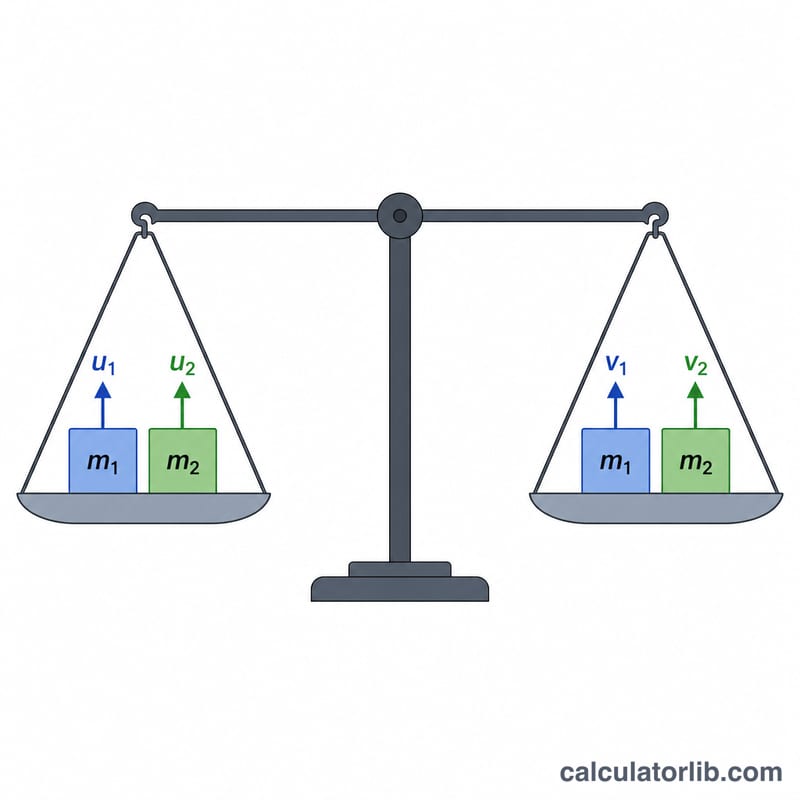
Starting from \(m_1 u_1 + m_2 u_2 = m_1 v_1 + m_2 v_2\), we isolate \(v_2\):
$$v_2 = \dfrac{m_1\,u_1 + m_2\,u_2 - m_1\,v_1}{m_2}$$
The numerator is the total system momentum minus the momentum carried by object 1 after the event; dividing by \(m_2\) gives object 2's final velocity.
Worked example
A 2 kg cart moving at 5 m/s strikes a stationary 3 kg cart. After the collision the 2 kg cart moves at 1 m/s. Total momentum = \(2\times5 + 3\times0 = 10\ \text{kg}\cdot\text{m/s}\). Then $$v_2 = \frac{10 - 2\times1}{3} = \frac{8}{3} \approx 2.667\ \text{m/s}.$$ The 3 kg cart moves off at about 2.67 m/s, and the total momentum after (\(2\times1 + 3\times2.667 = 10\)) is unchanged.
FAQ
Is momentum conserved if there is friction? Momentum is conserved only when no external net force acts. Significant friction is an external force, so use this tool for instantaneous collisions where it is negligible.
Does it work for elastic and inelastic collisions? Yes — momentum is conserved in both. In a perfectly inelastic collision the objects stick together, so \(v_1\) equals \(v_2\).
What units should I use? Use kilograms for mass and meters per second for velocity to get momentum in \(\text{kg}\cdot\text{m/s}\).