
What Is Momentum?
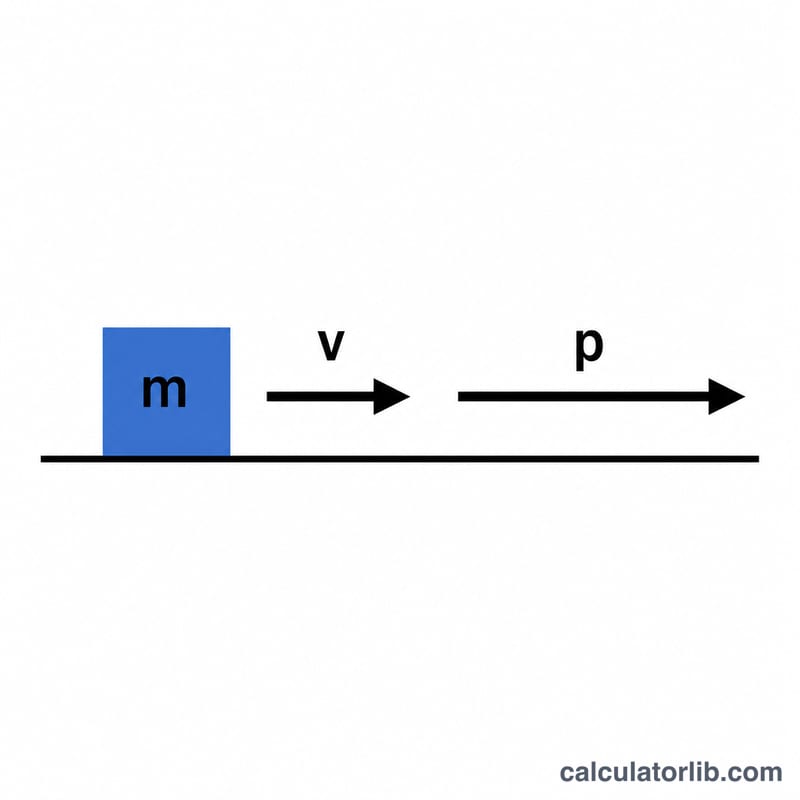
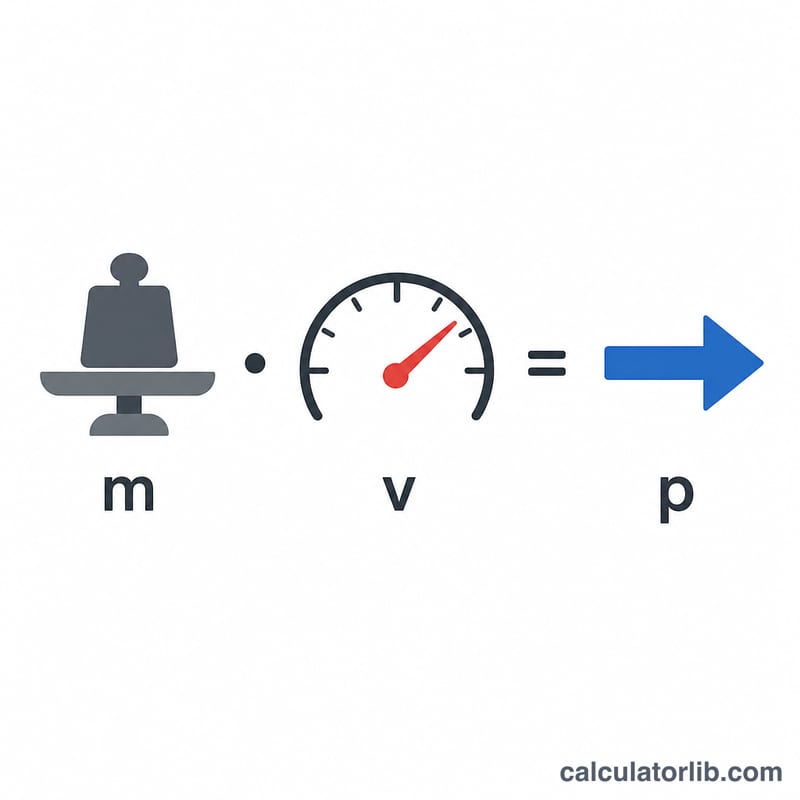
Momentum is a measure of the quantity of motion an object has. It is defined as the product of an object's mass and its velocity. In physics, momentum is a vector quantity, meaning it has both magnitude and direction — the direction of momentum is the same as the direction of the object's velocity. This calculator computes the magnitude of linear momentum using the classic formula \(p = m \cdot v\).
How to Use This Calculator
Enter the mass of the object in kilograms (kg) and its velocity in metres per second (m/s). The calculator multiplies the two values and returns the momentum in kilogram-metres per second (kg·m/s). A negative velocity (an object moving in the opposite direction) produces negative momentum, which simply reflects direction along your chosen axis.
The Formula Explained
The formula is $$p = m \times v$$ where:
p is momentum in kg·m/s, m is mass in kg, and v is velocity in m/s. Because momentum scales directly with both mass and velocity, doubling either value doubles the momentum. This relationship is at the heart of the conservation of momentum, one of the most important principles in mechanics.
Worked Example
Consider a 1,500 kg car travelling at 20 m/s. Its momentum is $$p = 1500 \times 20 = 30{,}000 \ \text{kg}\cdot\text{m/s}$$ If a 0.145 kg baseball is thrown at 40 m/s, its momentum is only $$0.145 \times 40 = 5.8 \ \text{kg}\cdot\text{m/s}$$ — far smaller, despite the higher speed, because of its tiny mass.
FAQ
What units does momentum use? The SI unit of momentum is the kilogram-metre per second (kg·m/s), equivalent to a newton-second (N·s).
Is momentum the same as force? No. Force is the rate of change of momentum over time (\(F = \Delta p / \Delta t\)). Momentum describes motion; force describes how that motion changes.
Can momentum be negative? Yes. Sign indicates direction. An object moving in the negative direction along your reference axis has negative momentum.