
What Is Muzzle Velocity?
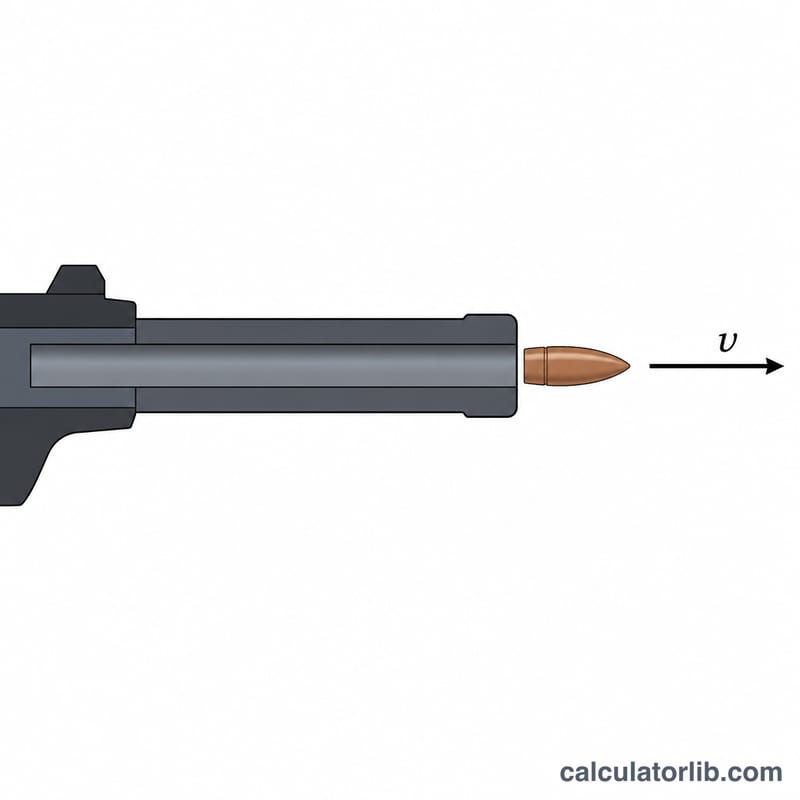
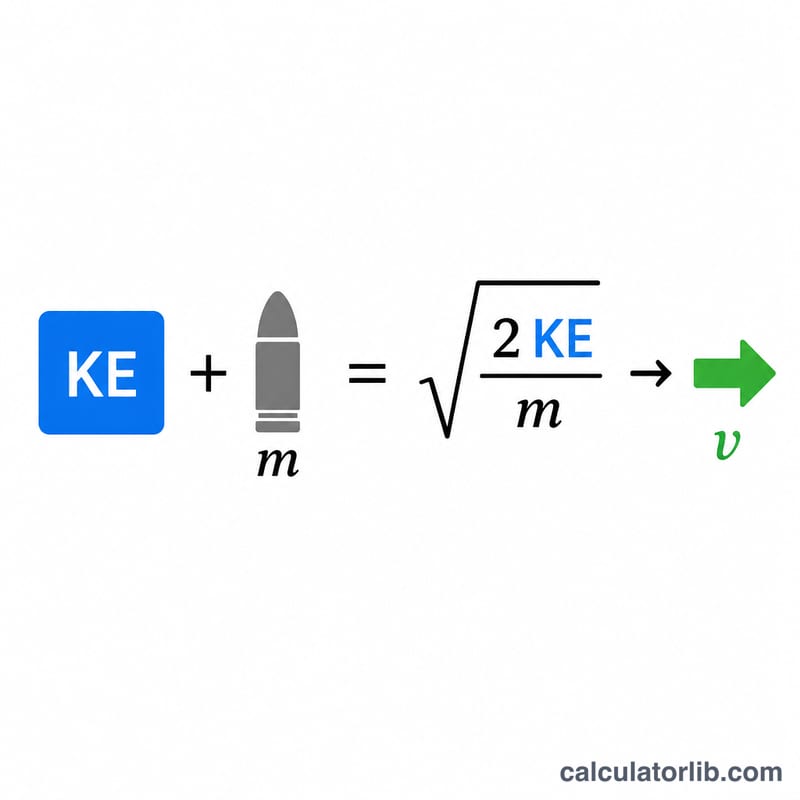
Muzzle velocity is the speed of a projectile the moment it leaves the barrel of a firearm or launcher. It directly affects range, trajectory, and impact energy. When you know the kinetic energy delivered to a projectile and its mass, you can solve for the velocity using the rearranged kinetic energy equation. This calculator is universal — it works for any object in any consistent unit system, but the inputs here use SI units (Joules and kilograms).
How to Use the Calculator
Enter the kinetic energy in Joules and the projectile mass in kilograms, then read the muzzle velocity in meters per second. A second value converts the result to feet per second (ft/s), the unit most commonly quoted in ballistics. Remember that bullet masses are tiny — a typical bullet weighing 10 grams is 0.01 kg.
The Formula Explained
Kinetic energy is defined as \(KE = \tfrac{1}{2} m v^2\). Solving for velocity gives $$v = \sqrt{\dfrac{2 \cdot \text{KE}}{m}}$$ The factor of 2 cancels the one-half in the kinetic energy term, and dividing by mass isolates \(v^2\). Taking the square root yields the velocity. Because velocity scales with the square root of energy, doubling the energy increases speed by only about 41%.
Worked Example
Suppose a 0.01 kg (10 g) bullet carries 2000 J of kinetic energy. Then $$v = \sqrt{\frac{2 \times 2000}{0.01}} = \sqrt{400{,}000} \approx 632.46 \text{ m/s},$$ or about 2,074.9 ft/s. That is a typical figure for a pistol or rifle cartridge.
FAQ
What units should I use? Use Joules for energy and kilograms for mass to get velocity in meters per second.
How do I convert grams to kilograms? Divide grams by 1000 — so a 124-grain (8 g) bullet is 0.008 kg.
Why is the result in both m/s and ft/s? Ballistics data is often published in feet per second, so we provide both for convenience (1 m/s ≈ 3.2808 ft/s).