
What Is the Projectile Range Calculator?
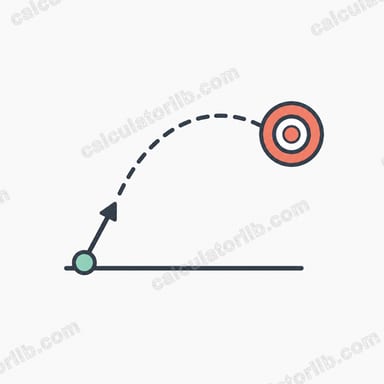
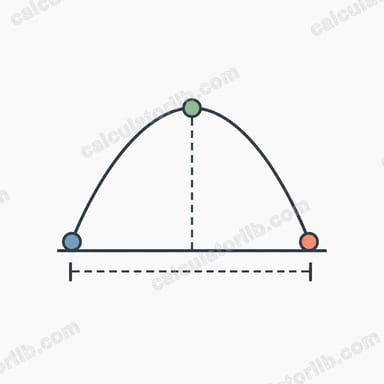
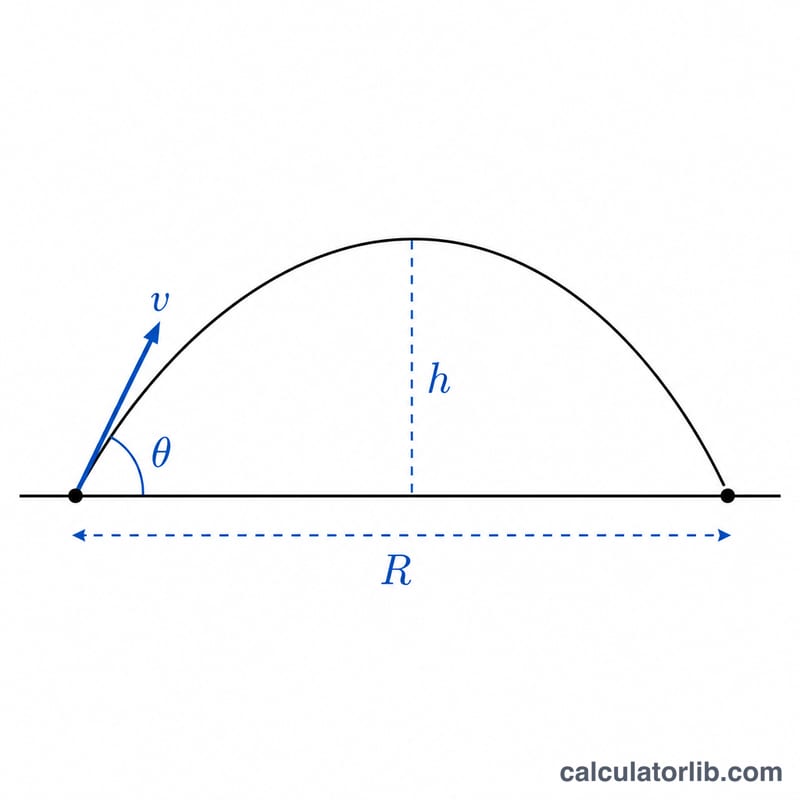
This calculator finds how far a projectile travels horizontally when launched from level ground. Given an initial speed, a launch angle, and the gravitational acceleration, it returns the horizontal range, the maximum height reached, and the total time the projectile spends in the air. It assumes no air resistance and that launch and landing occur at the same height.
How to Use It
Enter the initial velocity in meters per second, the launch angle in degrees (0–90), and the gravitational acceleration (9.81 m/s² on Earth, 1.62 on the Moon, 3.71 on Mars). The calculator instantly computes the trajectory metrics. For maximum range on flat ground, use a 45° angle.
The Formula Explained
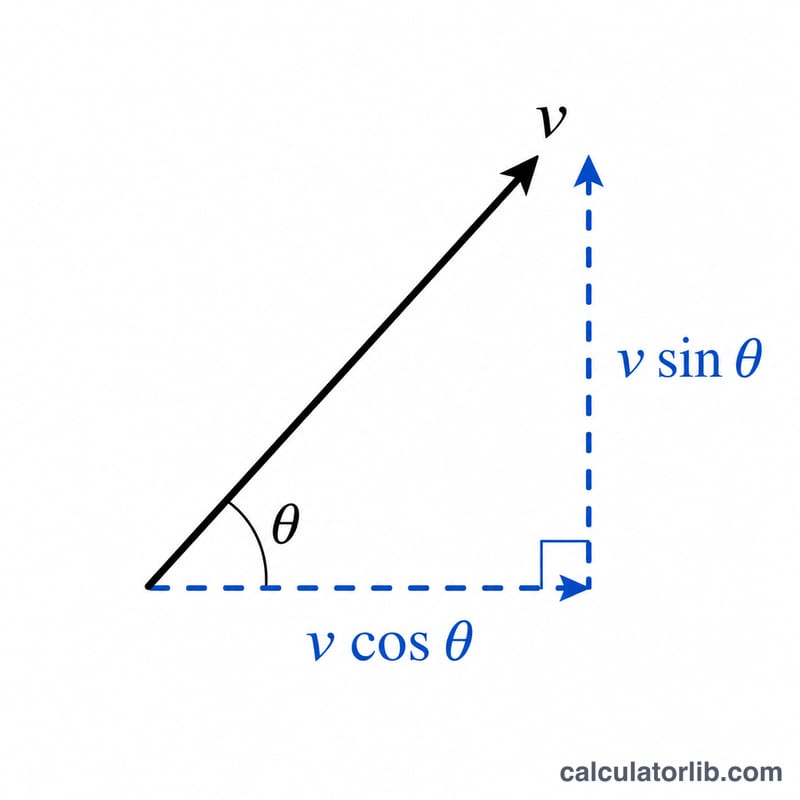
The horizontal range is $$R = \frac{v^{2} \cdot \sin(2\theta)}{g}$$ where \(v\) is the launch speed, \(\theta\) is the angle, and \(g\) is gravity. The factor \(\sin(2\theta)\) is largest at \(\theta = 45^\circ\), which is why that angle gives the greatest distance. Maximum height is $$H = \frac{v^{2} \cdot \sin^{2}(\theta)}{2g}$$ and time of flight is $$T = \frac{2v \cdot \sin(\theta)}{g}$$
Worked Example
Launch a ball at 20 m/s and 45° on Earth (\(g = 9.81\)). Then \(\sin(90^\circ) = 1\), so $$R = \frac{20^{2} \cdot 1}{9.81} = \frac{400}{9.81} \approx 40.77 \text{ m}$$ Max height $$H = \frac{400 \cdot \sin^{2}(45^\circ)}{2 \cdot 9.81} = \frac{400 \cdot 0.5}{19.62} \approx 10.19 \text{ m}$$ Time of flight $$T = \frac{2 \cdot 20 \cdot \sin(45^\circ)}{9.81} \approx 2.88 \text{ s}$$
FAQ
What angle gives the longest range? On level ground with no air resistance, 45° maximizes range.
Does this account for air resistance? No. It uses the idealized vacuum trajectory, which is accurate for slow or dense objects but overestimates range for light, fast ones.
Can I use it for other planets? Yes — just change the gravity value to match the body (e.g., 1.62 m/s² for the Moon).