
What Is the Quarter Mile Calculator?
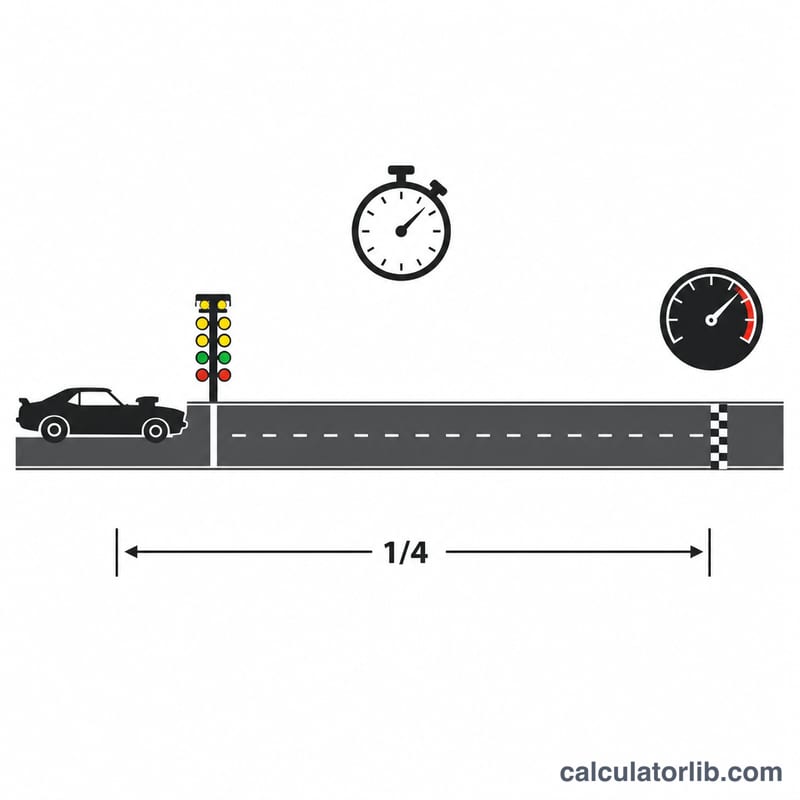
The quarter mile calculator estimates how fast a vehicle will cover a standard 1320-foot drag strip. It returns two key numbers: the elapsed time (ET) in seconds and the trap speed in mph at the finish line. Both estimates come from just two inputs — the vehicle's weight in pounds and its engine power in horsepower.
How to Use It
Enter your vehicle's total race weight (including driver and fuel) in pounds, then enter peak engine power at the wheels or crank in horsepower. The calculator instantly returns the predicted ET and trap speed. Lighter cars and more powerful engines produce quicker times and higher speeds.
The Formula Explained
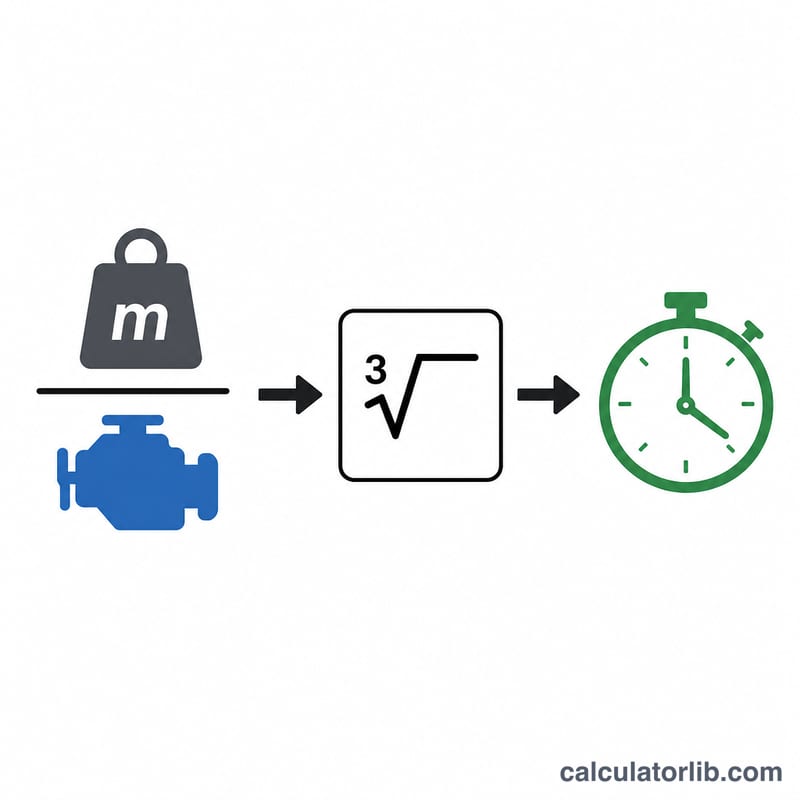
These estimates use the well-known empirical relationships popularized by Geoffrey Hale. ET scales with the cube root of the weight-to-power ratio, while trap speed scales with the cube root of the power-to-weight ratio:
$$\text{ET} = 5.825 \times \sqrt[3]{\dfrac{\text{Weight (lbs)}}{\text{Power (hp)}}}$$
$$\text{Trap} = 234 \times \sqrt[3]{\dfrac{\text{Power (hp)}}{\text{Weight (lbs)}}}$$
The cube-root relationship reflects how power and aerodynamic/rolling losses combine over the distance.
Worked Example
For a 3000 lb car with 300 hp: weight/power = 10, so $$\text{ET} = 5.825 \times 10^{1/3} = 5.825 \times 2.15443 \approx 12.55 \text{ seconds.}$$ Trap speed $$= 234 \times \left(\frac{300}{3000}\right)^{1/3} = 234 \times 0.1^{1/3} = 234 \times 0.46416 \approx 108.63 \text{ mph.}$$
FAQ
Is this exact? No — it's an estimate. Traction, gearing, aerodynamics, and driver skill all affect real results, often by a few tenths of a second.
Crank or wheel horsepower? The formula was calibrated using flywheel (crank) horsepower, but many enthusiasts use it with wheel hp for a more conservative estimate.
What weight should I use? Use the total weight at the line, including the driver and a typical amount of fuel.