
What Is Cost Per Mile (CPM)?
Cost per mile is the single most important number for any trucking operation. It tells you exactly how much it costs to run your truck for every mile you drive. Once you know your CPM, you can set freight rates that actually turn a profit, evaluate loads, and spot expenses that are eating into your margins.
How to Use This Calculator
Enter your monthly fixed costs (truck payment, insurance, permits, licenses — costs that stay the same regardless of miles), your monthly variable costs (fuel, tires, maintenance, tolls, driver pay — costs that rise with miles), and the total miles you drive in that month. The calculator divides total costs by total miles to give your cost per mile, plus a breakdown of the fixed and variable portions.
The Formula Explained
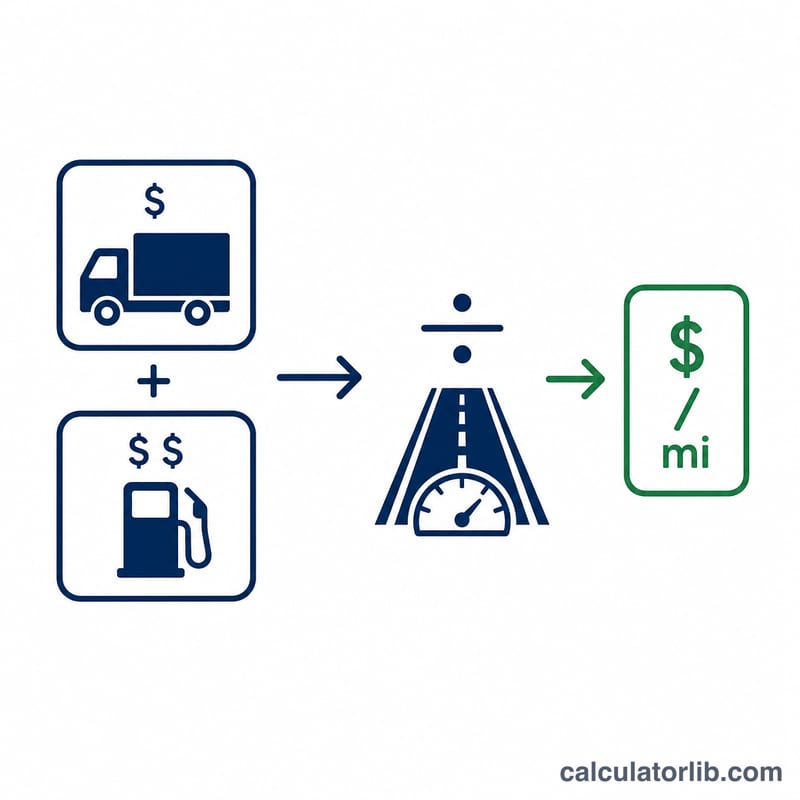
The math is straightforward: $$\text{CPM} = \dfrac{\text{Fixed Costs} + \text{Variable Costs}}{\text{Total Miles}}$$ Fixed costs spread across more miles produce a lower per-mile figure, which is why empty (deadhead) miles hurt so much — you still pay fixed costs but earn nothing for them.
Worked Example
Suppose your truck has $6,000 in monthly fixed costs and $8,000 in variable costs, and you drive 10,000 miles. Total cost is $14,000. Divide by 10,000 miles and your CPM is $1.40 per mile:
$$\text{CPM} = \dfrac{\$6{,}000 + \$8{,}000}{10{,}000} = \dfrac{\$14{,}000}{10{,}000} = \$1.40 \text{ per mile}$$To profit, you must earn more than \(\$1.40\) per loaded mile after accounting for empty miles.
FAQ
What counts as a fixed cost? Truck and trailer payments, insurance, registration, permits, and any cost that does not change with the miles you drive.
What counts as a variable cost? Fuel, tires, repairs, maintenance, tolls, and per-mile driver wages — anything that grows as you drive more.
Why is my CPM higher than expected? Low mileage spreads fixed costs over fewer miles, raising CPM. Driving more miles or cutting empty miles lowers it.