
What This Calculator Does
This Quick Manual J calculator gives a fast, ballpark estimate of the heating and cooling load for a home or room, expressed in BTU per hour (BTU/hr). It is a simplified rule-of-thumb tool inspired by the ACCA Manual J methodology used in the United States. A full Manual J load calculation accounts for insulation R-values, duct losses, infiltration, orientation, and local design temperatures — this version uses a streamlined approach so you can size a system quickly before consulting an HVAC professional.
How to Use It
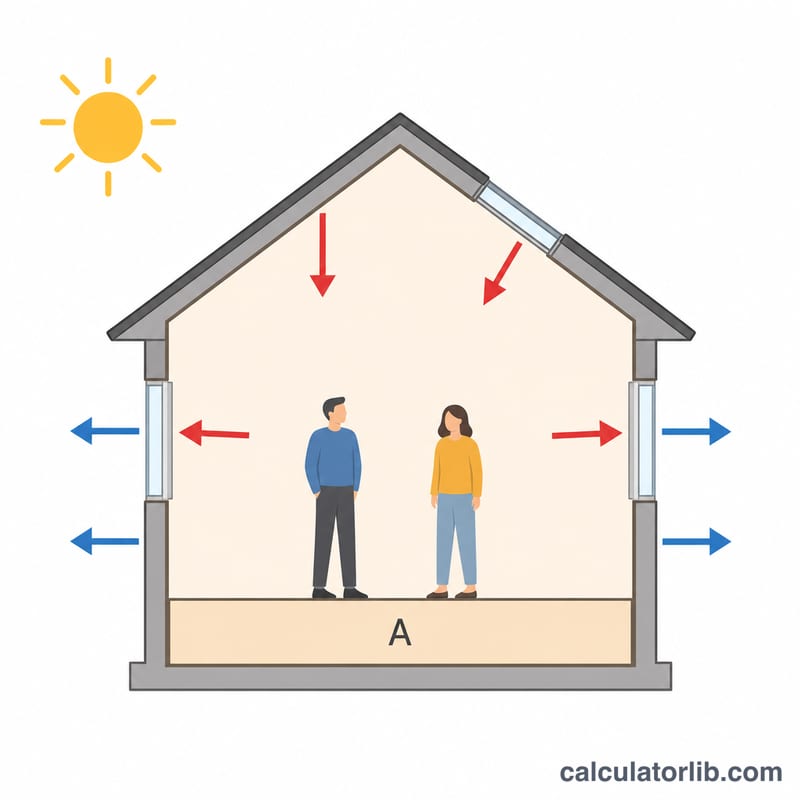
Enter the conditioned floor area in square feet, select the climate severity that best matches your region, then add the number of windows and the typical number of occupants. The calculator multiplies area by a climate factor, then adds heat gain from windows (roughly 1,000 BTU/hr each) and occupants (about 600 BTU/hr per person). The total is shown in BTU/hr and converted to "tons" of capacity (1 ton = 12,000 BTU/hr) to help you compare against equipment ratings.
The Formula Explained
The model is: $$\text{BTU} = (\text{Area} \times \text{Climate factor}) + (\text{Windows} \times 1000) + (\text{Occupants} \times 600)$$. The climate factor ranges from about 20 BTU/sq ft in mild coastal zones up to 50 BTU/sq ft in very extreme desert or far-north climates. Windows are significant sources of solar gain and conductive loss, and each person adds metabolic heat, so both are added on top of the base envelope load.
Worked Example
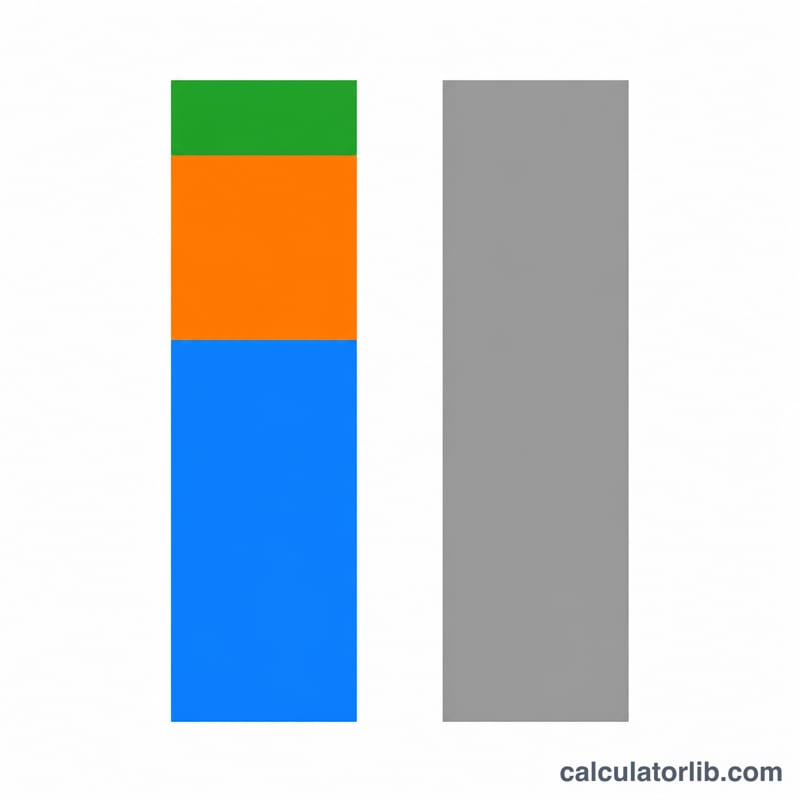
A 1,500 sq ft home in a moderate climate (factor 30) with 10 windows and 3 occupants: base load = \(1500 \times 30 = 45{,}000\) BTU/hr; window load = \(10 \times 1000 = 10{,}000\) BTU/hr; occupant load = \(3 \times 600 = 1{,}800\) BTU/hr. Total = 56,800 BTU/hr, or about 4.73 tons.
$$\text{Tons} = \frac{56{,}800}{12000} \approx 4.73$$FAQ
Is this a substitute for a real Manual J? No. Use it for early planning only; a certified contractor should run a full Manual J before buying equipment.
What does "tons" mean? It is a unit of HVAC capacity equal to 12,000 BTU/hr — historically the cooling power of melting one ton of ice per day.
Does this apply outside the US? The climate factors and BTU/ton conventions follow US/ACCA practice. Other regions often use kW (1 kW ≈ 3,412 BTU/hr).