
What is the Lux to Lumens Calculator?
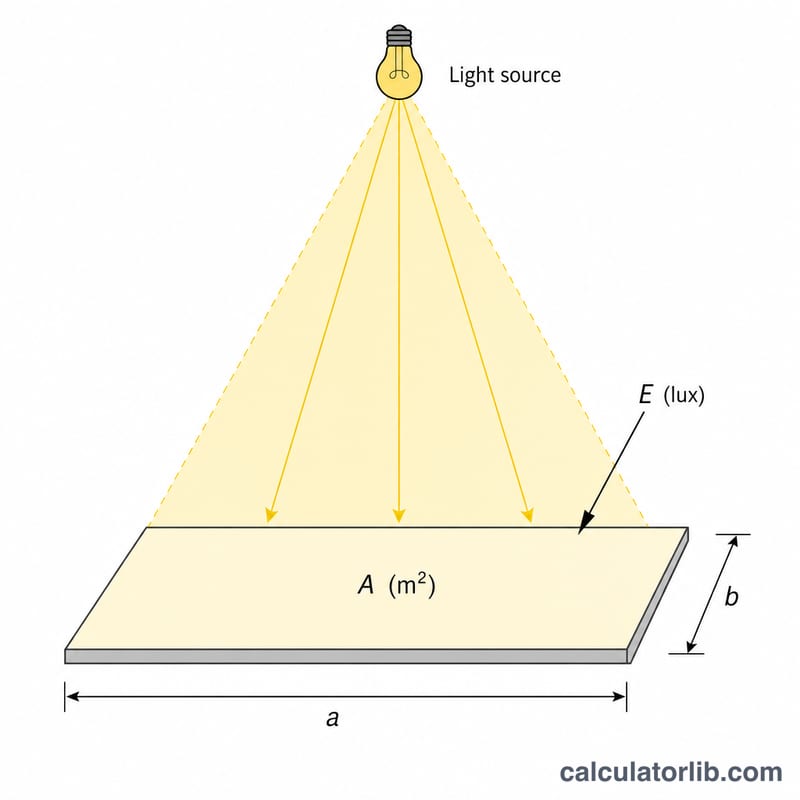
This tool converts illuminance measured in lux (lx) into luminous flux measured in lumens (lm). Lux tells you how much light lands on a surface per square metre, while lumens describe the total amount of visible light emitted. Because one lux equals one lumen per square metre, you simply multiply the lux value by the area being lit to recover the total lumens.
How to use it
Enter the illuminance reading in lux. Then choose how to define the lit surface: enter the area directly in square metres, or pick the circle option and supply a diameter so the calculator works out the area for you. The result is the total luminous flux in lumens, along with the area used.
The formula explained
The core relationship is $$\text{Lumens} = \text{Lux} \times \text{Area}_{m^2}$$ Lux is defined as lumens per square metre, so rearranging gives lumens by multiplying back by the area. For a circular surface defined by diameter \(d\), the area is \(A = \pi \left(\tfrac{d}{2}\right)^2\), which is then multiplied by the lux value.
Worked example
Suppose a desk lamp produces 500 lux across a 10 m² area. The luminous flux is $$500 \times 10 = 5{,}000 \text{ lumens}$$ If instead you light a circular table of 2 m diameter at 300 lux, the area is \(\pi \times 1^2 \approx 3.1416 \text{ m}^2\), so the flux is $$300 \times 3.1416 \approx 942.5 \text{ lumens}$$
FAQ
Is this an exact conversion? Lux and lumens are directly related through area, so the math is exact — but real-world readings vary with distance and light distribution.
Why do I need the area? Lux already includes area in its definition (lm/m²), so you must know the lit surface to find total lumens.
Can I use square feet? This calculator uses square metres. Convert feet to metres first (1 ft² ≈ 0.0929 m²).