
What is the Candela to Lumens Calculator?
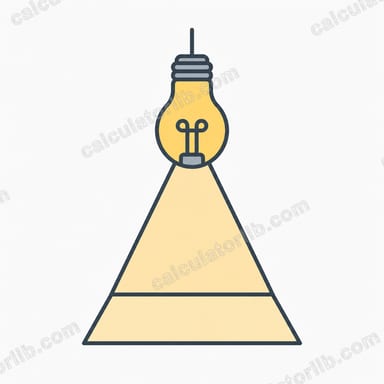
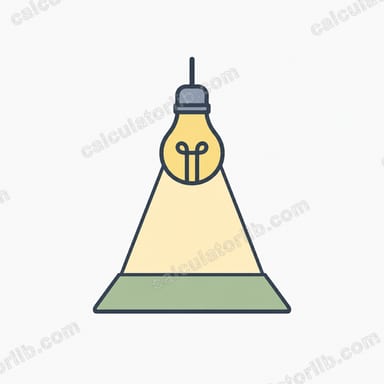
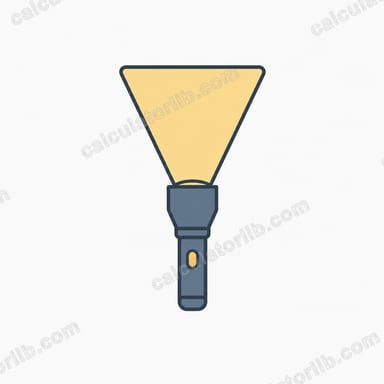
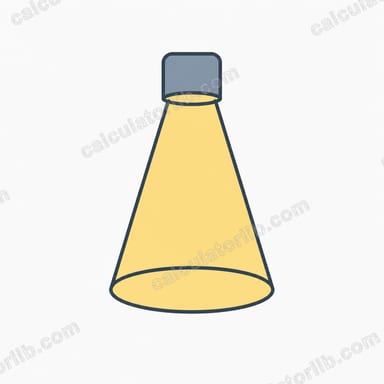
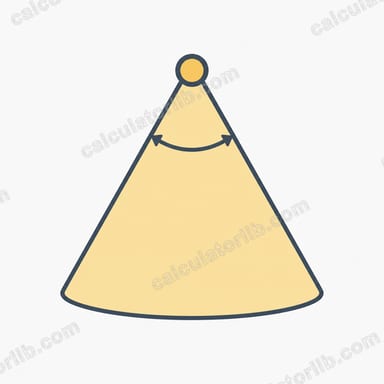
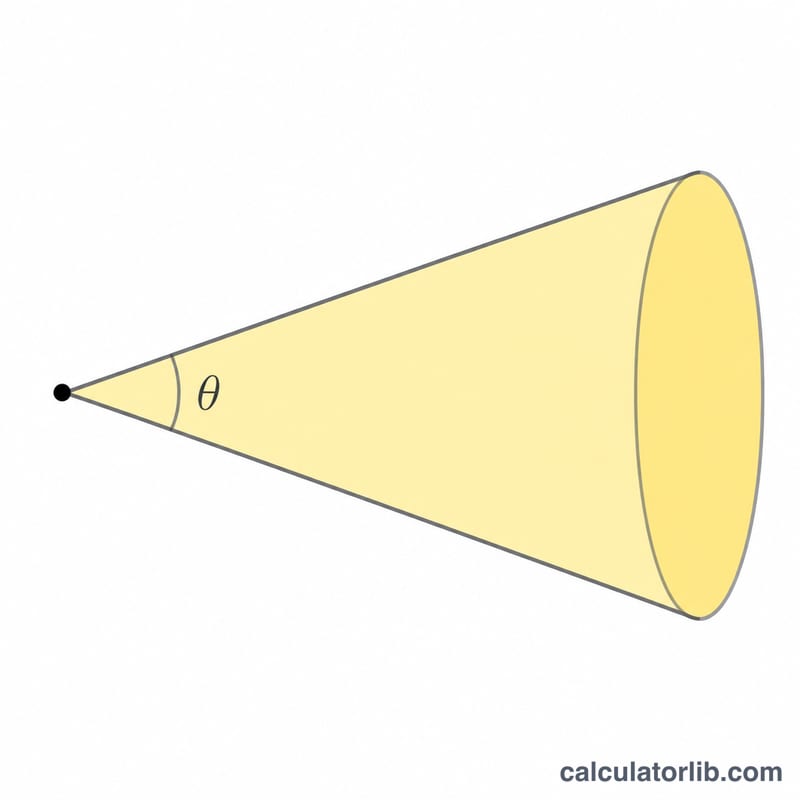
This tool converts luminous intensity, measured in candela (cd), into luminous flux, measured in lumens (lm). Candela describes how bright a light source appears in a particular direction, while lumens describe the total amount of visible light emitted within a beam. The conversion depends on the beam's apex angle — the full cone angle over which the light is concentrated.
How to use it
Enter the luminous intensity in candela and the apex angle of the beam in degrees. The calculator returns the equivalent luminous flux in lumens along with the solid angle of the cone in steradians. A narrow spotlight has a small apex angle and concentrates its lumens, while a wide floodlight spreads the same lumens over a larger angle.
The formula explained
The relationship is \(\Phi_V = I_V \times \Omega\), where \(\Omega\) is the solid angle of the beam cone. For a cone of apex angle \(\theta\), the solid angle in steradians is
$$\Omega = 2\pi\left(1 - \cos\!\left(\frac{\theta}{2}\right)\right)$$Because \(\theta\) is given in degrees, it is converted to radians before taking the cosine.
Worked example
For 1000 cd at an apex angle of 30°: half the apex angle is 15°, which is 0.261799 rad. \(\cos(15°) \approx 0.965926\). So
$$\Omega = 2\pi(1 - 0.965926) \approx 0.214094 \text{ sr}$$Multiplying by 1000 cd gives
$$1000 \times 0.214094 \approx 214.09 \text{ lumens}$$FAQ
Why do I need the apex angle? Candela is per-steradian intensity, so converting to total lumens requires knowing over how wide a cone the light is emitted.
What apex angle gives an isotropic (all-directions) source? 360°, which yields the full sphere of \(4\pi \approx 12.566\) sr, so \(\text{lumens} = \text{candela} \times 4\pi\).
Are these photometric, not radiometric, units? Yes — candela and lumens are both weighted by the human eye's sensitivity, so no separate luminous efficacy factor is needed.