
What Is the PPFD to DLI Calculator?
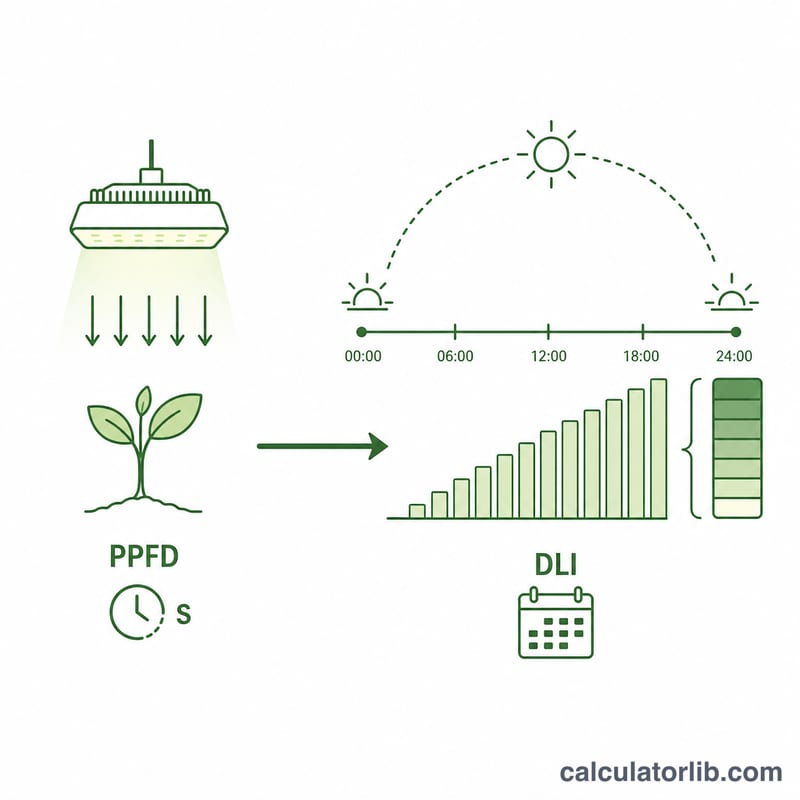
This calculator converts PPFD (Photosynthetic Photon Flux Density, measured in µmol/m²/s) into DLI (Daily Light Integral, in mol/m²/day). PPFD tells you how many photosynthetically useful photons land on a square meter every second, while DLI tells you the total photon dose your plants receive over a full day. DLI is the single most useful number for matching a grow light to a crop's needs.
How to Use It
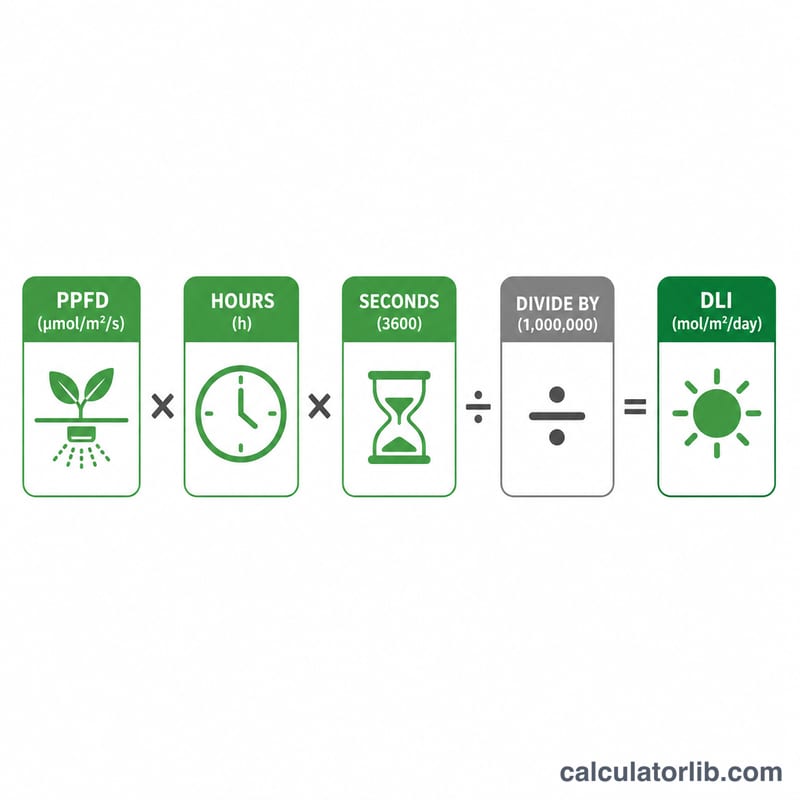
Enter the PPFD measured at the canopy (from a quantum meter or your light's datasheet) and the number of hours per day the light is on (the photoperiod). The calculator multiplies the per-second photon rate by the number of seconds in your photoperiod and converts micromoles to moles.
The Formula Explained
$$\text{DLI} = \frac{\text{PPFD} \times \text{Photoperiod} \times 3600}{1{,}000{,}000}$$ The 3600 converts hours to seconds (so PPFD's per-second rate becomes a per-day total over the photoperiod), and dividing by 1,000,000 converts micromoles (µmol) to moles (mol).
Worked Example
Suppose your light delivers 400 µmol/m²/s at the canopy and runs for 16 hours a day. $$\text{DLI} = \frac{400 \times 16 \times 3600}{1{,}000{,}000} = \frac{23{,}040{,}000}{1{,}000{,}000} = \textbf{23.04 mol/m}^2\textbf{/day}$$ — a solid target for many flowering vegetables.
FAQ
What DLI do my plants need? Leafy greens thrive around 12–17, tomatoes and peppers prefer 20–30, and cannabis flowering often targets 30–45 mol/m²/day. Always check crop-specific recommendations.
Is PPFD the same as lux? No. Lux is weighted to human vision; PPFD counts photons in the 400–700 nm photosynthetic range. Use a quantum (PAR) meter, not a lux meter.
Can the photoperiod exceed 24 hours? No — a day has 24 hours, so the photoperiod is capped at 24. Many crops also need a dark period to grow well.