
What is the Light Bulb Energy Cost Calculator?
This tool estimates how much electricity a light bulb consumes and what that costs over a day, month and year. Just enter the bulb's wattage, how many hours it runs each day, your electricity price per kilowatt-hour (kWh), and the number of identical bulbs. The calculator works with any currency and any region — simply use the price your utility charges per kWh.
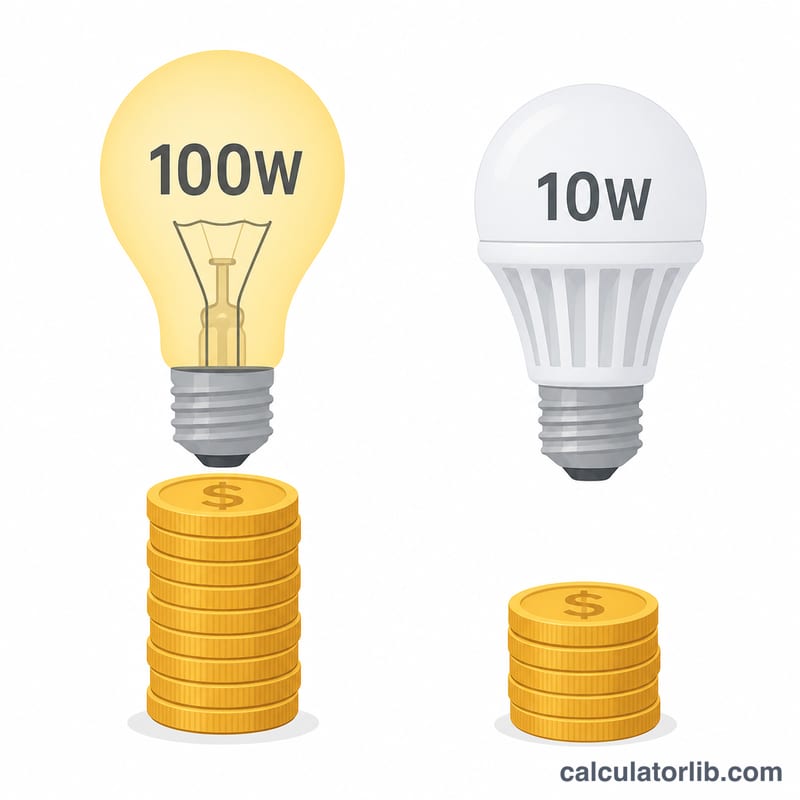
How to use it
Find the bulb's wattage printed on the bulb or its packaging (e.g. 60 W for an incandescent, 9 W for an equivalent LED). Estimate the average hours it is switched on per day. Enter your electricity rate — this appears on your utility bill, often around 0.10–0.35 per kWh depending on your country. Add the bulb count to model a whole room or fixture at once.
The formula explained
Electricity is billed in kilowatt-hours. A watt is one-thousandth of a kilowatt, so we divide the wattage by 1000 to get kilowatts. Multiplying by the hours per day gives kilowatt-hours used each day. Multiplying that by 365 gives the yearly energy, and multiplying by the price per kWh gives the yearly cost: annual_cost = watts/1000 × hours_per_day × 365 × price_per_kWh.
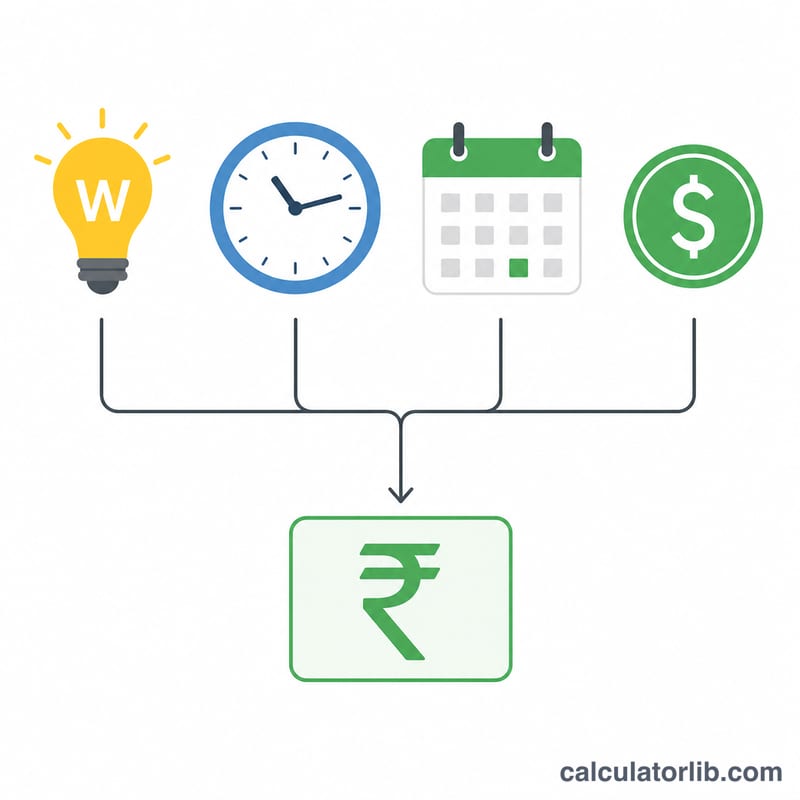
Worked example
A 60 W bulb runs 5 hours a day at a price of 0.15 per kWh. Daily energy = 60 / 1000 × 5 = 0.3 kWh, costing 0.3 × 0.15 = 0.045 per day. Over a year: 0.3 × 365 = 109.5 kWh, costing 109.5 × 0.15 = 16.43 per year for one bulb.
Typical Wattages by Bulb Type
Different lighting technologies produce roughly the same amount of visible light (measured in lumens) while drawing very different amounts of electrical power. The table below shows approximate wattages needed to reach a given brightness, grouped by the familiar "incandescent-equivalent" rating. Light output is what your eyes see; wattage is what your meter charges you for.
| Brightness (lumens, approx.) | Incandescent | Halogen | CFL | LED |
|---|---|---|---|---|
| ~450 lm (40 W-equiv.) | 40 W | 28–29 W | 9–11 W | 5–7 W |
| ~800 lm (60 W-equiv.) | 60 W | 42–43 W | 13–15 W | 8–10 W |
| ~1100 lm (75 W-equiv.) | 75 W | 53 W | 18–20 W | 11–13 W |
| ~1600 lm (100 W-equiv.) | 100 W | 72 W | 23–26 W | 14–18 W |
| ~2600 lm (150 W-equiv.) | 150 W | 105 W | 30–42 W | 22–28 W |
As a quick rule of thumb, a 60 W incandescent bulb (\(\approx 800\) lumens) can be replaced by an LED drawing only about 9 W — roughly one-seventh of the power for the same brightness. Efficacy ranges from about 15 lm/W for incandescent up to 80–100+ lm/W for modern LEDs, which is why LED running costs are so much lower.
Cost Comparison Across Common Scenarios
The annual cost of a single bulb is \(\frac{\text{Watts}}{1000} \times \text{Hours/Day} \times 365 \times \text{Price/kWh}\). The table compares a 60 W incandescent against its 9 W LED equivalent at an electricity price of $0.15/kWh, for different daily usage. Savings are the difference between the two annual figures (one bulb).
| Hours/Day | 60 W Incandescent (annual) | 9 W LED (annual) | Annual Savings |
|---|---|---|---|
| 2 h | $6.57 | $0.99 | $5.58 |
| 4 h | $13.14 | $1.97 | $11.17 |
| 8 h | $26.28 | $3.94 | $22.34 |
| 12 h | $39.42 | $5.91 | $33.51 |
For example, at 4 hours per day the incandescent bulb costs about \(\frac{60}{1000} \times 4 \times 365 \times 0.15 = \$13.14\) per year, while the LED costs only \(\frac{9}{1000} \times 4 \times 365 \times 0.15 = \$1.97\) — a saving of $11.17 from one bulb. Across a whole home with 20+ fixtures the savings multiply quickly; to model an entire bulb swap, see an LED vs incandescent savings calculator.
FAQ
Why switch to LED bulbs? An LED that produces the same light as a 60 W incandescent typically draws 8–10 W, cutting its running cost by roughly 85%.
Does this include the cost of buying the bulb? No — it only estimates the electricity (running) cost. Add purchase price separately for a full cost comparison.
What if my bulb isn't on every day? Use an average. For example, a bulb on 7 hours a day for 4 days a week averages 4 hours per day.