What This Calculator Does
The Credit Card Points Value Calculator turns abstract loyalty points or airline miles into a real dollar figure. Rewards programs rarely show you the cash value of your balance, and the worth of a single point can swing widely depending on how you redeem it — anywhere from 0.5¢ for gift cards to 2¢ or more for premium travel. This tool gives you a clear, comparable number.
How to Use It
Enter the number of points or miles you have earned, the value you assign to each point in cents (your redemption valuation), and optionally the total amount you spent to earn those points. The calculator returns the cash value of your rewards and, if you provide spend, your effective reward rate as a percentage.
The Formula Explained
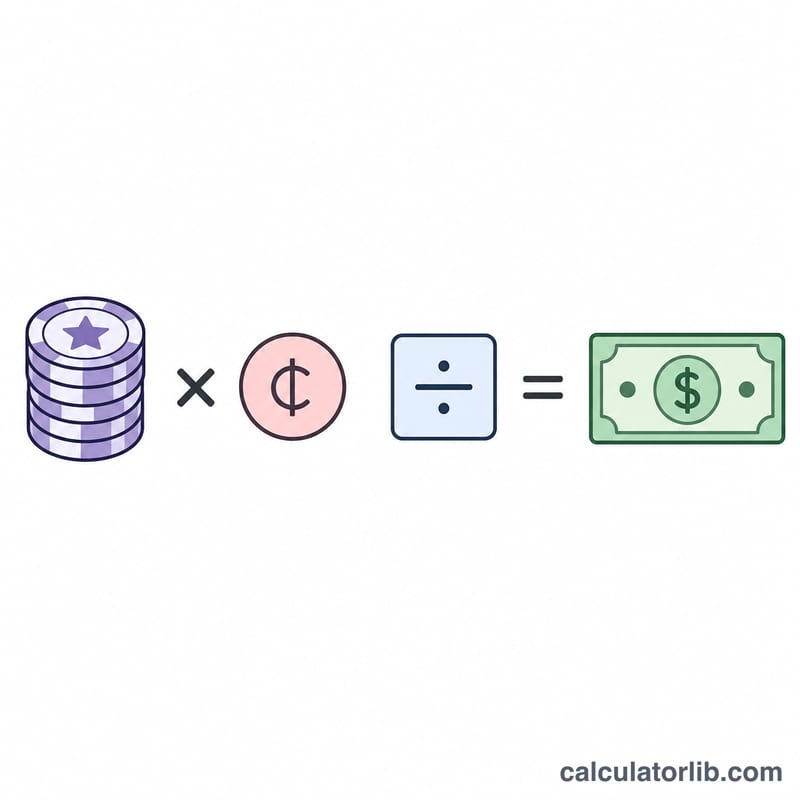
Cash value is simply points × cents per point ÷ 100, because there are 100 cents in a dollar. The effective reward rate divides that cash value by your total spend and multiplies by 100 to express it as a percentage — a quick way to compare cards and redemption strategies.
$$\text{Cash Value} = \frac{\text{Points / Miles} \times \text{Value per Point (cents)}}{100}$$
$$\text{Reward Rate} = \frac{\dfrac{\text{Points} \times \text{Value (cents)}}{100}}{\text{Total Spend (\$)}} \times 100\%$$
Worked Example
Suppose you have 50,000 points and value each at 1.5¢. Cash value = $$50{,}000 \times 1.5 \div 100 = \mathbf{\$750}$$. If you spent $5,000 to earn those points, the effective reward rate = $$750 \div 5{,}000 \times 100 = \mathbf{15\%}$$ (note that high rate reflects a sign-up bonus, not ongoing earning).
Typical Point Values by Program and Redemption Type
The calculator needs one number you supply yourself: the value per point in cents (the cents per point, or CPP). The table below collects the ranges that are commonly published by third-party valuation sources (travel-rewards publishers and personal-finance sites) for the major US-issued card programs. They are estimates of what a point tends to be worth when redeemed well — they are not posted exchange rates, and no issuer guarantees them.
| Redemption type | Typical value per point | Notes |
|---|---|---|
| Cash back / statement credit | 1.0¢ | The baseline for most transferable-points programs; fixed and always available. |
| Gift cards | 0.5–1.0¢ | Often below the cash-back rate; varies by merchant and promotion. |
| Shopping portal / "pay with points" at checkout | 0.7–1.0¢ | Usually the weakest common option. |
| Issuer travel portal booking | 1.0–1.25¢ | Some premium cards add a bonus (e.g. 1.25¢ or 1.5¢ per point) on portal bookings. |
| Transfer-partner airline / hotel awards | 1.3–2.0¢+ | Highest potential value, but entirely dependent on award availability. |
Transferable bank points (US programs)
| Program | Commonly cited range | Notes |
|---|---|---|
| Chase Ultimate Rewards | 1.0–2.0¢ | 1.0¢ floor as cash back; upper end requires airline/hotel transfers. |
| American Express Membership Rewards | 1.0–2.0¢ | Cash-out options typically value points below 1.0¢; transfers drive the top end. |
| Citi ThankYou Points | 1.0–1.8¢ | Value concentrated in airline transfer partners. |
| Capital One miles | 1.0–1.85¢ | Fixed 1.0¢ toward travel/cash; more via transfer partners. |
Airline miles
| Program | Commonly cited range |
|---|---|
| United MileagePlus | 1.1–1.4¢ |
| Delta SkyMiles | 1.0–1.3¢ |
| American AAdvantage | 1.2–1.5¢ |
Hotel points
| Program | Commonly cited range | Notes |
|---|---|---|
| Marriott Bonvoy | 0.6–0.9¢ | Dynamic award pricing; well under 1¢ in most redemptions. |
| Hilton Honors | 0.4–0.6¢ | Large point balances, low per-point value. |
| World of Hyatt | 1.5–2.0¢ | The usual exception — award charts keep per-point value high. |
Two cautions. First, hotel points other than Hyatt's generally sit well below 1¢, so a 100,000-point balance is often worth less than a 60,000-point bank-points balance. Second, every figure above is a published third-party valuation that shifts with award availability, cash prices on the date you book, dynamic award pricing, and program devaluations. The ranges also describe US-market programs and US-issued cards; co-branded and bank programs in other countries have their own redemption charts and values. Wherever possible, enter your own observed value — the cash price of the thing you actually redeemed for, divided by the points you spent — rather than a published average.
How Point Value Changes Across Redemption Scenarios
Both outputs follow directly from the inputs:
$$\text{Cash Value} = \frac{\text{Points} \times \text{Cents per Point}}{100} \qquad \text{Effective Reward Rate} = \frac{\text{Cash Value}}{\text{Total Spend}} \times 100\%$$Holding points and spend fixed, varying the redemption rate
Assume 60,000 points earned on $6,000 of spend — the shape of a typical welcome-bonus offer, where the bonus itself dominates the earn rate.
| Value per point | Redemption style | Cash value of 60,000 points | Effective reward rate on $6,000 |
|---|---|---|---|
| 0.5¢ | Weak gift-card redemption | $300.00 | 5.00% |
| 1.0¢ | Cash back / statement credit | $600.00 | 10.00% |
| 1.25¢ | Travel portal with bonus | $750.00 | 12.50% |
| 1.5¢ | Good transfer-partner award | $900.00 | 15.00% |
| 2.0¢ | Premium-cabin or Hyatt award | $1,200.00 | 20.00% |
Worked substitution for the 1.5¢ row:
$$\text{Cash Value} = \frac{60{,}000 \times 1.5}{100} = \frac{90{,}000}{100} = \$900 \qquad \text{Rate} = \frac{900}{6{,}000} \times 100\% = 15.00\%$$The spread is the whole point: the same 60,000-point balance is worth four times as much at 2.0¢ as at 0.5¢. Choosing the redemption, not earning the points, is what moves this number.
Holding points and rate fixed, varying the spend
Now fix 60,000 points at 1.5¢ per point. The cash value cannot change — it does not depend on spend at all — but the reward rate does.
| Total spend | Cash value | Effective reward rate |
|---|---|---|
| $3,000 | $900.00 | 30.00% |
| $6,000 | $900.00 | 15.00% |
| $20,000 | $900.00 | 4.50% |
Reward rate and spend move inversely: doubling the spend behind the same point balance halves the rate. A headline rate above roughly 5% almost always means a lump-sum bonus is being divided by a small amount of spend. To measure the card's ongoing earn rate instead, enter only the points earned from purchases and the spend that produced them, leaving the welcome bonus out.
Interpreting Your Result
The cash value is a valuation, not a balance. It answers "what would these points be worth if I could redeem them at the rate I entered?" It does not mean the points are convertible into that many dollars. A 2.0¢ valuation only materialises if an award seat or hotel night at that price is actually bookable for your dates — otherwise the realistic value falls back toward the program's fixed floor (often 1.0¢ or less). The same calculation at a rate you have personally achieved is far more reliable than one at a published average.
The effective reward rate is dollars of value returned per dollar spent, expressed as a percentage. Useful reference points for US cards:
- 1–2% — typical flat-rate cash-back and simple points cards on unbonused spend.
- 3–5% — common bonus categories (dining, groceries, travel, gas), often with quarterly or annual caps.
- Above 5% — almost always a welcome bonus amortized over a limited minimum-spend requirement, or an unusually high transfer-partner valuation. It is a one-time figure, not a repeatable earn rate.
Several factual caveats change the real number, and this calculator does not model any of them:
- Annual fees are not subtracted. A $900 valuation on a card with a $395 annual fee nets about $505 in the first year. Subtract fees yourself before comparing cards.
- Points can be devalued at any time. Issuers and loyalty programs change award pricing, transfer ratios and partner lists without advance notice and without compensation. Dynamic award pricing means there may be no published chart to rely on at all.
- There is generally no cash-out guarantee. Many airline and hotel points cannot be converted to cash at any rate; transferred points usually cannot be transferred back. Points held are an unsecured claim on a program, not money.
- Expiration and forfeiture. Some programs expire points after a period of account inactivity, and balances are commonly forfeited if the account is closed or falls out of good standing.
- US tax treatment. In the United States, rewards earned by spending on a card are generally treated as a purchase rebate rather than taxable income. Bonuses received without a spending requirement — for example, some account-opening or referral payments — may be treated differently and reported on a tax form. Rules differ in other countries, and this is a general description, not a tax determination for your situation.
Finally, a higher valuation is not automatically a better outcome. Valuing points at 2.0¢ by booking a premium-cabin flight you would never have paid cash for inflates the figure without saving you 2.0¢ per point in real money; a 1.0¢ statement credit against a bill you were going to pay anyway is worth exactly 1.0¢. Ask what you would otherwise have spent in cash.
This output is a descriptive valuation of a point balance, provided for general information only. It is not financial advice and not a recommendation about any card, program or redemption. Consider consulting a qualified professional about decisions specific to your circumstances.
FAQ
What cents-per-point value should I use? Use the value you actually get on redemption. Many transferable-points programs are worth roughly 1–2¢; cash-back is typically 1¢.
Why is my reward rate so high? If you include a large welcome bonus while only counting modest spend, the rate is inflated. For ongoing earning, exclude bonuses.
Do I have to enter spend? No. Leave it blank or zero and you'll still get the cash value; the reward rate will show as 0%.