
What is the Credit Card Payoff Time Calculator?
This calculator tells you how many months it will take to clear a credit card balance if you make the same fixed payment every month. It also shows the total amount you will pay and the total interest, so you can see the real cost of carrying a balance.
How to use it
Enter your current balance, the card's APR (annual percentage rate), and the fixed amount you plan to pay each month. The calculator returns the number of months to reach a zero balance, the equivalent in years, and the cumulative interest. If your payment is too small to cover even one month of interest, the balance would never be repaid — the tool warns you instead of returning a number.
The formula explained
The payoff time is derived from the standard loan amortization equation:
$$n = \left\lceil \frac{-\ln\!\left(1 - \dfrac{B \cdot i}{P}\right)}{\ln(1 + i)} \right\rceil$$
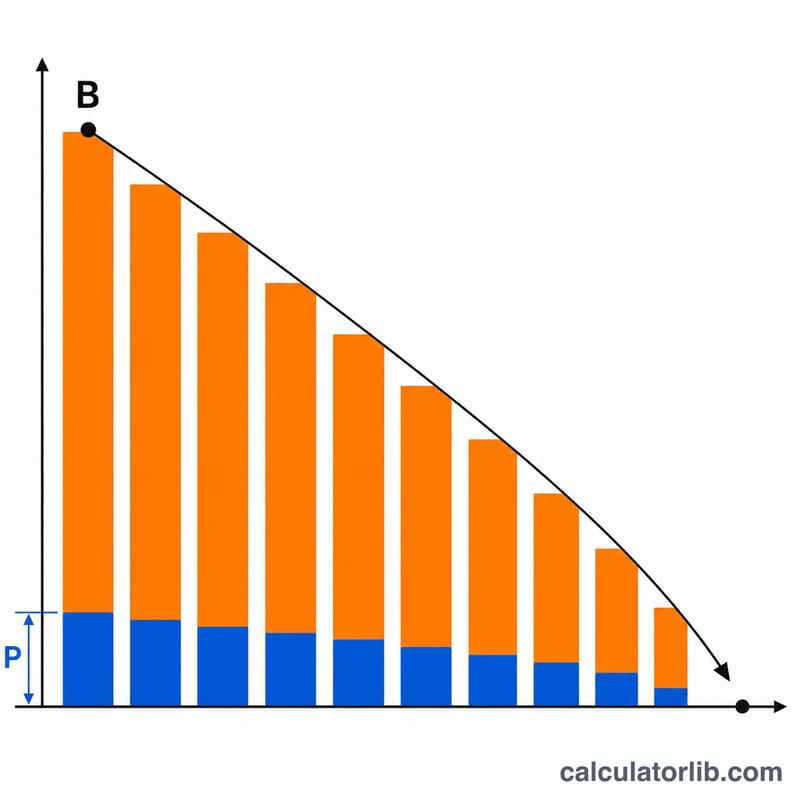
Here B is the balance, P is the fixed monthly payment, and \(i\) is the monthly interest rate (APR ÷ 12 ÷ 100). The term inside the logarithm must stay positive, which requires \(P > B\cdot i\) — that is, your payment must exceed the first month's interest.
Worked example
Balance = $5,000, APR = 18%, payment = $200. Monthly rate \(i = 0.18 / 12 = 0.015\). First-month interest = \(5000 \times 0.015 = \$75\), which is below $200, so the balance is payable. $$n = \frac{-\ln(1 - 5000\times 0.015/200)}{\ln(1.015)} = \frac{-\ln(0.625)}{\ln(1.015)} \approx \frac{0.470}{0.014889} \approx 31.6,$$ rounded up to 32 months (about 2.7 years).
FAQ
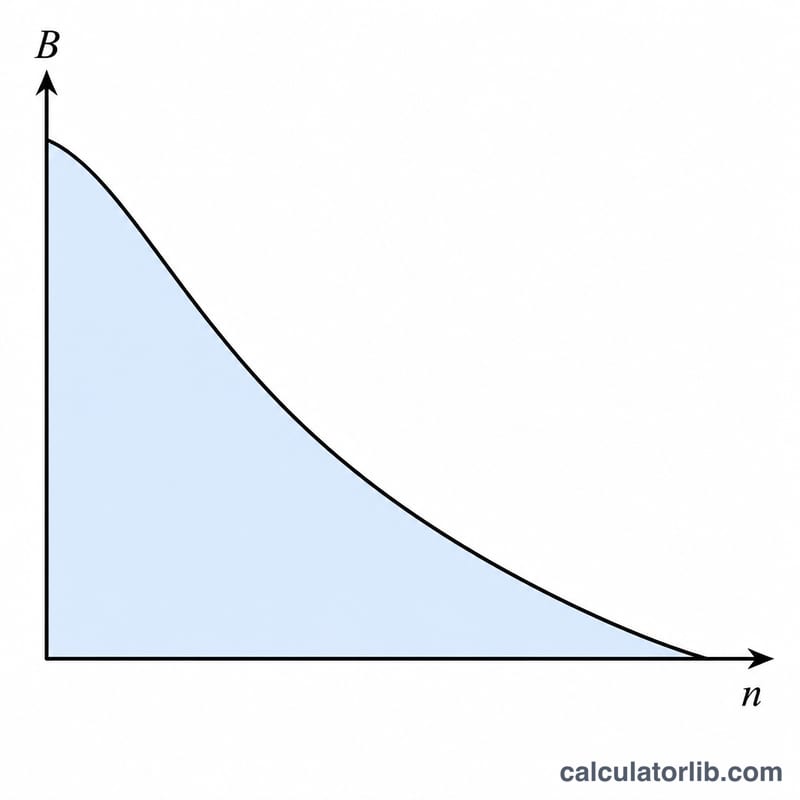
Why does it say "Never"? If your payment is equal to or less than the monthly interest, the balance grows or stays flat each month and is never repaid. Increase the payment above the interest charge.
Why is the last payment smaller? The final month usually needs less than the full payment to reach zero, so the total paid is computed by simulating the amortization month by month.
Does paying more help a lot? Yes — because interest compounds on the remaining balance, even a modest payment increase can cut months and hundreds of dollars in interest.