
What This Calculator Does
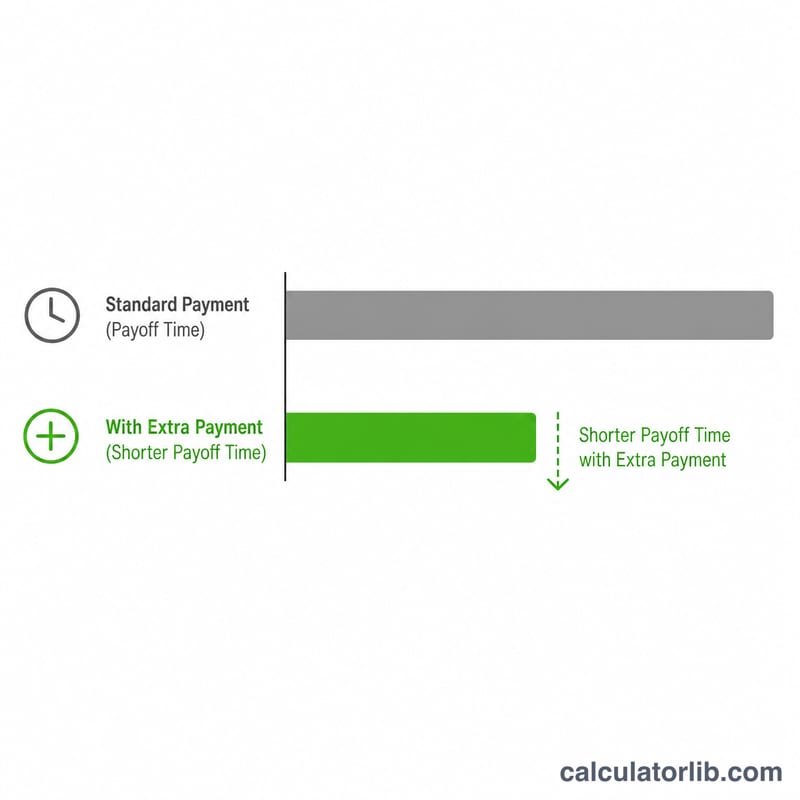
The Credit Card Payoff With Extra Payment Calculator shows how long it will take to clear your credit card balance and how much interest you'll pay, based on your current balance, APR, base monthly payment, and any extra you add each month. Even a small extra payment can dramatically shorten your payoff timeline and slash total interest.
How to Use It
Enter your current balance, the card's annual percentage rate (APR), the base amount you pay each month, and the extra amount you intend to add. The calculator returns the number of months to be debt-free, the equivalent in years, the total amount you'll pay, and the total interest cost.
The Formula Explained
The core equation is $$n = \frac{-\ln\!\left(1 - \dfrac{r \cdot B}{P + E}\right)}{\ln(1 + r)}$$ where \(r = \dfrac{\text{APR}}{1200}\) converts the annual rate to a monthly decimal rate, \(B\) is the balance, \(P\) is the base payment, and \(E\) is the extra payment. If the combined payment \((P + E)\) is less than the monthly interest charge \((r \times B)\), the balance never decreases and the card can't be paid off. The calculator then simulates each month to compute precise total interest.
Worked Example
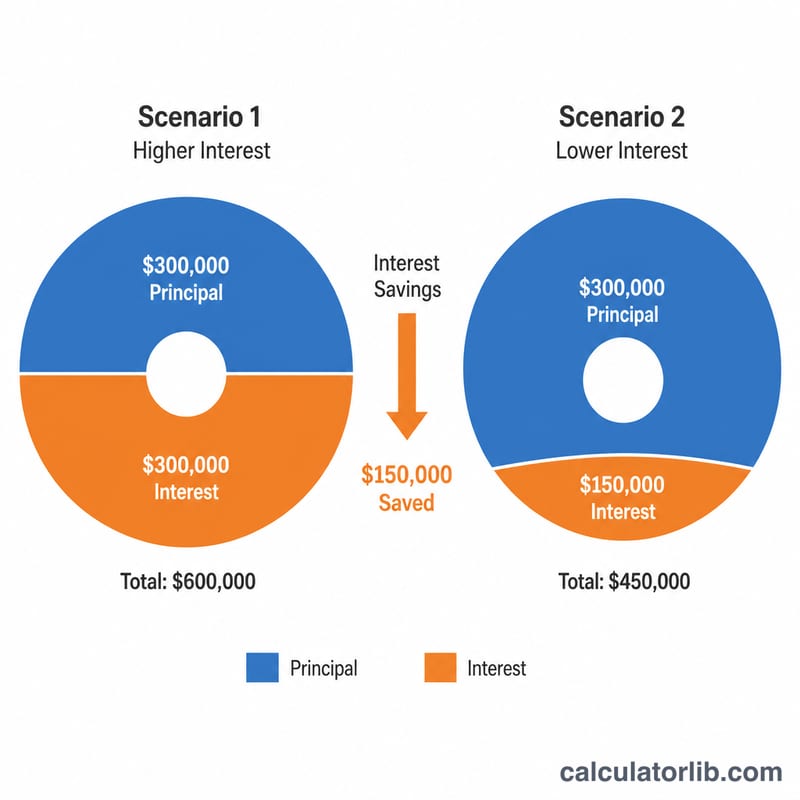
Suppose you owe $5,000 at 18% APR, pay $150 base plus $50 extra ($200 total). The monthly rate \(r = 18 / 1200 = 0.015\). Plugging in: $$n = \frac{-\ln\!\left(1 - \dfrac{0.015 \times 5000}{200}\right)}{\ln(1.015)} = \frac{-\ln(0.625)}{\ln(1.015)} \approx 31.6$$ rounded up to about 32 months. You'd pay roughly $6,300 total, meaning about $1,300 in interest.
FAQ
Why does adding extra help so much? Extra payments go straight to principal, reducing the balance that accrues interest each month, which compounds into big savings over time.
What if my payment is too low? If your total payment is less than the monthly interest, the balance grows forever and the calculator flags that no payoff is possible.
Does this account for new purchases? No. It assumes you stop adding charges and make consistent payments until the balance is cleared.