
What Is the Lux to PPFD Calculator?
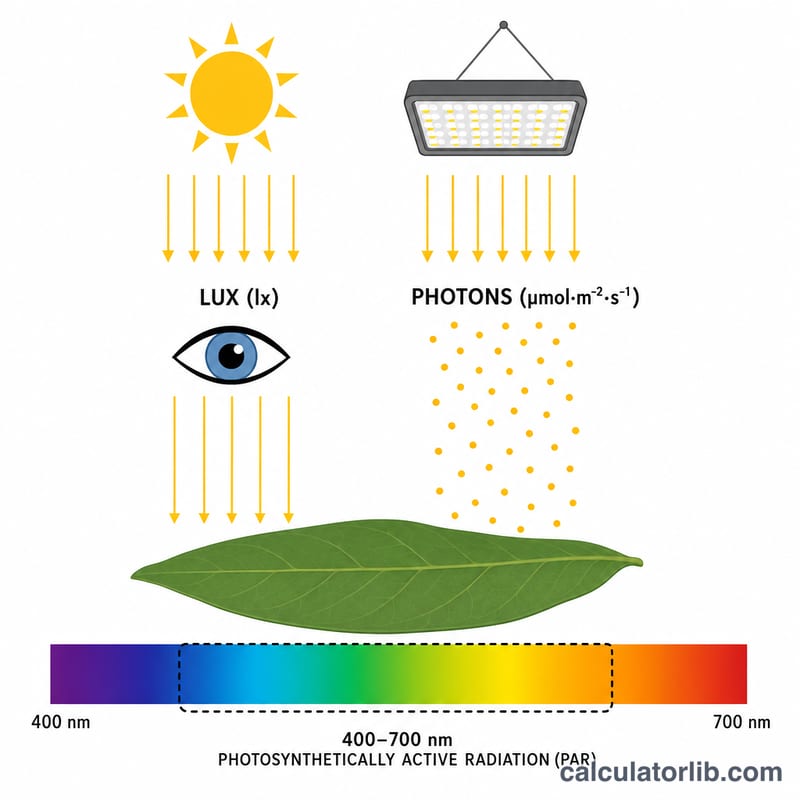
Lux measures brightness as perceived by the human eye, while PPFD (Photosynthetic Photon Flux Density) measures the number of photosynthetically active photons (400–700 nm) landing on a surface each second, expressed in µmol/m²/s. Plants care about photon count, not perceived brightness, so growers convert lux readings from cheap meters or phone apps into an estimated PPFD. This calculator does that using a conversion factor that depends on the light source's spectrum.
How to Use It
Enter your illuminance reading in lux, then pick the light source that matches your fixture or environment. The calculator multiplies the lux value by the source's conversion factor to give an approximate PPFD. Because the factor depends on spectrum, choosing the correct source greatly improves accuracy.
The Formula Explained
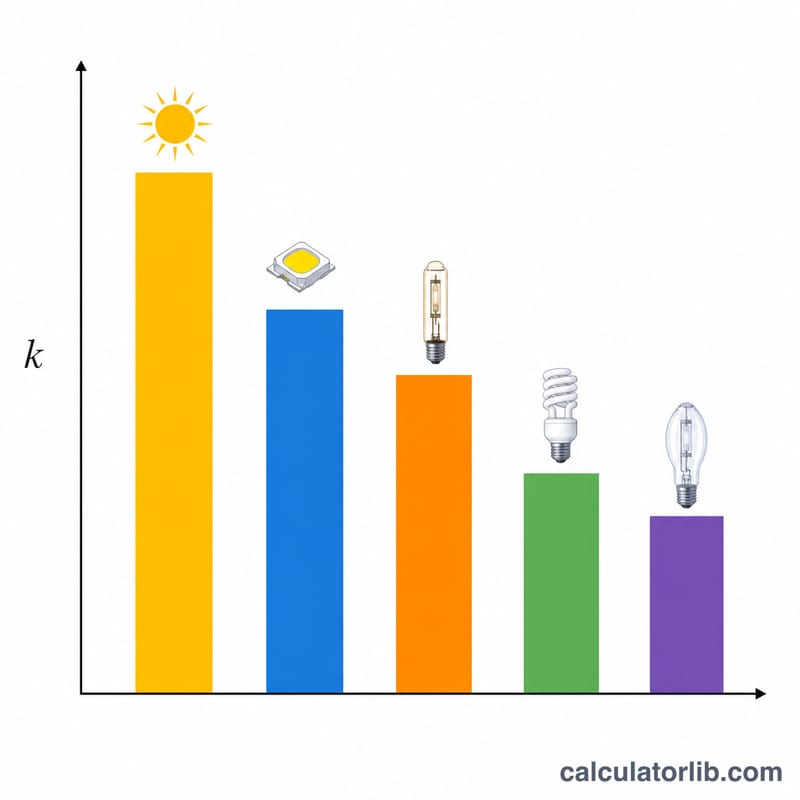
The relationship is simply $$\text{PPFD} = \text{Lux} \times k$$ where k is the conversion factor. Sunlight is roughly \(0.0185\), white LEDs around \(0.0146\), HPS about \(0.0142\), metal halide near \(0.0135\), and cool fluorescent close to \(0.0122\). These values come from the ratio of photon flux to luminous flux for each spectral distribution. The conversion is an estimate — exact values vary with the specific spectrum of your light.
Worked Example
Suppose a lux meter reads 30,000 lux under sunlight. Using \(k = 0.0185\): $$\text{PPFD} = 30{,}000 \times 0.0185 = 555 \ \mu\text{mol/m}^2\text{/s}$$ — a healthy light level for many fruiting plants.
FAQ
Is lux-to-PPFD conversion accurate? It is an approximation. A spectroradiometer or quantum sensor gives true PPFD, but lux conversion is a useful low-cost estimate when the spectrum is known.
Why does the source matter? Different spectra deliver different photon counts for the same perceived brightness, so each source needs its own factor.
What PPFD do plants need? Roughly 100–300 for leafy greens and seedlings, and 400–800+ for flowering and fruiting plants.