
What is the Watts to Lux Calculator?
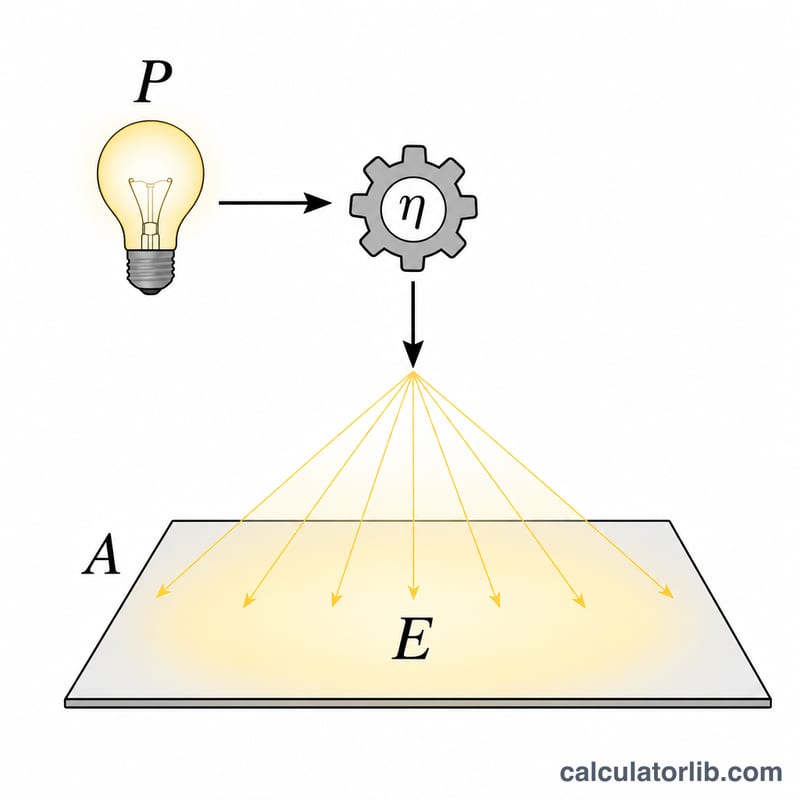
This calculator converts electrical power in watts (W) into illuminance in lux. Because watts measure energy use while lux measures the amount of visible light falling on a surface, the conversion depends on two extra factors: the lamp's luminous efficacy (\(\eta\), in lumens per watt) and the area being lit (\(A\), in square metres). It is useful for lighting design, comparing bulbs, and checking whether a room reaches recommended light levels.
How to use it
Enter the lamp power in watts, the luminous efficacy of the light source in lumens per watt, and the floor or surface area you want to illuminate in square metres. The calculator multiplies power by efficacy to get total luminous flux (lumens), then divides by the area to give the average illuminance in lux.
Typical luminous efficacy values: incandescent \(\approx\) 12–18 lm/W, halogen \(\approx\) 16–24 lm/W, CFL \(\approx\) 50–70 lm/W, and LED \(\approx\) 80–120 lm/W.
The formula explained
The relationship is $$E_v(\text{lux}) = \frac{P(\text{W}) \times \eta(\text{lm/W})}{A(\text{m}^2)}$$ First the total light output \(\Phi_v = P \times \eta\) is found in lumens. Since \(1\ \text{lux} = 1\ \text{lumen per square metre}\), dividing the lumens by the area gives lux. This assumes the light is spread evenly over the surface.
Worked example
Suppose you have a 100 W LED panel with an efficacy of 90 lm/W lighting a 10 m² room. Total flux $$= 100 \times 90 = 9{,}000 \text{ lumens}.$$ Illuminance $$= 9{,}000 \div 10 = \mathbf{900 \text{ lux}},$$ which is bright enough for detailed office work.
FAQ
Why do I need luminous efficacy? Watts only measure power consumed, not light produced. Efficacy converts electrical power into light output, so it is essential for the conversion.
Is the result an average? Yes. The calculator assumes light is distributed evenly across the area, so it gives an average illuminance rather than the value at a single point.
What is a good lux level? Living rooms need around 100–300 lux, offices 300–500 lux, and detailed tasks like drawing 750–1,000 lux.