What This Calculator Does
This tool converts an appliance's power rating in watts (W) and the number of hours it runs into the energy it consumes in kilowatt-hours (kWh). kWh is the unit your electricity provider uses for billing, so knowing it lets you estimate the running cost of any device.
How to Use It
Enter the device's power draw in watts (check the label or spec sheet) and how many hours it operates. The calculator instantly returns the energy used in kWh and watt-hours. To find the cost, multiply the kWh result by your electricity rate (price per kWh).
The Formula Explained
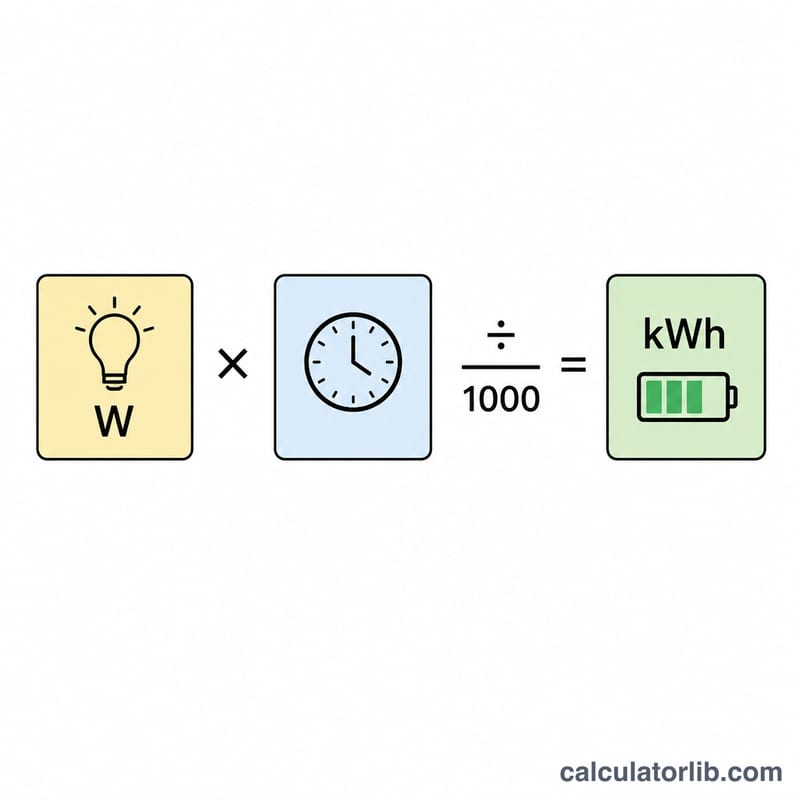
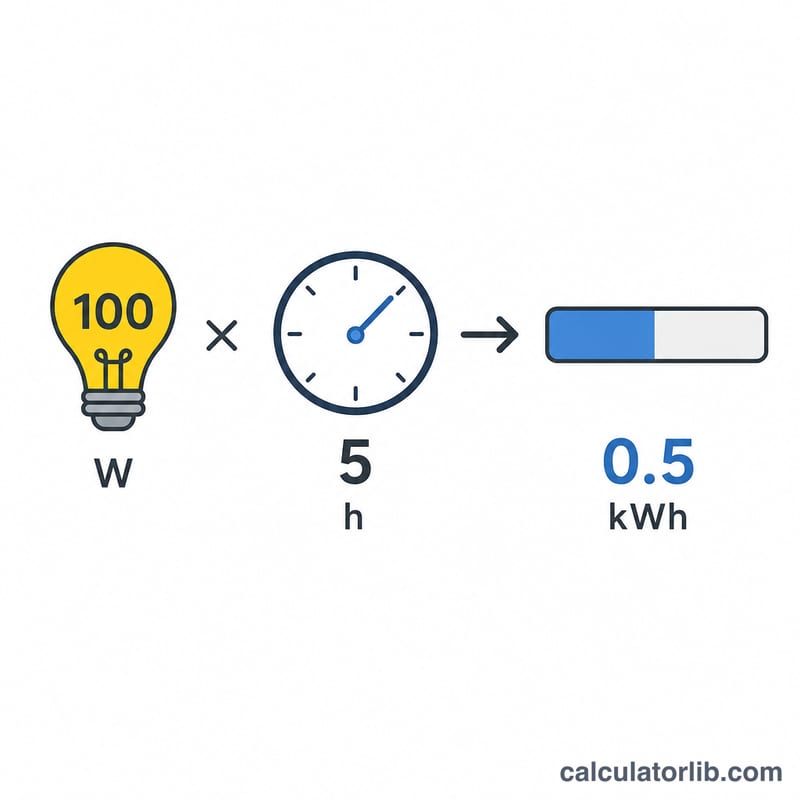
Energy equals power times time. Power is measured in watts and time in hours, giving watt-hours. Dividing by 1000 converts watt-hours to kilowatt-hours:
$$\text{kWh} = \frac{\text{Watts} \times \text{hours}}{1000}$$
One kilowatt equals 1000 watts, which is why the division by 1000 is needed.
Worked Example
Suppose a 1500 W space heater runs for 4 hours. The energy used is $$(1500 \times 4) \div 1000 = 6000 \div 1000 = 6 \text{ kWh}.$$ If electricity costs $0.15 per kWh, that session costs \(6 \times \$0.15 = \$0.90\).
Typical Appliance Wattage and Energy Use
The table lists approximate typical power ranges for common household devices. Actual wattage varies by model, age, settings and operating mode, so check the rating label on your own device. Energy for one hour is \(\text{kWh} = \text{W} \times 1 \text{ h} \div 1000\).
| Device | Approx. typical power (W) | Approx. energy for 1 hour (kWh) |
|---|---|---|
| LED bulb | 10 W | 0.01 kWh |
| Laptop | 50–60 W | 0.05–0.06 kWh |
| Television | 50–150 W | 0.05–0.15 kWh |
| Refrigerator (while the compressor is running) | 100–200 W | 0.1–0.2 kWh |
| Microwave oven | 1000–1500 W | 1.0–1.5 kWh |
| Space heater | 1500 W | 1.5 kWh |
| Window air conditioner | 500–1500 W | 0.5–1.5 kWh |
| Electric kettle | 1500–3000 W | 1.5–3.0 kWh |
Note: a refrigerator's compressor cycles on and off, so its real hourly average is lower than the running wattage. Many devices also draw less than their maximum rating most of the time.
Watts, Watt-Hours, and kWh Conversions
| Relationship | Value |
|---|---|
| 1 kilowatt (kW) | 1000 W |
| 1 kilowatt-hour (kWh) | 1000 Wh |
| 1 watt-hour (Wh) | 0.001 kWh |
| 1 watt (W) | 1 joule per second (J/s) |
| 1 kWh | 3.6 MJ = 3,600,000 J |
| 1 kWh | approx. 3412 BTU |
Converting minutes to hours
Divide minutes by 60 to get hours: \(h = \text{minutes} \div 60\).
- 15 min = 0.25 h
- 30 min = 0.5 h
- 45 min = 0.75 h
- 90 min = 1.5 h
Then use \(\text{kWh} = \dfrac{\text{W} \times h}{1000}\).
Energy Use Comparison: Different Devices and Run Times
Each row uses \(\text{kWh} = \text{W} \times h \div 1000\). The 30-day figure assumes the same session repeats every day. The wattages are example values, not measurements of any specific product.
| Scenario | Calculation per session | kWh per session | kWh per 30 days |
|---|---|---|---|
| 10 W LED, 5 h/day | 10 × 5 ÷ 1000 | 0.05 | 0.05 × 30 = 1.5 |
| 60 W laptop, 8 h/day | 60 × 8 ÷ 1000 = 480 ÷ 1000 | 0.48 | 0.48 × 30 = 14.4 |
| 1500 W heater, 2 h/day | 1500 × 2 ÷ 1000 = 3000 ÷ 1000 | 3 | 3 × 30 = 90 |
| 1000 W microwave, 0.25 h/day (15 min) | 1000 × 0.25 ÷ 1000 | 0.25 | 0.25 × 30 = 7.5 |
| 150 W TV, 4 h/day | 150 × 4 ÷ 1000 = 600 ÷ 1000 | 0.6 | 0.6 × 30 = 18 |
Short bursts of high-power devices, such as a heater, can use far more energy than a low-power device that runs for many hours. To estimate cost, multiply kWh by your local electricity rate per kWh.
FAQ
What is a kilowatt-hour? A kWh is the amount of energy used by a 1000-watt device running for one hour. It is the standard unit on electricity bills.
Where do I find a device's wattage? Look at the rating label, power supply, or manual. If only volts and amps are listed, multiply them (\(\text{W} = \text{V} \times \text{A}\)).
How do I get the cost? Multiply the kWh result by your utility's price per kWh.