
What is the Beer IBU Calculator?
IBU stands for International Bitterness Units, the standard measure of perceived bitterness in beer contributed by hops. This calculator estimates the IBU of a batch from four inputs: the hop's alpha acid percentage, the weight of hops added, the estimated utilization (how much of the alpha acid is isomerized into the beer), and the total batch volume. It is a universal brewing tool useful for homebrewers and professional brewers alike.
How to use it
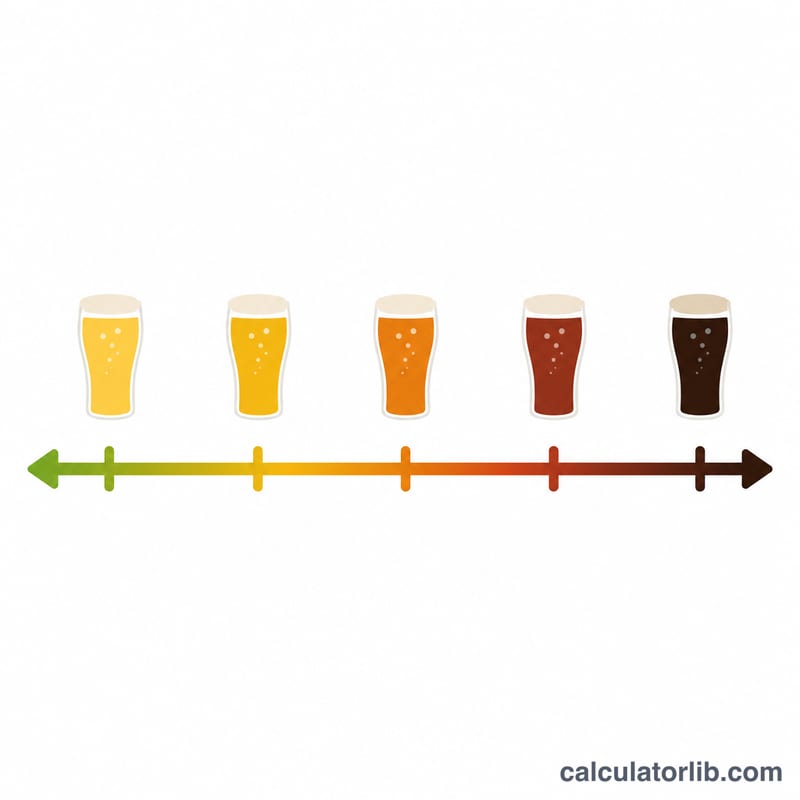
Enter the alpha acid percentage printed on your hop package, the weight of hops in grams, an estimated utilization percentage (typically 5-30% depending on boil time and gravity), and your final batch volume in liters. The calculator returns the estimated IBU instantly.
The formula explained
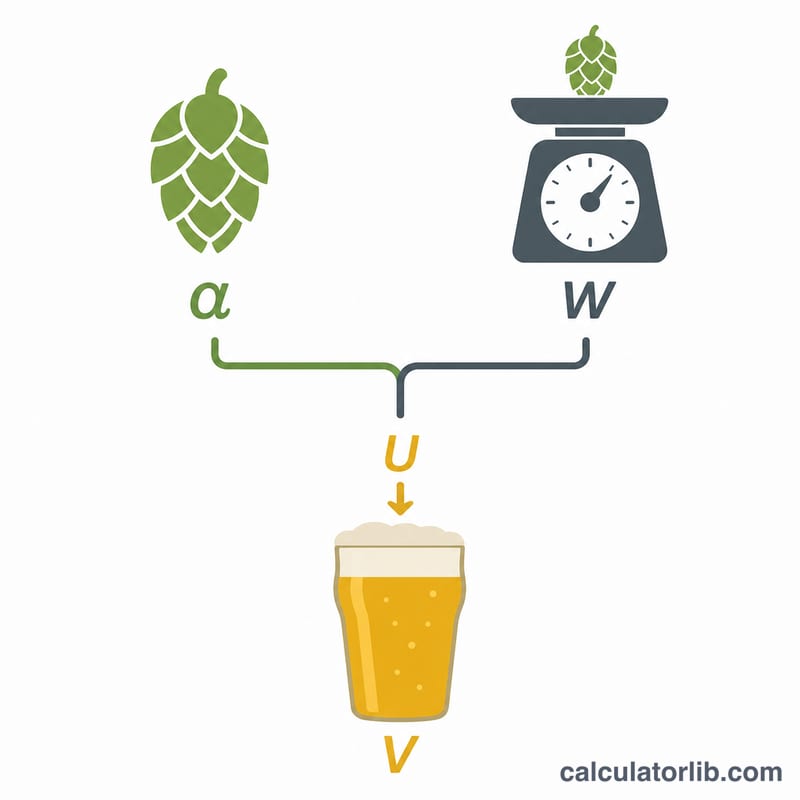
The bitterness is calculated as $$\text{IBU} = \frac{\dfrac{\text{alpha}}{100} \times \text{weight\_g} \times \dfrac{\text{utilization}}{100} \times 1000}{\text{volume\_L}}$$ The factor of 1000 converts grams of alpha acid into milligrams of iso-alpha acid per liter, which is the definition of one IBU. Higher alpha hops, larger additions, longer boils (higher utilization) and smaller batches all increase the IBU.
Worked example
Suppose you add 30 g of hops with 12% alpha acid at 25% utilization into a 20 L batch. $$\text{IBU} = \frac{0.12 \times 30 \times 0.25 \times 1000}{20} = \frac{900}{20} = \textbf{45 IBU}$$ — a solidly bitter pale ale.
Hop Utilization by Boil Time and Gravity
Hop utilization is the fraction of alpha acids that isomerize into the soluble iso-alpha acids that produce bitterness. It rises with boil time and falls as wort gravity increases (a denser wort suppresses isomerization). The values below follow the widely used Tinseth model, expressed as a percentage to plug directly into the IBU formula.
| Boil time (min) | OG 1.030 | OG 1.040 | OG 1.050 | OG 1.060 | OG 1.070 | OG 1.080 | OG 1.090 |
|---|---|---|---|---|---|---|---|
| 0 | 0.0% | 0.0% | 0.0% | 0.0% | 0.0% | 0.0% | 0.0% |
| 10 | 9.7% | 8.9% | 8.1% | 7.3% | 6.7% | 6.1% | 5.5% |
| 20 | 16.6% | 15.1% | 13.7% | 12.5% | 11.3% | 10.3% | 9.4% |
| 30 | 21.5% | 19.6% | 17.8% | 16.2% | 14.7% | 13.3% | 12.1% |
| 45 | 25.6% | 23.3% | 21.1% | 19.2% | 17.5% | 15.9% | 14.4% |
| 60 | 27.6% | 25.1% | 22.8% | 20.7% | 18.8% | 17.1% | 15.5% |
| 90 | 29.0% | 26.4% | 24.0% | 21.8% | 19.8% | 18.0% | 16.4% |
The Tinseth utilization is calculated as \( U = f_G \times f_T \), where the gravity factor \( f_G = 1.65 \times 0.000125^{(G-1)} \) and the time factor \( f_T = \dfrac{1 - e^{-0.04t}}{4.15} \), with \(G\) the boil gravity and \(t\) the boil time in minutes. Use the OG closest to your boil gravity, then read off the utilization for your hop addition's boil time.
Typical IBU Ranges by Beer Style
IBU measures bitterness in milligrams of iso-alpha acids per liter. Perceived bitterness, however, also depends on malt sweetness and body — a 60 IBU stout can taste smoother than a 40 IBU pale ale because residual malt balances the bitterness. The ranges below reflect commonly cited style guidelines.
| Beer style | Typical IBU range | Character |
|---|---|---|
| Light lager | 8–18 | Very low, clean bitterness |
| Pilsner | 25–45 | Crisp, noticeably hoppy |
| Pale ale | 30–50 | Moderate to firm |
| Amber ale | 20–40 | Malt-balanced |
| Porter | 18–35 | Roast-balanced, restrained |
| Stout | 25–60 | Varies; dry/imperial higher |
| IPA (American) | 40–70 | Assertively bitter |
| Double / Imperial IPA | 60–100+ | Intense, big malt backbone |
| Barleywine | 35–100 | Wide; malt-forward to hoppy |
Because human palates saturate, IBU values much above roughly 80–100 are difficult to distinguish — beyond that point, bigger numbers signal recipe intent more than measurable taste difference.
FAQ
What utilization should I use? A 60-minute boil at typical gravity is often around 20-30%. Shorter boils and higher wort gravity reduce utilization.
What IBU range is normal? Lagers sit around 8-25 IBU, pale ales 30-45, and IPAs 40-100+.
Does this work for ounces and gallons? This version uses grams and liters; convert your values first (1 oz \(\approx\) 28.35 g, 1 gal \(\approx\) 3.785 L).