
What is the 500 Rule?
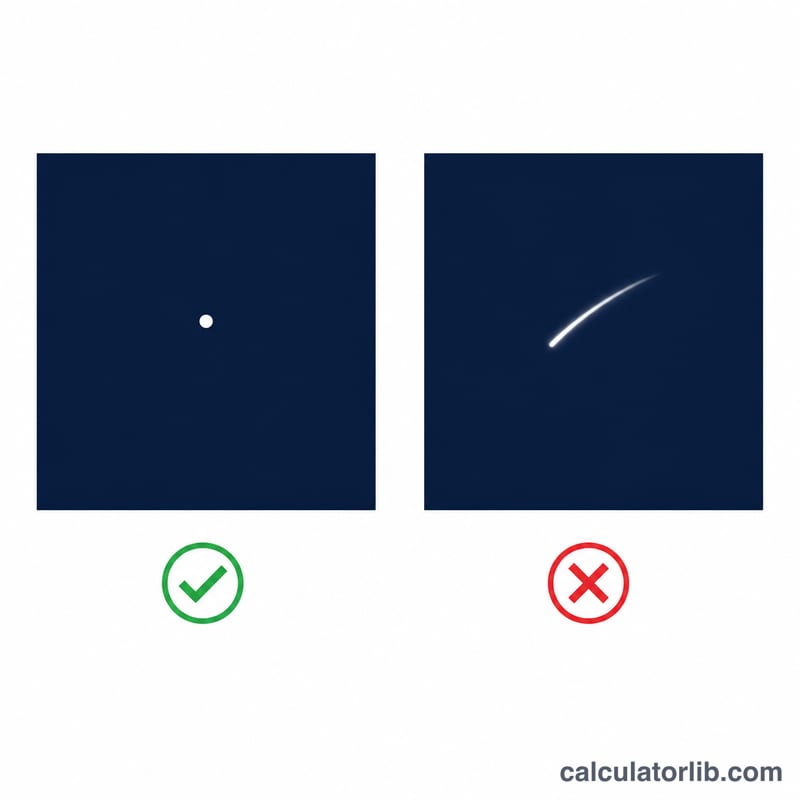
The 500 Rule is a quick guideline used in astrophotography to find the longest shutter speed you can use before the Earth's rotation turns the stars into noticeable streaks instead of crisp points. It works for any camera and lens worldwide — it is pure geometry, not country-specific. Simply divide 500 by your effective focal length (lens focal length multiplied by your sensor's crop factor).
How to use this calculator
Enter your lens focal length in millimetres and select your camera's crop factor: 1.0 for full-frame, 1.5 for most APS-C bodies (Nikon, Sony, Fuji, Pentax), 1.6 for Canon APS-C, or 2.0 for Micro Four Thirds. The calculator returns the maximum exposure time in seconds. We also show the stricter 300 Rule, which produces sharper stars on modern high-megapixel sensors.
The formula explained
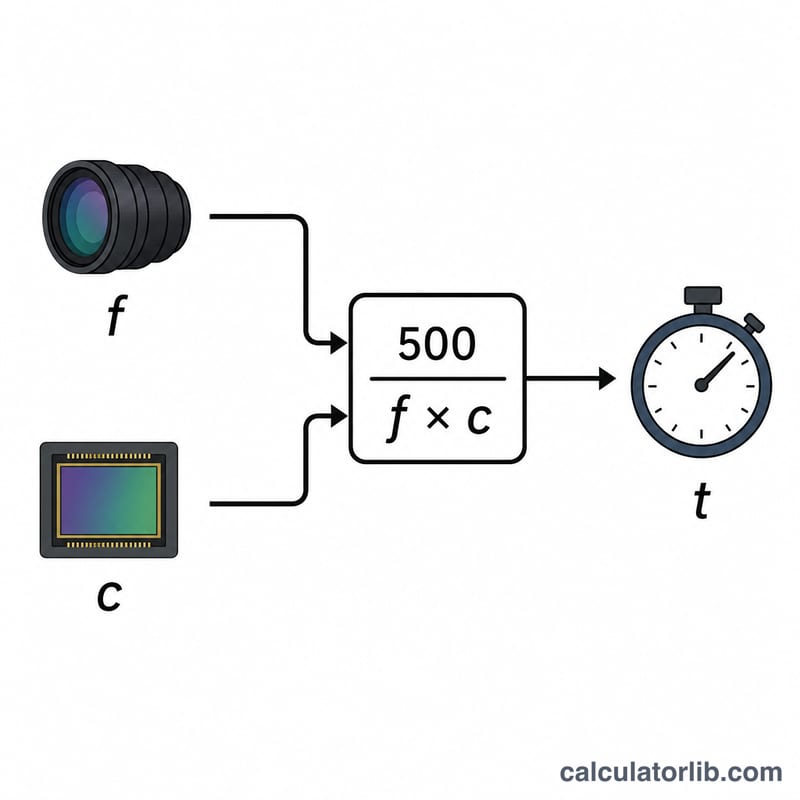
The exposure limit is $$t = \frac{500}{f \times c}$$ The crop factor converts your real focal length into a full-frame equivalent, because a smaller sensor magnifies the apparent motion of the stars. A longer effective focal length means a shorter allowable exposure.
Worked example
Suppose you shoot with a 24mm lens on an APS-C camera with a 1.5 crop factor. The effective focal length is \(24 \times 1.5 = 36\)mm. The 500 Rule gives $$\frac{500}{36} \approx 13.9 \text{ seconds}.$$ So you can expose for about 14 seconds before stars begin to trail. The 300 Rule would suggest a tighter \(\frac{300}{36} \approx 8.3\) seconds for extra sharpness.
Key Terms Explained
- Focal length
- The optical distance (in millimetres) from the lens's rear principal point to the sensor when focused at infinity. Shorter focal lengths (e.g. 14–24 mm) give wider fields of view, which is ideal for capturing large portions of the night sky and allows longer star exposures.
- Crop factor
- The ratio of a full-frame (36×24 mm) sensor's diagonal to a smaller sensor's diagonal. Common values are 1.0 (full-frame), 1.5 (most APS-C), 1.6 (Canon APS-C), and 2.0 (Micro Four Thirds). It scales a lens's angle of view relative to full-frame.
- Effective (equivalent) focal length
- The actual focal length multiplied by the crop factor — the full-frame focal length that would produce the same field of view. A 24 mm lens on a 1.5× sensor has a 36 mm equivalent focal length. The 500 Rule uses this product in its denominator because field of view, not the raw focal length, determines how quickly stars streak.
- Shutter speed / exposure time
- The length of time the sensor is exposed to light, expressed in seconds. Longer exposures gather more light from faint stars but also allow Earth's rotation to blur point stars into short streaks.
- Star trailing
- The apparent motion of stars across the frame caused by Earth's rotation. Beyond the maximum exposure, individual stars render as visible arcs rather than sharp points. The 500 Rule sets a threshold to keep this motion below the resolution of a typical print or screen.
- NPF rule
- A more precise alternative to the 500 Rule that accounts for pixel pitch (N), aperture (P) and focal length (F). It generally yields shorter, stricter exposure limits, making it better suited to high-resolution sensors where the looser 500 Rule can still show slight trailing at 100% magnification.
FAQ
Is the 500 Rule exact? No — it is an approximation. Pixel density, focus, and how much trailing you tolerate all matter. For precise results, photographers use the NPF rule.
Why use 300 instead of 500? High-resolution sensors reveal trailing sooner, so a smaller number (300 or 200) gives sharper pinpoint stars.
Does aperture matter? Not for the shutter limit itself, but a wider aperture lets you keep exposures short while still gathering enough light.