

What Is the Rule of 72?
The Rule of 72 is a quick mental-math shortcut that estimates how many years it takes for an investment to double in value at a fixed annual compound rate of return. Instead of running full compound-interest equations, you simply divide 72 by your expected annual percentage return. It is a universal financial heuristic — it works the same in any country and currency.

How to Use This Calculator
Enter your expected annual return rate as a percentage (for example, enter 8 for 8%). The calculator divides 72 by that number and shows the approximate number of years it will take your savings to double. This is handy for retirement planning, comparing investments, or understanding the long-term power of compounding.
The Formula Explained
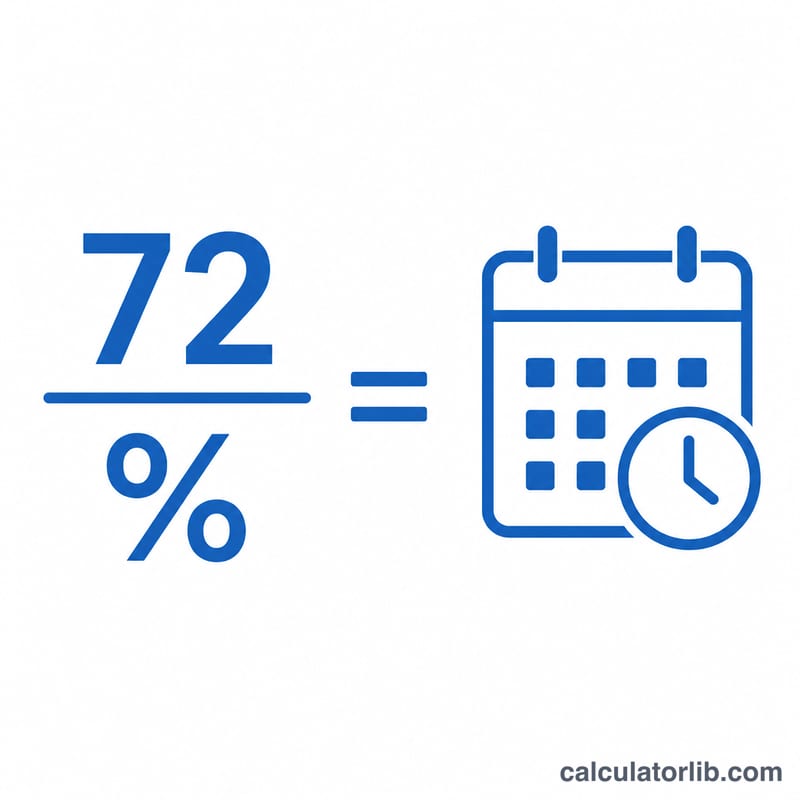
The formula is $$\text{Years} = \frac{72}{r}$$ where \(r\) is the annual return expressed as a whole-number percent. The number 72 is used because it is close to the mathematically exact value (about 69.3, from the natural log of 2) while being easily divisible by 2, 3, 4, 6, 8, 9, and 12 — making the arithmetic simple. The approximation is most accurate for return rates between roughly 6% and 10%.
Worked Example
Suppose your retirement portfolio earns an average annual return of 8%. Dividing 72 by 8 gives 9 — $$\frac{72}{8} = 9$$ so your money would roughly double every 9 years. If you invested $50,000 today, you could expect about $100,000 in 9 years, $200,000 in 18 years, and $400,000 in 27 years, ignoring contributions and taxes.
FAQ
Is the Rule of 72 accurate? It is an approximation. For rates near 8% it is very close; for very high or very low rates it drifts from the exact compound result.
Can I use it for inflation? Yes — divide 72 by the inflation rate to estimate how long until prices double and your money's purchasing power halves.
Why not the Rule of 70 or 69? 70 and 69.3 are closer to the exact math, but 72 has more clean divisors, making it easier for quick mental estimates.