

What Is the Rule of 114?
The Rule of 114 is a quick mental-math shortcut for estimating how long it takes an investment to grow to three times (triple) its original value at a fixed annual compound interest rate. It is the tripling-time cousin of the better-known Rule of 72 (doubling) and Rule of 144 (quadrupling). Simply divide 114 by your annual interest rate (in percent) to get the approximate number of years.

How to Use This Calculator
Enter your expected annual interest rate or rate of return as a percentage — for example, type 6 for 6%. The calculator divides 114 by that number and instantly shows the approximate years (and months) needed for your money to triple. Use a realistic long-term return figure for the most meaningful estimate.
The Formula Explained
The formula is \(t = 114 / r\), where t is the time in years and r is the annual interest rate expressed as a whole-number percentage. The constant 114 comes from the natural logarithm of 3 (about 1.0986) multiplied by 100, then rounded slightly upward for clean division. It assumes interest compounds once per year and the rate stays constant.
$$\text{Tripling Time (years)} = \frac{114}{\text{Rate (\%)}}$$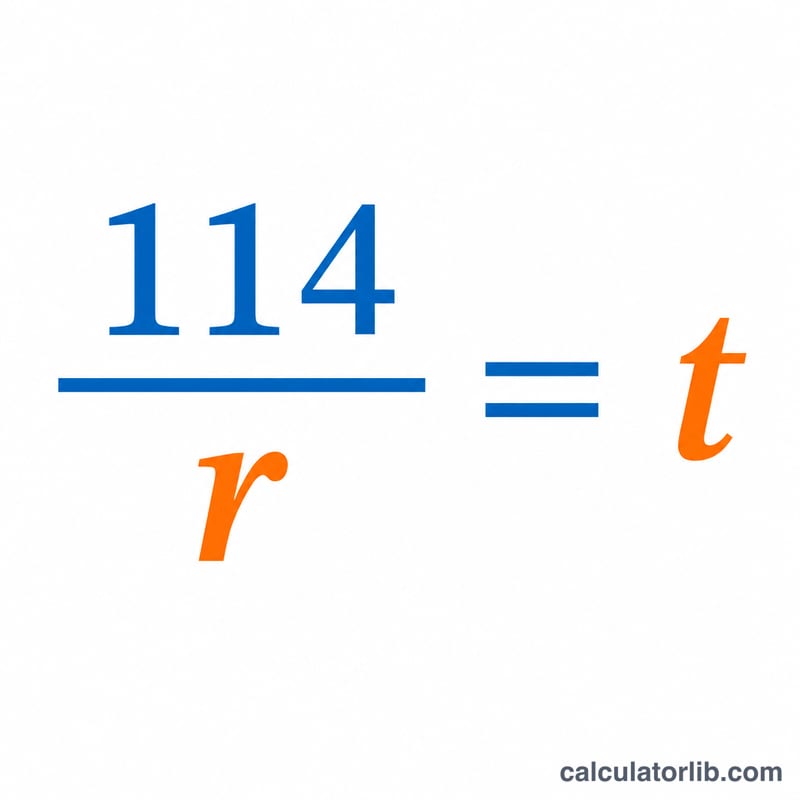
Worked Example
Suppose you invest in a fund earning 6% per year. Tripling time = $$\frac{114}{6} = 19 \text{ years}$$ If the rate were 9%, it would be \(114 / 9 \approx 12.67\) years. Lower the rate to 4% and tripling stretches to 28.5 years — illustrating how sensitive growth is to your return.
FAQ
Is the Rule of 114 exact? No, it is an approximation. It is most accurate for typical rates between 4% and 12%; very high or very low rates drift from the precise logarithmic answer.
How does it relate to the Rule of 72? The Rule of 72 estimates doubling time; the Rule of 114 estimates tripling time. Both use the same divide-the-constant-by-the-rate trick.
Does it account for taxes or inflation? No. It uses the nominal compound rate only. For real (inflation-adjusted) growth, subtract inflation from your rate before dividing.