
What Is the Rule of 70?
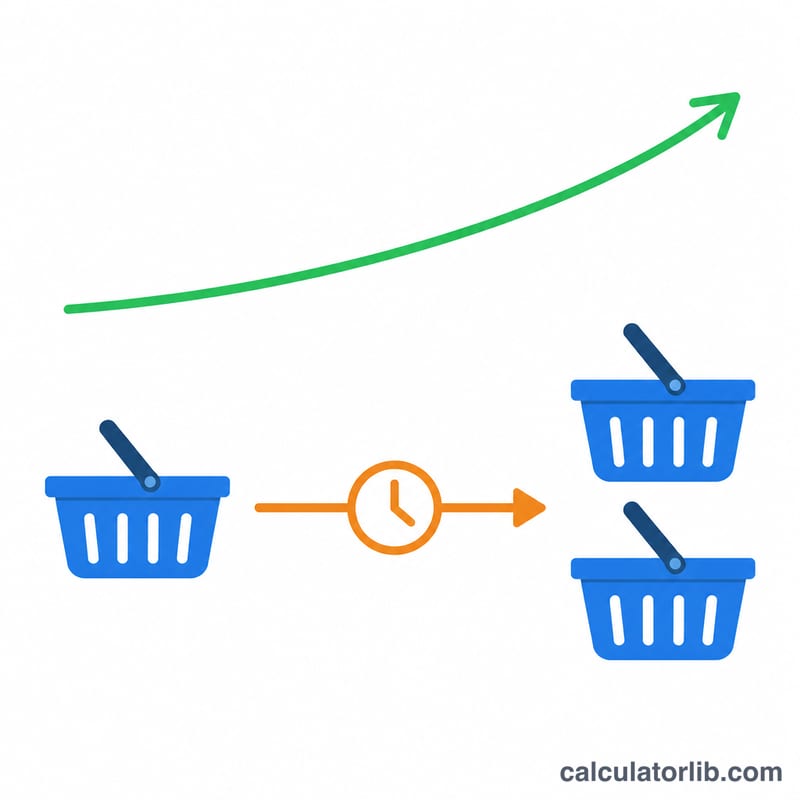
The Rule of 70 is a quick mental-math shortcut for estimating how long it takes for a quantity growing at a constant percentage rate to double in size. Applied to inflation, it tells you roughly how many years it will take for the general price level to double — and, equivalently, for the purchasing power of your money to be cut in half. It works for any compounding rate: investment returns, population growth, or GDP.
How to Use This Calculator
Enter the annual inflation rate as a percentage (for example, type 3.5 for 3.5%) and the calculator instantly returns the approximate number of years for prices to double, along with the equivalent in months. The smaller the rate, the longer the doubling time; the higher the rate, the faster prices spiral.
The Formula Explained
The rule comes from the math of exponential growth. The exact doubling time is \(\ln(2) \div \ln(1 + r)\), which for small rates is closely approximated by \(69.3 \div r\%\). The number 70 is used instead of 69.3 because it is rounder and divides cleanly by many common rates, making the estimate easy to do in your head:
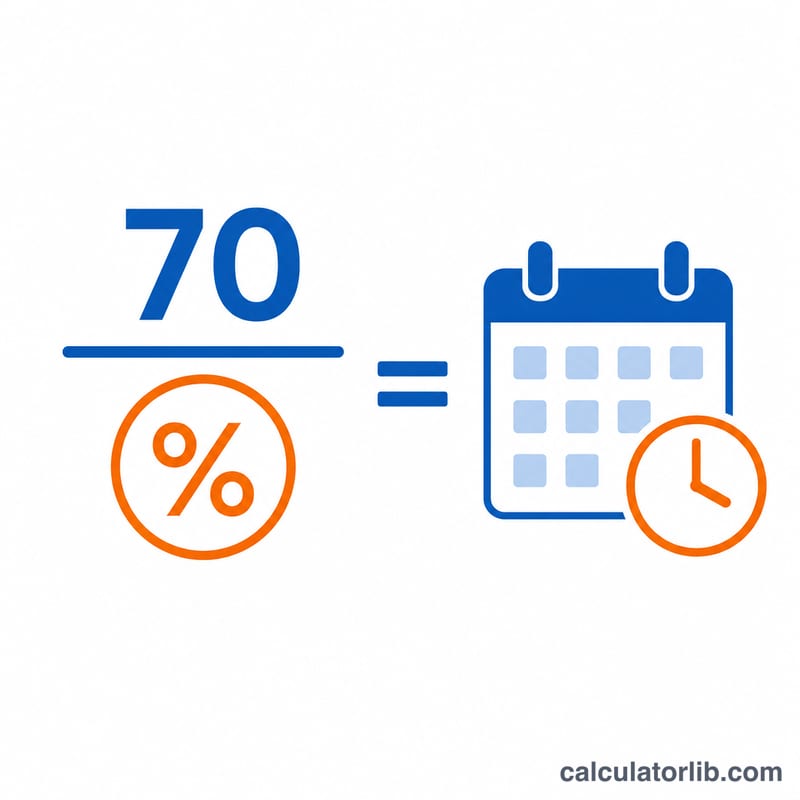
$$\text{Years to Double} = \frac{70}{\text{Inflation Rate (\%)}}$$
Worked Example
Suppose inflation runs at 3.5% per year. Dividing 70 by 3.5 gives 20 years.
$$\frac{70}{3.5} = 20 \text{ years}$$
So at 3.5% inflation, something that costs $100 today would cost roughly $200 in about 20 years. At 7% inflation that doubling time collapses to just 10 years.
FAQ
Is the Rule of 70 exact? No — it is an approximation. It is most accurate for rates between about 1% and 10%; for very high rates it slightly overstates the doubling time.
Why 70 and not 72? Both are used. The "Rule of 72" is popular for investment returns because 72 has more divisors, while 70 is closer to the true value of 69.3 and is common for inflation and growth estimates.
Can I use it for deflation? The basic rule assumes positive growth. For a negative rate (deflation), the formula no longer gives a meaningful doubling time.