
What is the RFM (Relative Fat Mass) Calculator?
The Relative Fat Mass (RFM) calculator estimates your body fat percentage using just two simple measurements: your height and your waist circumference. Developed by Woolcott and Bergman and published in 2018, the RFM index was shown to track whole-body fat percentage (measured by DXA scans) more closely than the traditional Body Mass Index (BMI) in a large study population. Because it needs no weight, skinfold calipers, or special equipment, it is one of the easiest body-composition estimates you can make at home.
How to use this calculator
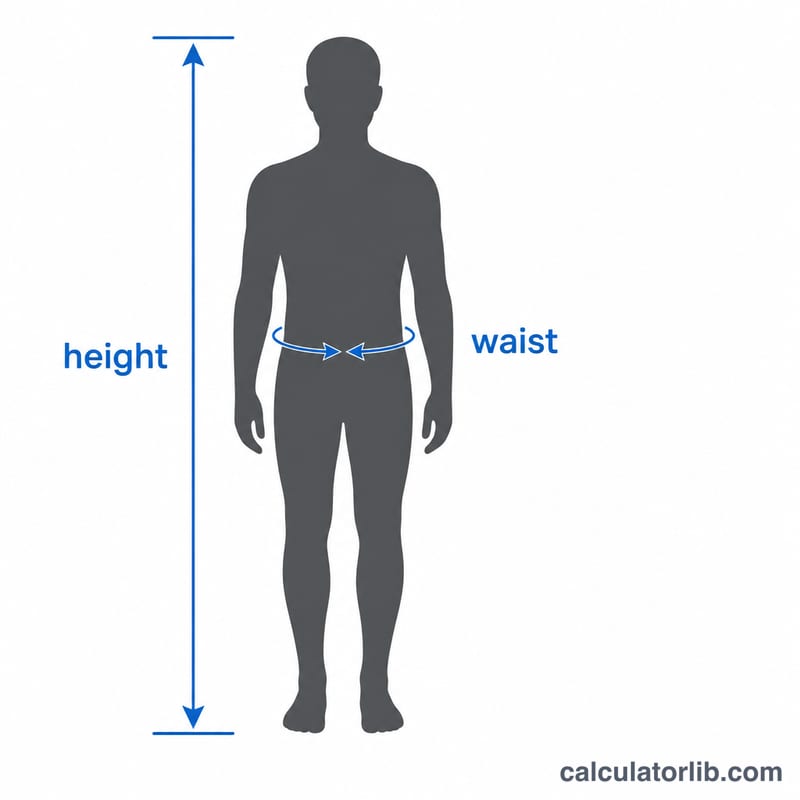
Select your gender, then enter your height and waist circumference in the same unit (centimeters here). Measure your waist at the level of the navel (belly button), standing relaxed and exhaling normally. The calculator instantly returns your estimated body fat percentage and a general category. Be sure not to suck in your stomach, as that will understate your result.
The formula explained
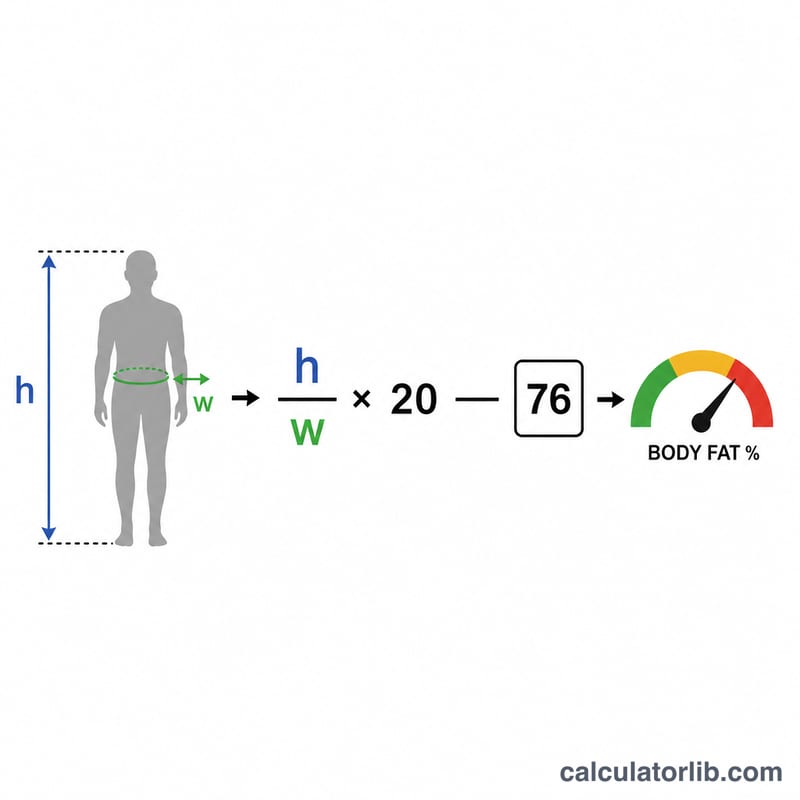
The RFM equation uses the ratio of height to waist, multiplied by 20, and subtracted from a sex-specific constant:
Men: $$\text{RFM} = 64 - 20 \times \frac{\text{Height (cm)}}{\text{Waist (cm)}}$$Women: $$\text{RFM} = 76 - 20 \times \frac{\text{Height (cm)}}{\text{Waist (cm)}}$$
The taller you are relative to your waist, the larger the subtracted term, and the lower your estimated fat percentage. The 12-point difference in the constant (64 vs 76) reflects the higher essential fat stores typical of women.
Worked example
Consider a man who is 175 cm tall with an 85 cm waist. $$\text{RFM} = 64 - \left(20 \times \frac{175}{85}\right) = 64 - (20 \times 2.0588) = 64 - 41.176 = \mathbf{22.8\%}$$ estimated body fat, which falls in the overweight range for men.
FAQ
Is RFM better than BMI? Research suggests RFM correlates more strongly with actual measured fat percentage and misclassifies fewer people, especially across different body shapes.
What is a healthy RFM? Roughly 14–21% for men and 24–32% for women is often considered healthy, though ranges vary by age and source.
Can I use inches? Yes — as long as height and waist are in the same unit, the ratio is unchanged, so the formula still works. This calculator uses centimeters.