
What is the Inflation Equivalent Value Calculator?
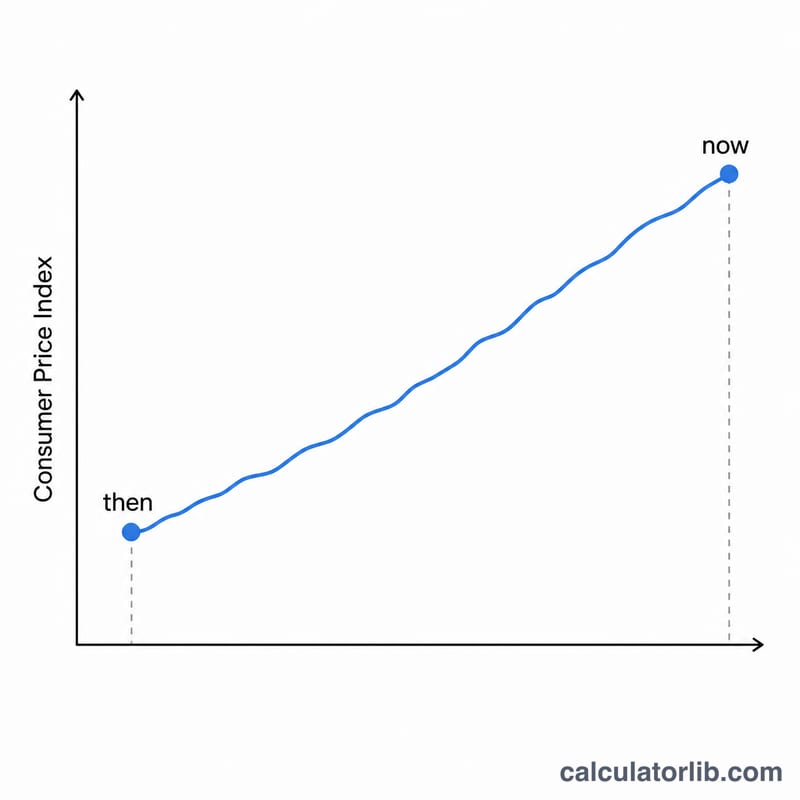
This calculator tells you how much money you would need today to match the buying power of a dollar amount from an earlier date. It works by comparing two Consumer Price Index (CPI) readings — the index value at the time of the original amount and the index value now. Because the CPI measures the average price level of a basket of goods and services, the ratio of the two index values captures how much prices have changed overall.
How to use it
Enter the original dollar amount, the CPI for the starting period (CPI Then), and the CPI for the current or target period (CPI Now). The tool returns the equivalent value, the dollar increase, and the total inflation between the two dates. CPI figures are published by national statistics agencies (for example the U.S. Bureau of Labor Statistics), so you can plug in any country's index as long as both values come from the same series.
The formula explained
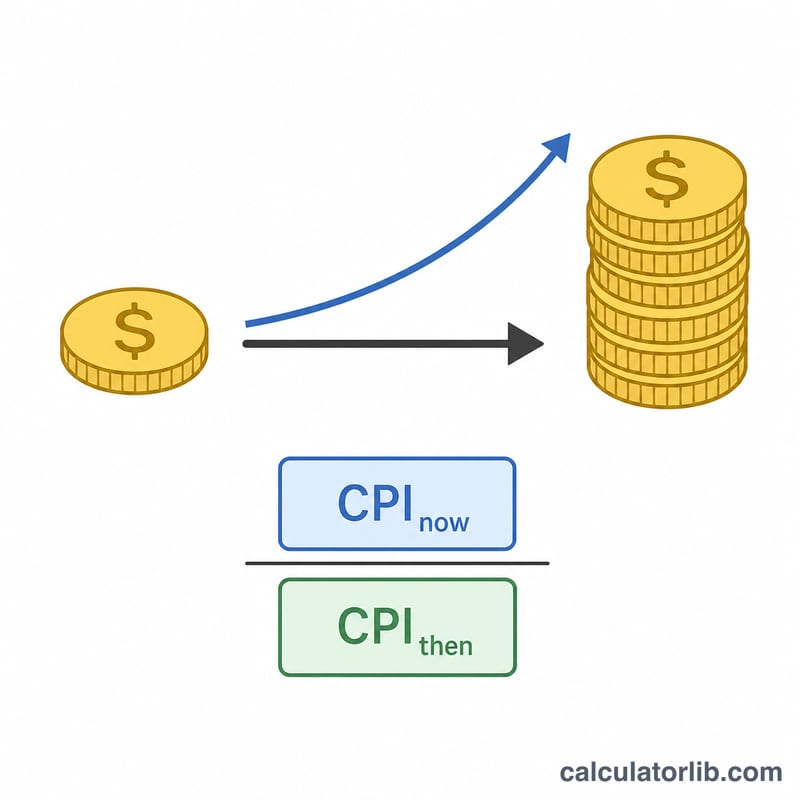
The core relationship is $$\text{Equivalent} = \text{Amount} \times \frac{\text{CPI}_{\text{now}}}{\text{CPI}_{\text{then}}}$$ If prices have doubled, the ratio is 2 and your money's equivalent value doubles. Total inflation is simply that ratio minus one, written as a percentage.
Worked example
Suppose you had $100 when the CPI was 100, and today the CPI is 310. The equivalent value is $$100 \times \frac{310}{100} = \$310.$$ That means $100 then has the same buying power as $310 now — a total inflation of 210%.
FAQ
Where do I find CPI values? Government statistics websites publish monthly and annual CPI tables; use the index level (not the percent change) for each period.
Does it matter which CPI series I use? Yes — be consistent. Both numbers must come from the same index (e.g. CPI-U for the U.S.) for the ratio to be meaningful.
Is this the same as a salary or investment return? No. This shows price-level equivalence only; it does not include interest, raises, or investment growth.