

What This Calculator Does
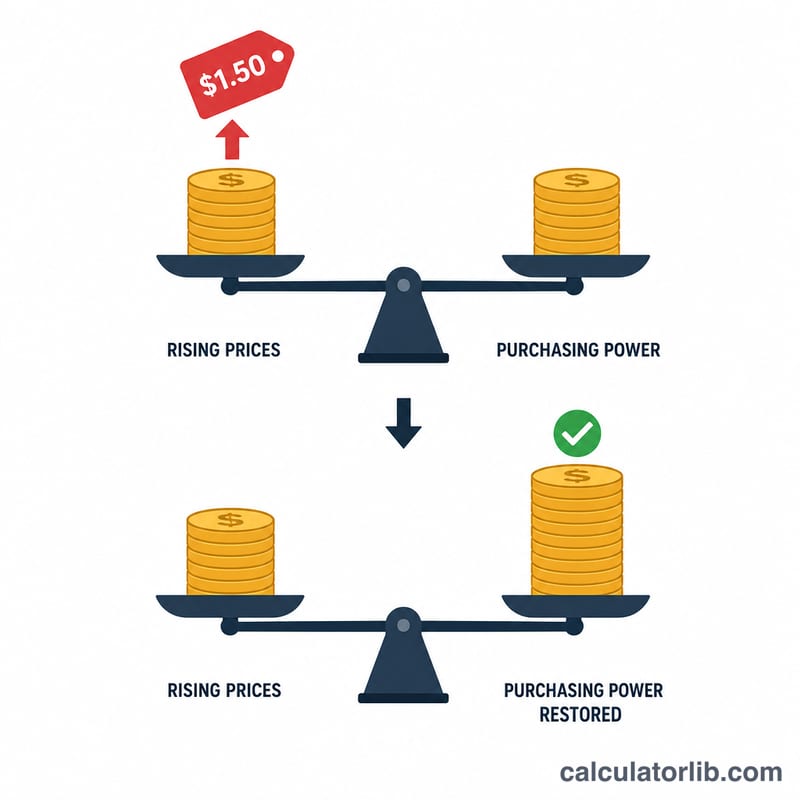
Inflation quietly erodes the value of your paycheck. If prices rise 3% and your salary stays the same, you can buy 3% less than you could last year — effectively a pay cut. This calculator shows the exact dollar raise you'd need just to break even with inflation and keep your real purchasing power intact.
How to Use It
Enter your current annual salary and the expected (or published) inflation rate as a percentage. The calculator returns the raise needed in dollars, plus the new salary that would leave you no worse off than before. Anything above that figure is a real raise; anything below it means you're losing ground.
The Formula Explained
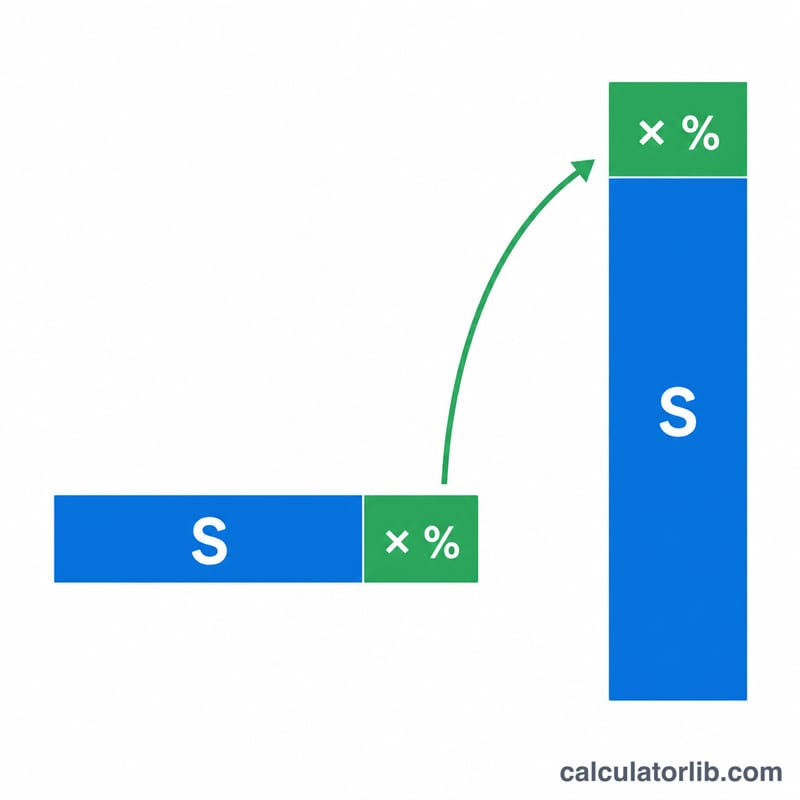
The math is simple: multiply your salary by the inflation rate divided by 100. A 4% inflation rate on a $50,000 salary requires $50,000 \times 4 \div 100 = $2,000. Add that back to your salary to get the new amount ($52,000) needed to maintain the same standard of living.
$$\text{Raise Needed} = \text{Salary} \times \frac{\text{Inflation Rate (\%)}}{100}$$
$$\text{New Salary} = \text{Salary} + \text{Raise Needed}$$
Worked Example
Suppose you earn $60,000 and inflation is running at 3.5%. The raise needed is $60,000 \times 3.5 \div 100 = $2,100. So you'd need a new salary of $62,100 just to stand still. A raise of only $1,000 would actually be a real-terms pay cut of about $1,100.
$$\text{Raise Needed} = 60{,}000 \times \frac{3.5}{100} = 2{,}100$$
FAQ
Is this an exact prediction of future prices? No — it's based on the inflation rate you enter. Use an official figure like CPI for accuracy, or your own estimate for planning.
Does a raise that just matches inflation make me better off? No, it only keeps you even. To get ahead, your raise must exceed the inflation rate.
What inflation rate should I use? Many people use the most recent annual CPI figure for their country, often in the 2–5% range, but you can model any scenario.