
What is cumulative inflation?
Cumulative inflation is the total percentage increase in the general price level over a stretch of time — not just one year, but the entire period combined. It tells you how much more expensive a basket of goods has become between a starting point and an ending point. Economists track this using a price index such as the Consumer Price Index (CPI), where each value represents the relative cost of goods at a given moment.
How to use this calculator
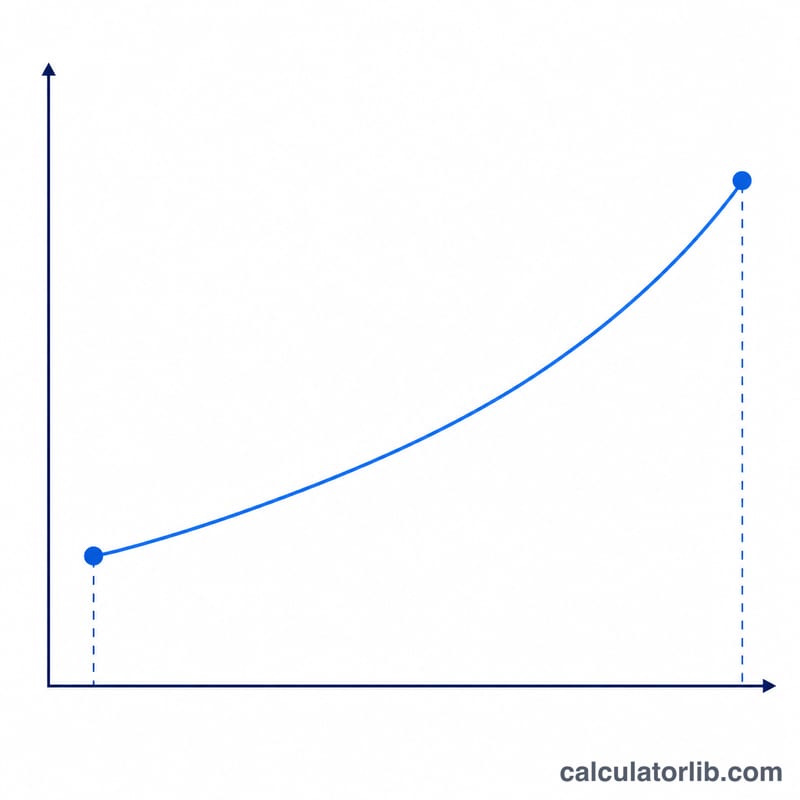
Enter the starting CPI (the price index at the beginning of the period) and the ending CPI (the price index at the end). The calculator returns the total cumulative inflation as a percentage. Optionally enter the number of years between the two readings and you will also get the annualized inflation rate — the steady yearly rate that compounds to the same total change.
The formula explained
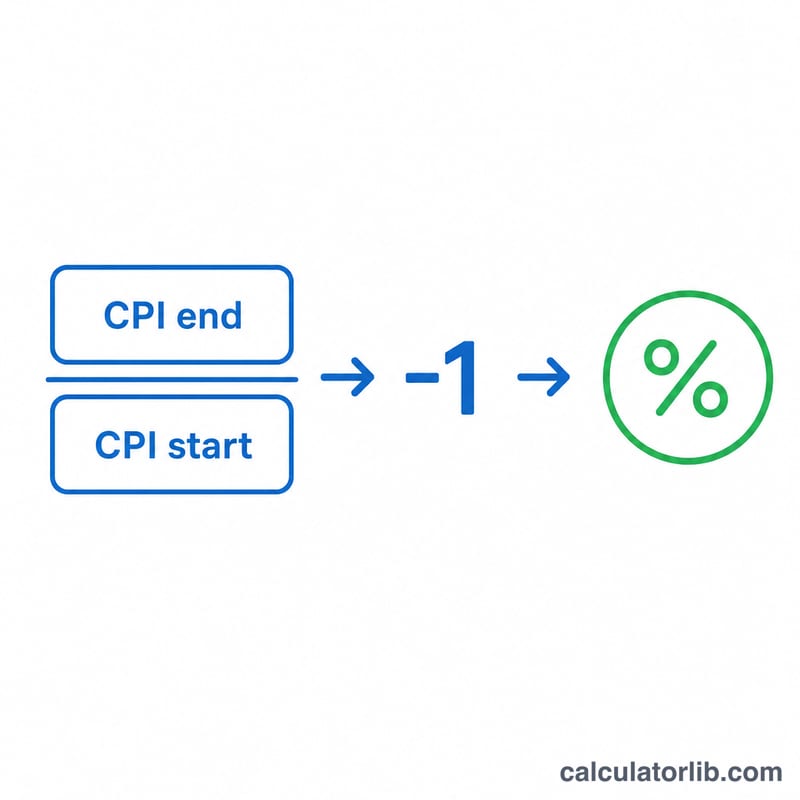
The core formula is $$\text{Cumulative Inflation} = \left( \frac{\text{Ending CPI}}{\text{Starting CPI}} - 1 \right) \times 100\%$$. Dividing the ending index by the starting index gives a price multiplier; subtracting 1 and multiplying by 100 converts it into a percentage gain. To convert that into an annual rate over n years, we take the n-th root of the multiplier and subtract 1: $$\text{Annualized Rate} = \left( \left( \frac{\text{Ending CPI}}{\text{Starting CPI}} \right)^{\frac{1}{\text{Years}}} - 1 \right) \times 100\%$$.
Worked example
Suppose CPI was 200 at the start and 260 at the end, over 10 years. The price multiplier is \( 260 / 200 = 1.3 \), so cumulative inflation is $$(1.3 - 1) \times 100 = 30\%$$ The annualized rate is $$(1.3^{1/10} - 1) \times 100 \approx 2.66\% \text{ per year}$$ So prices rose 30% in total, equivalent to about 2.66% compounding annually.
FAQ
Where do I find CPI values? National statistics agencies publish CPI series — for example the U.S. Bureau of Labor Statistics, the UK Office for National Statistics, or Eurostat. Use the index level for the relevant months or years.
Why isn't cumulative inflation just the sum of yearly rates? Because inflation compounds. Each year's price increase is applied on top of the previous year's already-higher prices, so the total is slightly more than a simple sum.
Can I use this with prices instead of CPI? Yes. Any two comparable price figures work — enter the old price as the start and the new price as the end to see the cumulative percentage increase.