
What Is the Salary Inflation Calculator?
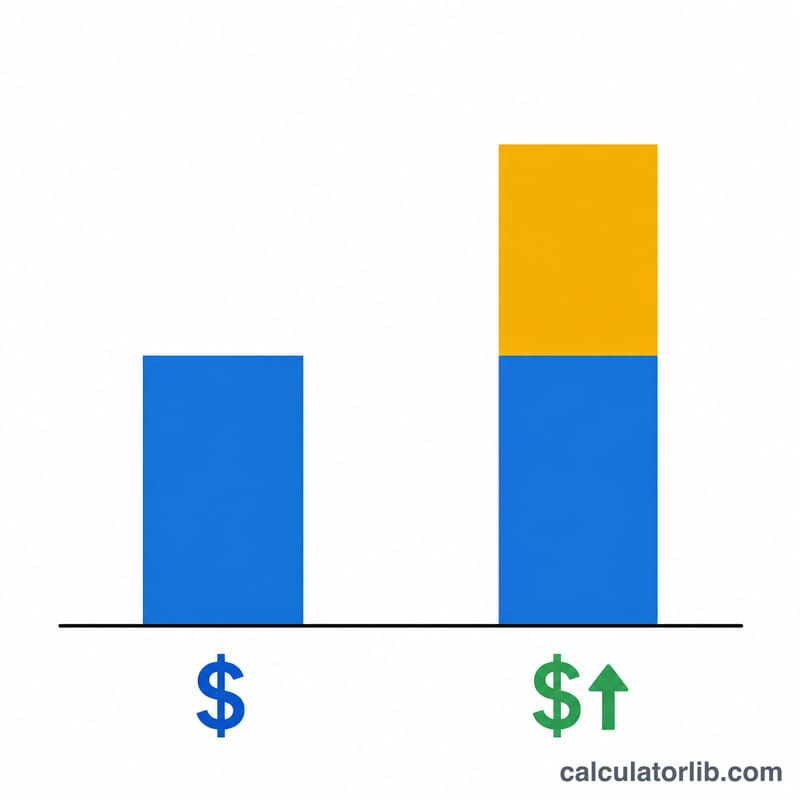
The Salary Inflation Calculator shows how much your salary would need to grow to maintain the same purchasing power after several years of inflation. Inflation erodes the real value of money over time, so a fixed salary buys less each year. This tool tells you the equivalent future salary needed to "break even" against rising prices.
How to Use It
Enter your current salary, the expected average annual inflation rate as a percentage, and the number of years to project forward. The calculator returns the inflation-adjusted salary, the total dollar increase required, and the overall percentage increase.
The Formula Explained
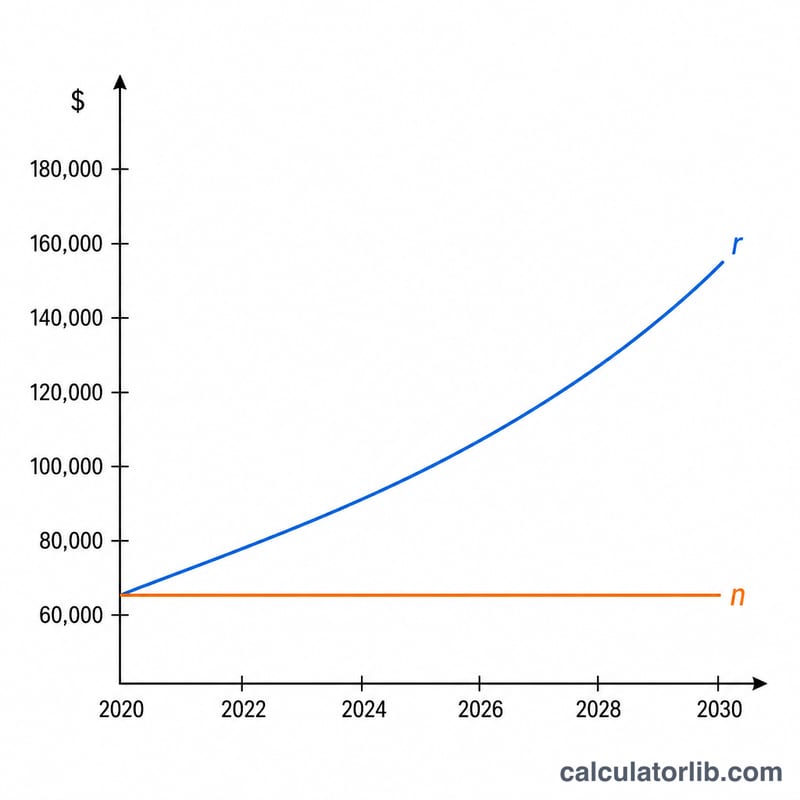
The calculation uses compound growth: $$\text{Adjusted Salary} = \text{Salary} \times (1 + r)^{n}$$ where r is the inflation rate expressed as a decimal (for example, 3% = 0.03) and n is the number of years. Because inflation compounds, each year's increase is applied on top of the previous total, not just the original salary.
Worked Example
Suppose you earn $50,000 and expect 3% annual inflation over 10 years. The adjusted salary is $$50{,}000 \times (1.03)^{10} = 50{,}000 \times 1.343916 \approx \$67{,}195.82$$ That means you'd need about $17,195.82 more — a 34.4% increase — just to keep the same purchasing power you have today.
FAQ
Does this account for taxes or raises? No. It isolates the effect of inflation only, so you can compare it separately against your actual raises.
What inflation rate should I use? Many people use a long-run average of 2–3%, but you can enter any rate that matches your country or expectations.
Is the result a guarantee? No. It's a projection based on a constant assumed rate; real inflation varies year to year.